
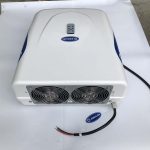
12V AC for Bus can be used in traditional buses, especially small and medium-sized passenger vehicles or models converted from mature platforms, whose basic electrical architecture generally uses the 12V voltage standard.
Adding an independent parking air conditioner to these vehicles by directly using the existing 12V circuit minimizes modification costs and complexity.
Busclima engineers say that mature 12V DC inverter rooftop air conditioning products are already available on the market, specifically designed for commercial vehicles.
For example, the E-Clima3000 has a cooling capacity of up to 13000W/10000BTU, uses a DC inverter compressor, and can operate at either 12V or 24V, with battery undervoltage protection.
This system can be directly connected to the vehicle’s 12V/24V battery (usually multiple lead-acid batteries connected in parallel or upgraded lithium iron phosphate batteries), operating independently after the vehicle is turned off, achieving “integrated operation while in motion.” Market research reports also confirm that 12V rated air conditioning motors remain an important product type in the commercial vehicle sector.
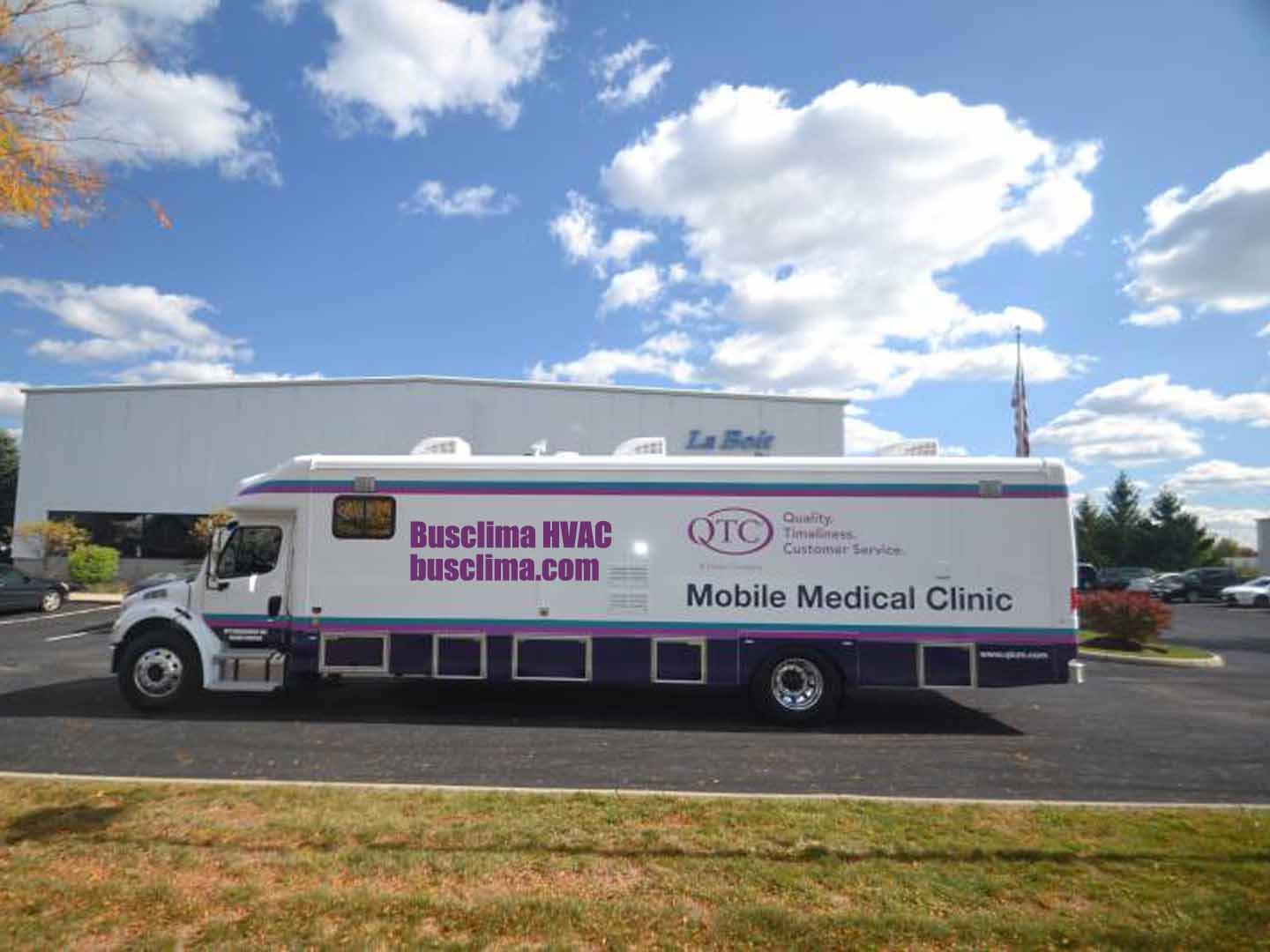
For existing fleets and cost-conscious operators, installing a 12V bus air conditioner is the most direct and economical solution to achieve “zero fuel consumption, zero emissions, and zero noise” parking temperature control.
It significantly improves the driver’s rest environment, enhances the passenger experience, and avoids the high costs and regulatory risks associated with engine idling.
Busclima engineers say that with the increasing prevalence of electric buses and the surge in intelligent devices (such as large screens, multi-zone air conditioning, and high-power thermal management systems), the electrical load on the low-voltage side of vehicles has risen sharply.
12V AC for buses faces inherent limitations when providing high power: according to the formula P=UI, for the same power, the lower the voltage, the higher the current.
This results in thicker and heavier wiring harnesses, higher losses, and severe component overheating.
Busclima engineers say the industry has clearly recognized this bottleneck.
According to the “2026 Outlook on Top 10 Strategic Technology Trends in China’s Mobility Industry,” with the continuous adoption of high-power intelligent components such as drive-by-wire steering, active suspension, and high-performance thermal management in vehicles, the 12V Ac For Bus is finding it increasingly difficult to support the system’s high-efficiency operation and physical power requirements.
Especially in pure electric buses, to ensure range, any unnecessary energy loss must be optimized to the extreme, making the high current and high line loss characteristics of the 12V system a prominent weakness.
Busclima engineers stated that the 112V Ac For Bus is gradually reaching its technological and efficiency limits in future high-end, large electric bus applications.
This is forcing the entire industry to seek a fundamental upgrade to its low-voltage electrical architecture.
Busclima engineers explained that to fundamentally solve power and efficiency issues and provide a solid power foundation for advanced autonomous driving (L3+) and full-domain intelligence, increasing the low-voltage system voltage level is an inevitable choice.
A 48V voltage can reduce the current required to transmit the same power to one-quarter of that of a 12V system, thereby significantly reducing wiring harness cross-sectional area, weight, and transmission losses.
Busclima engineers say this trend has become a core topic at top industry technology conferences.
At the “48V Advanced Power System Innovation Technology and Industrialization Breakthrough” symposium hosted by the China Society of Automotive Engineers in 2025, industry chain experts unanimously agreed that the 48V system is a key driver for supporting the upgrade of intelligent mobility.
The conference pointed out that the industry evolution will proceed in two steps: in the short term, a hybrid architecture of “12V main power distribution + priority deployment of some 48V high-power components” will be adopted; in the medium to long term, it will evolve towards a “48V main power distribution network.” Voyah Automobile experts predict that Chinese automakers are making rapid progress, and the large-scale implementation of 48V systems is expected between 2028 and 2030.
Busclima engineers say that future new electric buses, with their high-load components such as air conditioning (especially high-power electric compressors), heat pumps, and cooling fans, are very likely to be directly powered by the 48V network.
This will make the air conditioning system more efficient and energy-saving, and as part of the vehicle’s intelligent thermal management, it will work closely with battery temperature control and cabin environment to provide passengers with a more comfortable and quieter experience.
Busclima engineers say that adding 12V air conditioning to existing buses remains a cost-effective and realistic option for improving operational quality.
However, looking to the future, especially for fleets planning to purchase new high-end electric buses, close attention should be paid to whether the vehicles adopt a more advanced 48V low-voltage electrical architecture.
This will not only affect the performance of the air conditioning itself, but also reflect the overall vehicle’s level of intelligence, energy efficiency, and long-term competitiveness. Decision-makers need to make a wise trade-off between immediate practical benefits and long-term technological leadership.
Related posts:
 12V Bus Ac
 12V Ac For Buses
 12V Bus Air Conditioner
12V Bus Ac Unit
12V Bus Air Conditioner
12V Bus Ac Unit
 12V Bus Air Conditioner Price
 12V Carrier Bus Air Conditioner
 12V 24v Bus Air Con
 12V Coaches Hvac
 12V Rv Air Conditioning Units
 Camper Air Conditioner 12V
 12 Volt RV Air Conditioning Units represent an energy and technological revolution
 Motorhome Aircon 12V
 12V Air Conditioner For Motorhome
 12V Rv Ac Unit
 12V Camper Air Conditioner used in medicalmobile
 12 Volt Rv Air Conditioner
 12 Volt Rv Ac Unit