
12V AC Unit for RVs has become a mainstream choice in the market due to its high compatibility with the characteristics of minibus RVs.
As RV travel transitions from a niche exploration to a mainstream lifestyle, the demand for parking comfort is increasing. As the core of the parking comfort system, the choice of air conditioning directly affects the energy architecture and travel experience. The “2025 China RV Travel Consumption Trend White Paper” clearly states that “new energy, low energy consumption, and quiet operation have become the three primary considerations for RV owners upgrading their equipment.”
| Model | E-Clima2200 | E-Clima3000 | E-Clima4000 | E-Clima6000 | E-Clima8000 | E-Clima2600S |
| Voltage (V) |
DC12V/24V | DC12V/24V | DC12V/24V | DC12V/24V | DC12V/24V | DC12V/24V |
| Cooling Capacity (W/BTU) |
2200W//7500 | 3000W/10000BTU | 4000W/15000BTU | 6000W/20472BTU | 8000W/27300BTU | 2600W/78870BTU |
| Installation | Rooftop Mounted | Rooftop Mounted | Rooftop Mounted | Rooftop Mounted | Rooftop Mounted | Split Mounted |
| Evaporator Air Volume (m³/h) |
650 | 700 | 650 | 650 | 1500 | 450 |
| Condenser Air Volume (m³/h) |
1050 | 1400 | 1050 | 1700 | 3600 | 1400 |
| Refrigerant | R134a | R134a | R134a | R134a | R134a | R134a |
| Dimension (mm*mm*mm) |
700*580*263 | 885*710*290 | 700*580*263 | 1580*385*180/ 920*928*250 |
1260*1030*180 | 682*465*192 540*362*165 |
| Weight (KG) |
32 | 35 | 18/47 | 18/47 | 31 |
Against the backdrop of the continuous transformation of RV equipment towards specialization and electrification, the power supply method and energy efficiency of parking air conditioners have become key factors determining the quality of travel. According to data cited in the “2025 Blue Book on the Development of New Energy Commercial Vehicle Technology,” more than 70% of motorhome users list “long-term air conditioning use without mains power” as their primary upgrade requirement. As a flexible and space-efficient minibus RV, its electrical system characteristics and living needs make a 12V DC inverter roof-mounted air conditioner the optimal technological approach.
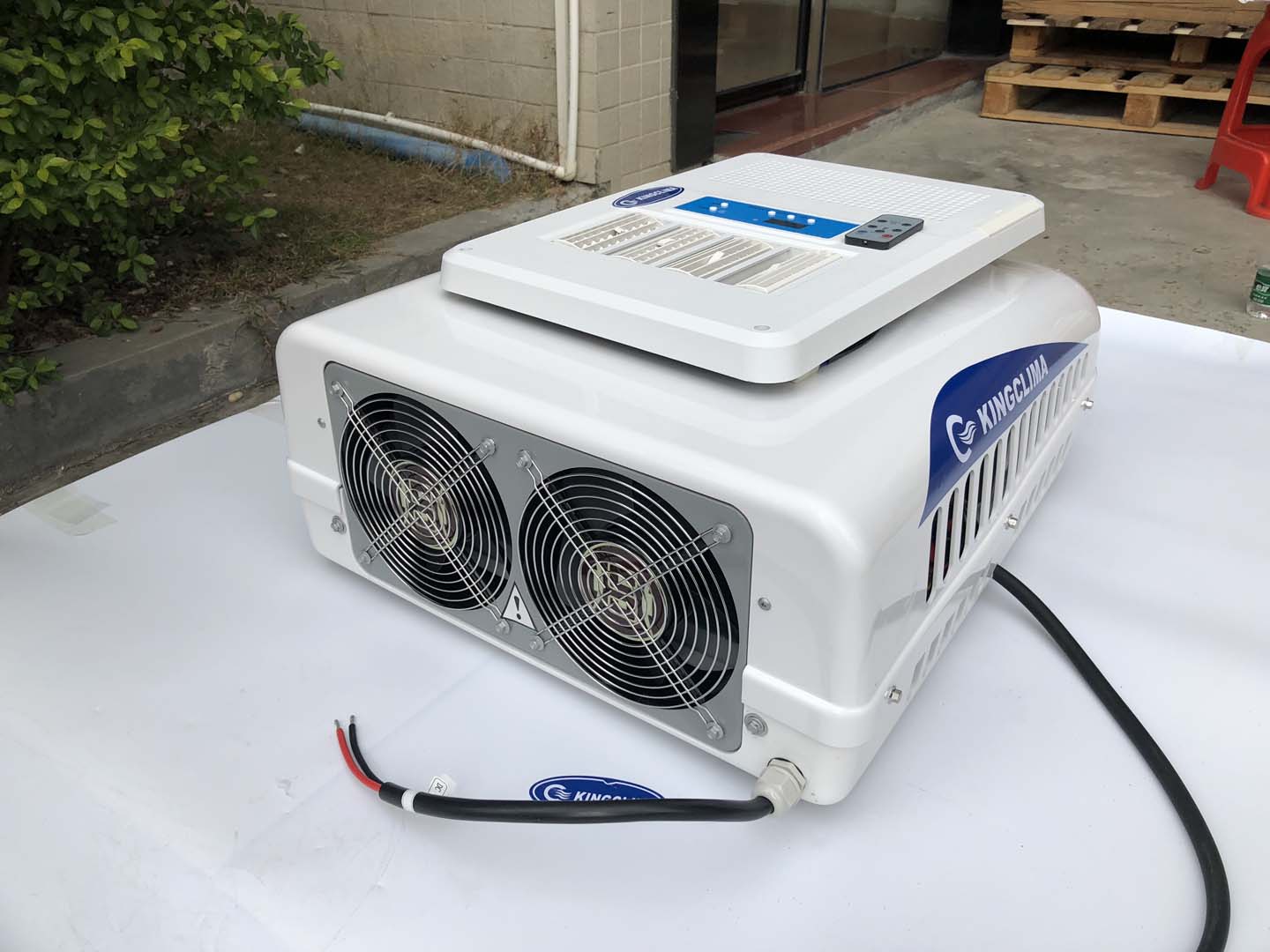
Technical Parameters and Energy Compatibility – 12V AC Unit for RVs
Traditional household air conditioners or early RV air conditioners mostly use 220V AC power. When parked, they rely on high-power inverters or external AC power, which not only incurs conversion losses but also puts enormous pressure on the RV’s battery system. Minibus RVs offer moderate space, but their electrical system capacity is relatively limited.
The 12V DC inverter roof-mounted Camper Air Conditioner directly matches the RV’s basic battery voltage, eliminating the need for inverter conversion and resulting in higher energy efficiency. Its inverter technology automatically adjusts the compressor speed according to the interior temperature, enabling soft start and continuous low-power operation. Wang, a technical expert from the RV Committee of the China Association of Automobile Manufacturers, pointed out at a recent technical seminar: “The application of DC inverter technology reduces peak power consumption by over 40%, which means that with the same lithium battery capacity, the driving range can be more than doubled, a core guarantee for the RV’s freedom to ‘disconnect from the power grid.'”
For minibus RVs, which are generally equipped with 12V circuit systems and limited battery capacity, the 12V DC inverter air conditioner provides the most direct solution in terms of energy efficiency, system compatibility, and driving range.
Installation Integration and Spatial Aesthetics – 12V AC Unit For RV
Minibus RVs have a unified body structure and a compact interior space. Traditional split-type air conditioners require valuable storage or living space and are complex to install.
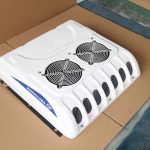
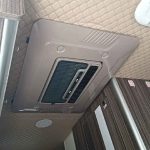
The roof-mounted air conditioner adopts an integrated design, with the main unit completely embedded in the roof, leaving only the air outlet inside the vehicle, maximizing the saving of interior vertical space. According to the latest meeting content of the “2025 RV Conversion Technical Specifications,” the recommended installation location should prioritize the vehicle’s center of gravity area, with proper roof reinforcement and waterproofing to ensure driving safety and vehicle integrity. Its flat design also minimizes wind resistance and noise.
The roof-mounted installation method achieves equipment concealment, perfectly matching the minibus RV’s pursuit of efficient space utilization and a clean, streamlined appearance—a balance between technology and aesthetics.
Usage Scenarios and Living Habits—12V AC Unit For RV
RV usage scenarios are diverse, encompassing complex situations such as hot summer campsites, quiet nighttime sleep, and temperature differences between the front and rear cabins during travel.
The quiet inverter operation of the 12V DC air conditioner solves the problem of noise disturbance during nighttime rest. Its rapid cooling capacity can meet the rapid cooling needs after being exposed to the sun outdoors. Li Wei, a seasoned RV traveler and the organizer of “Slow Travel China,” shared in her presentation: “Since switching to a DC inverter rooftop air conditioner, we dare to explore more southern regions even in the height of summer. Our children can nap peacefully in the afternoon, and the continuous low-power operation at night has completely eliminated our anxiety about electricity usage, making our travel pace much more relaxed.”
This product not only provides temperature control but also deeply supports the RV lifestyle of “parking anytime, comfortable living,” enhancing the freedom of travel in all weather conditions and regions.
Customer Base and Value Proposition – 12V Ac Unit For RV
The RV user base is becoming increasingly segmented, ranging from retired couples and young families to mobile office workers in the startup world, each with diverse needs.
For families who value the quality of long-distance travel, stable and quiet air conditioning is a necessity; for users converting minibuses into business receptions or mobile studios, continuous and reliable air conditioning operation is crucial for a professional image and work efficiency; for users seeking a “camping” experience, low power consumption directly determines the length of time they can go without supplies. A recent article in the financial column “New Observations on Travel Consumption” pointed out that “the new generation of RV consumers are not only buying equipment, but also the definite value of a ‘controllable and comfortable environment.'”
The core customers of the 12V DC roof-mounted air conditioner are those who view RVs as “mobile homes” and highly value energy autonomy, quiet living conditions, and spatial integrity. It represents an efficient, intelligent, and future-oriented choice for travel and living equipment.
Summary – 12V AC Unit For RV
In conclusion, the 12V DC inverter roof-mounted air conditioner is not simply an upgrade to cooling equipment, but a systematic adaptation for the specific platform and usage scenarios of minibus RVs. Starting from the underlying energy logic, it solves core pain points such as energy efficiency, space, and noise through technological innovation, ultimately serving users’ pursuit of a high-quality travel and living experience. Choosing it means choosing a more efficient, more relaxed, and freer RV lifestyle.
Related posts:
 12V Rv Ac Unit
 12 Volt Rv Ac Unit
 Camper Air Conditioner
 Small Ac For Camper
 Camper Ac
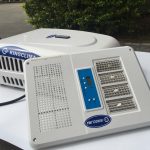 Best Ac For Rv
 Small Rv Ac
 Low Profile Rv Ac Unit
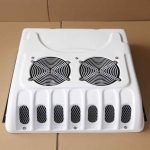 Air Conditioning Units for RV and Minibus Air Conditioner
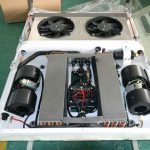 Air Conditioning Units for Campers Installation Process
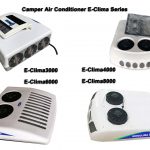 Camper Air Conditioning Unit
 Similarities between RV Camper Air Conditioner and Minibus AC
 Air Conditioning for Motorhomes Manufacturing Process
 Ac For RV Camper Market Analysis Report
 Camper Roof Ac Unit
 Small Air Conditioner for Camper
 12 Volt Air Conditioner For Rv
 Low Profile Rv Ac