
12V Camper AC Application in Blood Donation Vehicles
The integration of 12V Camper AC into blood donation vehicles aims to enhance their off-grid operation capabilities and energy efficiency. However, this technological choice directly impacts the core requirements of reliability, stability, and compliance in mobile medical systems. Its feasibility requires rigorous evaluation from four dimensions: performance parameters, extreme scenarios, professional operating procedures, and institutional procurement logic. Any oversight in a single dimension could lead to mission failure. This report follows a “phenomenon-analysis-conclusion” logical chain to provide systematic decision-making basis.
Performance Parameters – 12V Camper AC
Phenomenon: The high energy efficiency ratio (COP) claimed by 12V Camper Air Conditioner is attractive for blood donation vehicles requiring long-term independent outdoor operation. However, during integration testing, its intermittent full-speed operation or power adjustment mode easily leads to temperature fluctuations outside the allowable range (e.g., >±2℃) inside the vehicle compartment, posing a risk to the blood storage environment.
Analysis: The core of environmental control in blood donation vehicles is “steady-state maintenance,” not simply “rapid cooling.” The temperature control requirements are extremely stringent; the temporary storage area outside the blood storage box also needs to maintain a relatively stable low-temperature environment to prevent blood quality degradation during the process. The latest revised edition of the 2025 “Construction and Management Specifications for Mobile Blood Donation Units” clearly stipulates that the environmental temperature of the blood collection area and the blood temporary storage area should be constantly maintained within a narrow range of 20-24℃. Director Li, a member of the expert group that formulated the specifications and a clinical transfusion expert, pointed out in his interpretation: “Environmental fluctuations in blood donation vehicles directly affect the activity of components such as platelets. The frequent adjustment of compressor speed in traditional variable-frequency air conditioners, aimed at improving energy efficiency, is the main source of temperature ‘micro-fluctuations’. For air conditioners used in blood donation vehicles, the first performance indicator should be ‘temperature control accuracy’ and ‘ultra-low fluctuation rate’, followed by energy efficiency.” Furthermore, the high operating current of the 12V system, reaching hundreds of amperes, poses a continuous threat to the stability of the vehicle’s electrical grid, which powers precision testing equipment (such as rapid blood typing instruments).
Conclusion: Therefore, directly using 12V electric air conditioners designed for RVs carries extremely high risks. It is essential to select or customize a DC inverter air conditioner with a “medical steady-state mode.” In this mode, the compressor should operate more smoothly and continuously, prioritizing a flat temperature curve. Simultaneously, the air conditioner must have a completely independent power circuit and electromagnetic shielding to thoroughly isolate it from electrical interference with medical equipment.
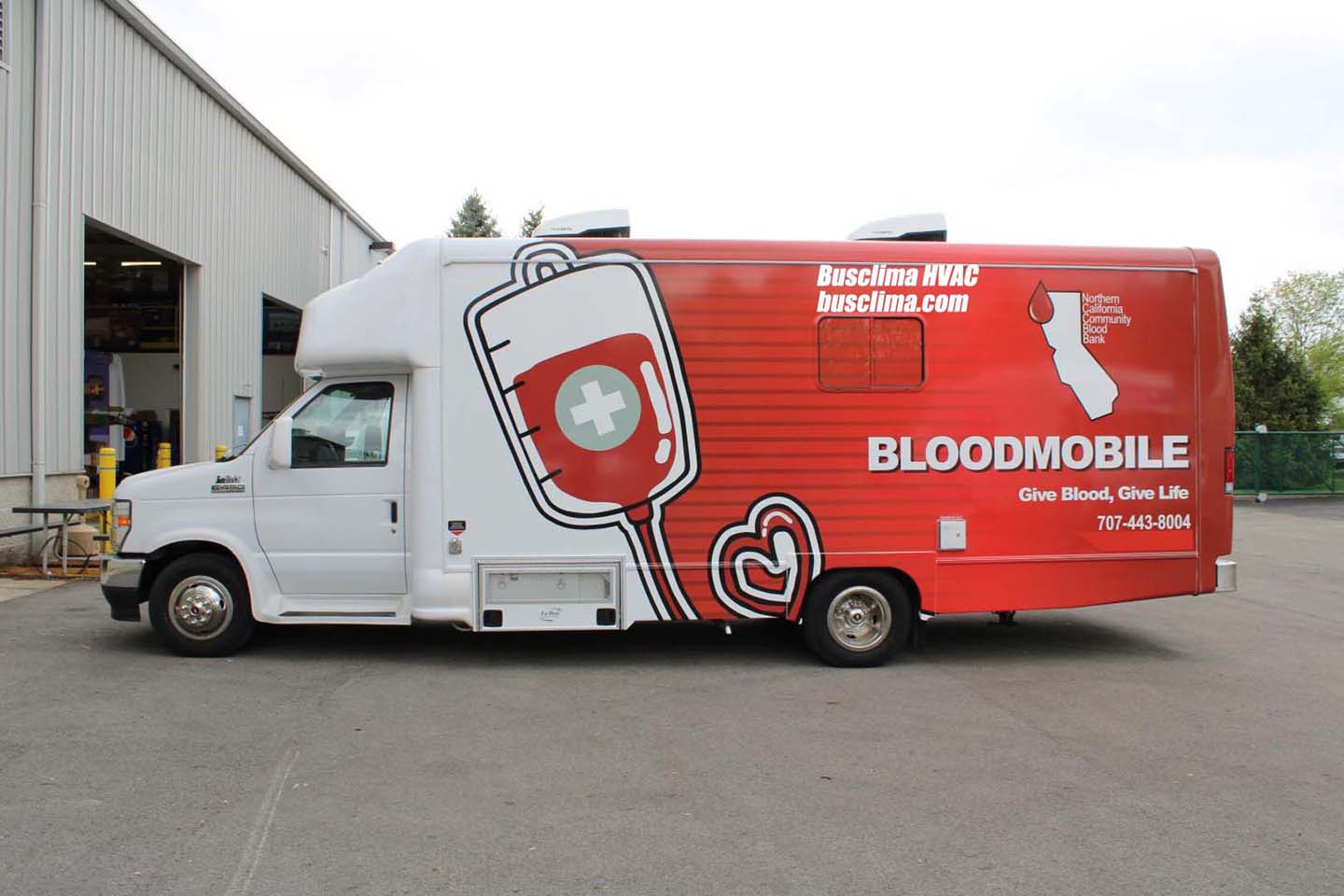
12V Camper AC Use Case – Extreme Pressure Testing in High-Intensity Outdoor Operations
Phenomenon: Blood collection vehicles often operate continuously for 6-8 hours in summer in open squares, factory areas, and other unsheltered locations. During this time, the vehicle is idling or switched off, and the rooftop air conditioner condenser faces extreme heat dissipation challenges due to high temperatures and low airflow. This easily triggers high-pressure protection shutdown, causing a rapid increase in cabin temperature.
Analysis: This phenomenon touches upon the design limits of mobile air conditioners in “static high heat load” scenarios. Under full load, the heat generated by the human body, medical equipment, and intense solar radiation combine to create a huge and continuous heat load. In the “High-Temperature Adaptability Test Report for Special Vehicles” published by an agency under the State Administration for Market Regulation in 2025, several civilian-grade rooftop air conditioners triggered protection within 2-3 hours during static testing in a simulated 40℃ environment without headwind due to insufficient heat dissipation. The report emphasizes that medical special vehicles should use models with larger condenser heat exchange areas, higher fan static pressure, and designs specifically for harsh heat dissipation conditions. Engineer Wang Lei, who participated in the test, pointed out: “The ‘nominal cooling capacity’ of the blood collection vehicle’s air conditioner must be recalibrated under the ‘lowest heat dissipation conditions.’ We are more concerned with its sustainable cooling capacity at an ambient temperature of 48℃ and with the vehicle stationary; this data is the truly usable data.”
Conclusion: Therefore, 12V electric air conditioners suitable for blood collection vehicles must pass mandatory certification under “high-temperature static conditions.” They need to be equipped with industrial-grade large-sized condensers and high-pressure centrifugal fans, and even consider auxiliary spray cooling systems, to ensure continuous and stable cooling output during the hottest midday hours, guaranteeing uninterrupted blood collection operations.
12V Camper AC Operating Procedure – Rigid Constraints on Equipment Interaction Due to Aseptic Procedures
**Phenomenon:** Healthcare workers must follow strict aseptic procedures during blood collection, and frequently touching complex air conditioning touchscreens or using mobile apps for adjustment is neither compliant with infection control requirements nor conducive to focused work. They need a reliable “set it and forget it” system.
**Analysis:** The internal workflow of a blood collection vehicle is highly standardized and demanding; the environmental control system should operate silently as a background infrastructure. Complex, multi-layered electronic interaction is inconvenient when wearing gloves and is not intuitive or reliable in emergency situations. The 2025 “White Paper on Human-Machine Interaction Safety for Medical Devices” suggests that for equipment used in high-risk clinical environments, basic controls should prioritize physical knobs or waterproof buttons, and status indicators should be clear, conspicuous, and unambiguous. The white paper cites a survey of mobile surgical unit operators, showing that over 80% of healthcare workers trust control panels with clear physical feedback and status indicator lights. A head nurse in a blood collection vehicle provided feedback: “The first thing we do when we get on the vehicle is to turn on and check all kinds of medical equipment. The air conditioning should ideally be turned on remotely or on a timer in advance. During work, we don’t and shouldn’t adjust the air conditioning. Its panel should be simple, with only an on/off switch and temperature display; any advanced settings should be completed and locked by logistics personnel in advance.”
**Conclusion:** Therefore, the human-machine interface of the blood collection vehicle’s air conditioning must be medically adapted: simplifying front-end operation and strengthening back-end preset and remote monitoring capabilities. Ideally, the air conditioning should be remotely set and locked by logistics personnel via the vehicle’s central control system or a cloud platform according to the task plan, with the on-board panel only retaining an emergency override switch and clear status/fault indicator lights.
12V Camper AC Procurement – Risk Aversion and Systemic Requirements in Institutional Procurement
**Phenomenon:** Blood centers or health commissions, as procurement entities, are extremely cautious in selecting equipment related to blood safety. They may question the long-term reliability and compliance of 12V electric air conditioners as “non-medical specialized equipment,” fearing they could become potential flaws in overall acceptance and auditing.
**Analysis:** Institutional procurement follows the principle of “clear responsibility and controllable risk.” Procurement decisions are not about finding the single best technology, but rather selecting a system solution with the lowest overall risk, the most stable supply chain, and the most complete compliance documentation. In 2025, a provincial-level government procurement center added a clause to its “Sample Tender Document for Integrated Professional Medical Vehicles Project,” requiring core subsystem suppliers to provide “proof of at least two years of continuous trouble-free operation of similar products in tertiary hospitals or equivalent public health institutions.” The center’s负责人 (person in charge) explained: “Blood collection vehicles are critical to public blood safety, and for every key piece of equipment, we require traceable success stories and peer reviews as ‘endorsement.’ Even if innovative technologies have excellent parameters, we cannot bear the inherent unknown risks if they haven’t been validated in large-scale institutional markets.”
Conclusion: Therefore, successfully introducing 12V electric air conditioning solutions to the blood collection vehicle market hinges not on technical feasibility, but on building institutional credibility. Suppliers need to provide complete medical electromagnetic compatibility reports, long-term reliability data, production certifications compliant with relevant medical device quality management systems, and most importantly—authoritative customer case studies demonstrating stable operation in other similar medical vehicles. Otherwise, this solution will be difficult to include in mainstream procurement lists.
12V Camper AC Comprehensive Conclusion
Applying 12V electric air conditioning to blood collection vehicles is a challenging leap from “technical feasibility” to “system reliability” and “institutional acceptance.” It requires shifting the understanding of parameters from energy efficiency to steady-state accuracy and anti-interference capabilities; testing usage scenarios from general operating conditions to extreme static high-temperature conditions; adapting operating procedures from user-friendly to medical sterile operation-friendly; and ultimately, directly addressing the procurement entity’s natural aversion to unknown technological risks by building credibility with complete compliance documents and successful case studies. Therefore, directly transplanting consumer-grade RV products is almost impossible. The feasible path is to collaborate with professional medical vehicle integrators, using medical standards as the guiding principle, to jointly customize or deeply modify a 12V DC environmental control system that meets all the above requirements, and promote it as a fully validated “medical temperature control solution” rather than a “single air conditioning unit.” This is a systems engineering project, whose complexity and cost are far greater than simply replacing a single piece of equipment.
Related posts:
 15000 Btu Camper Air Conditioner
 12V Camper Air Conditioner used in medicalmobile
 12V Rv Ac Unit
 12 Volt Rv Ac Unit
 12V Ac Unit For Rv
 Camper Roof Air Conditioner
 Small Air Conditioner For Rv
 Camper Air Conditioner
 Air Conditioning Units for RV and Minibus Air Conditioner
 Small Rv Ac
 Best Ac For Rv
 Air Conditioning Units for Campers Installation Process
 Air Conditioning for Motorhomes Manufacturing Process
 Camper Ac
 Similarities between RV Camper Air Conditioner and Minibus AC
 Small Ac For Camper
 Ac For RV Camper Market Analysis Report
 Low Profile Rv Ac Unit