
12V RV AC – Definition
12V RV AC specifically refers to a rooftop or floor-mounted air conditioning system directly driven by the RV’s 12V DC battery system, eliminating the need for an inverter to convert DC to AC. Its fundamental difference from traditional RV air conditioners (typically 110V/120V or 220V/240V AC) lies in its “native DC” attribute. Traditional solutions, when used off-grid, must rely on an inverter to convert the battery’s 12V DC to AC, a conversion process that itself results in 10%-15% energy loss. In contrast, the 12V DC air conditioner directly adapts to the battery voltage through internal circuitry, driving a compressor and fan optimized for DC, theoretically eliminating inverter losses and thus achieving greater energy efficiency. It represents an important technological direction for RV electrification and off-grid living in pursuit of ultimate energy efficiency.
12V RV AC Core: Technical Challenges and Implementation Path
However, driving high-power cooling equipment with low 12V voltage faces significant technical challenges. According to Ohm’s Law, for the same power output, the lower the voltage, the greater the current required. A 12V air conditioner with a certain cooling capacity may draw as much as 100-150 amps. This requires the entire power supply circuit from the battery to the air conditioner—including cables, connectors, fuses, and relays—to be exceptionally robust and sturdy to withstand the heat generated by the high current and ensure extremely low voltage drop. Therefore, its core technology lies in the development of ultra-efficient DC inverter compressors and the matching design of the vehicle’s electrical system. At the 2025 RV Technology Seminar, electrical system engineer Chen pointed out: “A true 12V DC air conditioner is not simply a matter of replacing the compressor; it’s a systems engineering project. It requires coordinated design with high-performance lithium batteries, large-section wiring harnesses, and intelligent battery management to cope with the ‘current surge’ of instantaneous startup. Currently, leading products have reduced the startup current by about 40% and achieved smoother power regulation by using rare-earth permanent magnet motors and full DC inverter technology.”
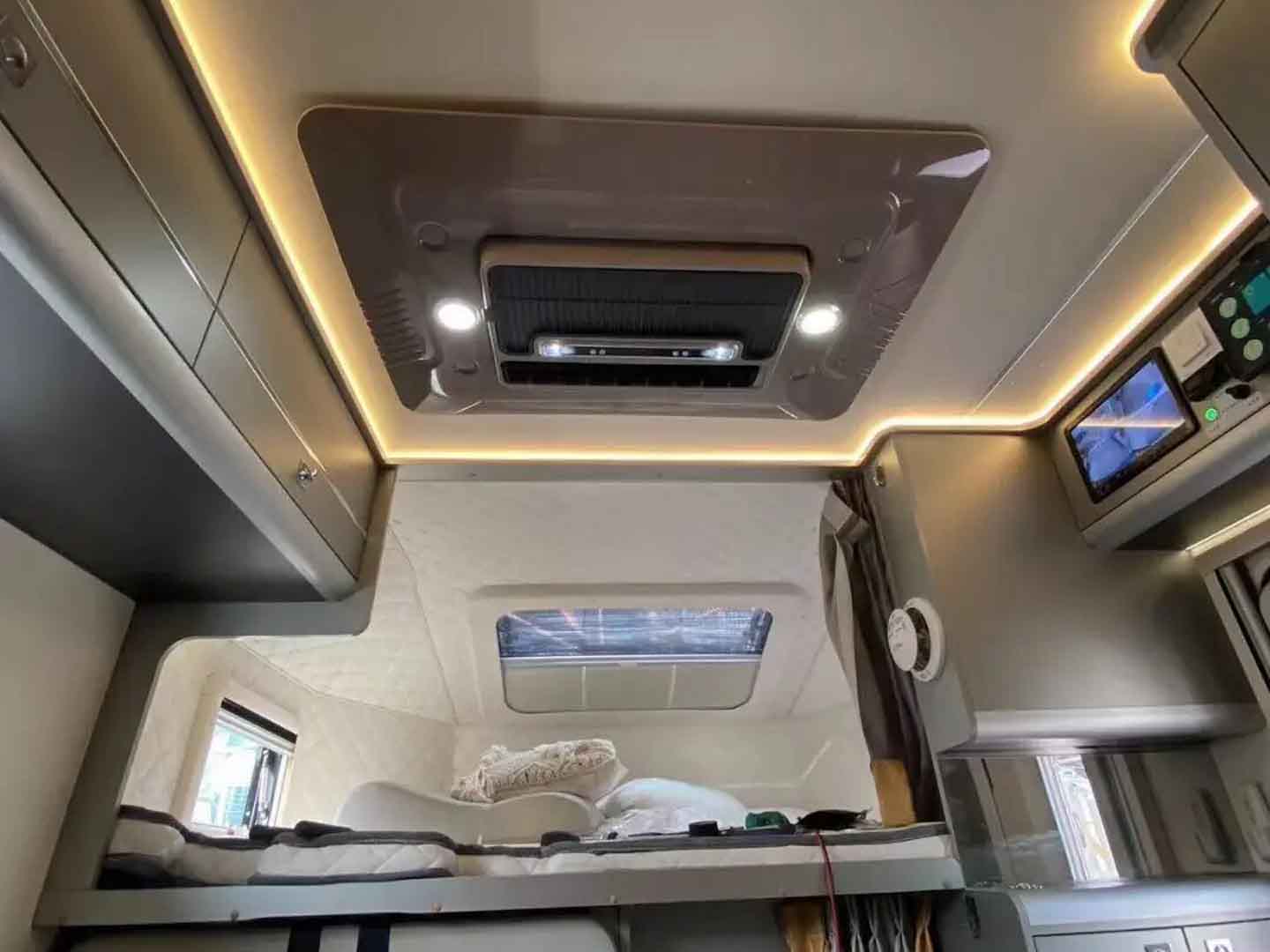
12V RV AC Advantages: Application Logic in Off-Grid Scenarios
The core advantage of 12V DC air conditioners lies in their extreme utilization of off-grid energy. For RV users who rely on solar panels and lithium-ion battery storage and seek long-term independent survival away from campsites, every watt-hour of electricity is precious. By eliminating the losses in the inverter stage, a 12V system can directly use more battery energy for cooling, extending the air conditioner’s operating time. For example, with the same battery capacity, a high-efficiency 12V Camper Ac may provide 20%-30% more continuous operating time than a combination of “inverter + traditional AC air conditioner”. Furthermore, because it is directly powered by the battery, its start/stop and control can be more deeply integrated with the battery management system, enabling intelligent temperature control management based on remaining battery power and preventing over-discharge. This makes it an ideal choice for pure off-road adventurers, long-distance travelers, and other deeply off-grid users.
12V RV AC Trade-offs: Cost, Choice, and Market Status
Choosing a 12V air conditioner does not come without a price. First, its initial purchase cost is significantly higher than that of a comparable traditional air conditioner, due to the involvement of a more expensive dedicated compressor and a more complex electronic control system. Secondly, as mentioned earlier, the cost of upgrading is high: users must ensure that the main cables and power distribution units of the RV chassis can withstand extremely high currents, typically requiring higher-capacity (e.g., at least 600Ah) lithium batteries and a more powerful solar charging system, which is a huge overall investment. Currently, there are relatively few established 12V air conditioning brands on the market, mainly concentrated in the mid-to-high-end adventure RV market or offered as a modification solution. Users must perform precise energy consumption calculations before making a decision: assessing their off-grid usage needs, the actual power supply capacity of the battery and solar system, and the electricity budget reserved for air conditioning. For users who frequently use campground power or generators for supplemental power, the economic advantage of 12V air conditioning may not be significant.
Related posts:
 Bus Air Conditioner is used for buses and medium-sized commercial vehicles
 Van Air Conditioner
 Acc Bus Air Conditioning
 Van Ac Unit
 Introduction to Ac For Bus
 Best Rv Air Conditioner
 Motorhome Air Conditioning and Minibus Manufacturer Matching
 12 Volt Air Conditioner For Camper
 Camper Air Conditioner
 Ac For Van
 Bus Air Conditioning Unit
 Air Conditioning Units for RV and Minibus Air Conditioner
 Air Conditioner In Camper
 Air Conditioner for Bus Conversion
 IC Bus Air Conditioning: A Comprehensive Evolution of Integration, Intelligence, and Sustainability
 Bus Con Supplier reminds all bus owners to clean BUS AC
 Similarities between RV Camper Air Conditioner and Minibus AC
 Campers With Air Conditioning