
12V Ac For Buses
12V AC for buses has risen from a traditional auxiliary device to a strategic key system that determines the overall energy consumption, range and passenger experience of the vehicle.
Its technological evolution is closely following the top-level policy design and the leading trends in the industry.
According to the remarks made by an expert from the Equipment Industry Development Center of the Ministry of Industry and Information Technology at the “2025 China Automotive Air Conditioning Industry Conference”, “The intelligence and low energy consumption of the thermal management system in buses have become one of the core indicators for evaluating the advancement of new energy vehicles.” The revised version of the “Technical Specifications for New Energy Vehicle Air Conditioning Systems” to be implemented in 2025 also explicitly strengthens the mandatory requirements for the energy consumption of independent parking cooling systems and the use of environmentally friendly refrigerants.
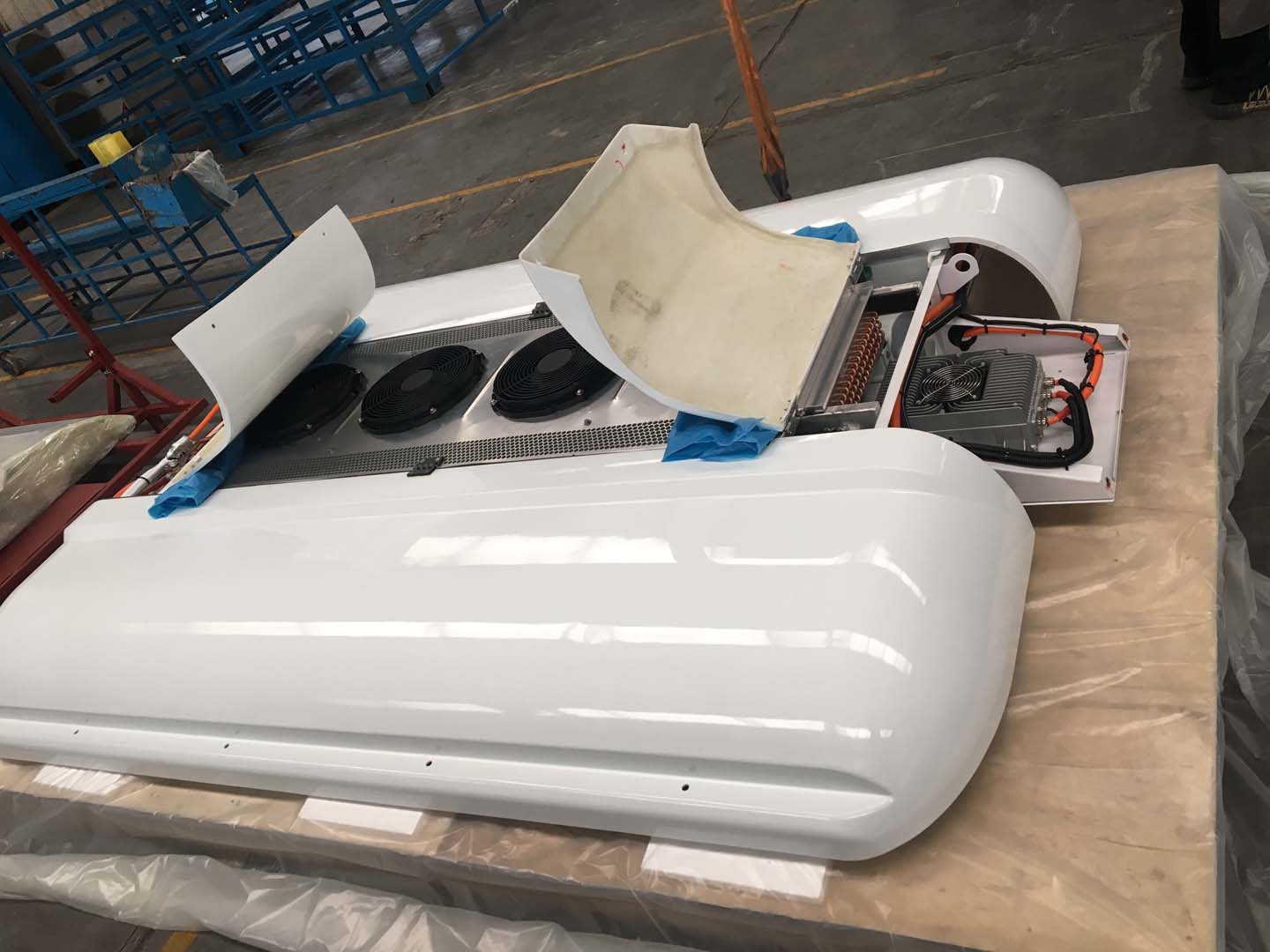
The efficient heart precisely matching the low-voltage electrical architecture – 12V AC for buses
The reason is that the power battery of pure electric buses provides high voltage (typically 400V – 750V) to drive the vehicle, but the entire vehicle’s low-voltage electrical appliances (such as lights, instruments, and control units) still rely on 12V/24V batteries. Traditional high-voltage electric DC Ac For Bus need to continuously wake up the high-voltage power battery to maintain cooling when the vehicle is parked (such as when the driver is resting or waiting for dispatch), which will cause unnecessary “charging” cycles, accelerate battery degradation, and pose high-voltage safety risks.
The development of a 12V DC inverter air conditioning system specifically designed for electric buses has emerged. It uses an independent 12V DC power supply (usually directly powered by the vehicle’s low-voltage lithium battery pack or through a DC/DC converter from the high-voltage battery), with the core being a highly efficient and low-power consumption DC inverter compressor. For instance, Carrier’s new generation of air conditioning systems for electric buses, which are industry-leading, can control the maximum power consumption to below 1kW in parking mode, but have a cooling capacity of over 9kW, with a coefficient of performance (COP) far exceeding that of traditional fixed-frequency systems. Its control logic is deeply integrated into the vehicle’s BMS (Battery Management System), enabling real-time acquisition of battery power information and intelligent power regulation.
The result is that this design achieves a seamless and safe connection with the low-voltage electrical architecture of the electric bus. It enables the air conditioning to operate stably for a long time even after the vehicle’s high-voltage system is completely powered off, completely avoiding the predicament of “wastefully” consuming the high-voltage power battery’s power for air conditioning. This directly contributes to extending the vehicle’s nominal driving range and enhances the safety and service life of the high-voltage system.
From “Mobile Refrigeration” to “Smart Temperature Control Ecosystem” – 12V AC for Buses
The reason is that the operational scenarios of electric buses are highly sensitive to energy. Besides the cooling demands during driving, a large number of “static scenarios” – such as long waiting periods at the first and last stops for passengers, mandatory rest periods for drivers, overnight parking and heat preservation, and pre-cooling before summer operations – are the “blind spots” and pain points in energy consumption management.
The 12V parking air conditioning system has undergone revolutionary optimization for these scenarios. It enables the vehicle to maintain a comfortable cabin temperature solely with the low-voltage battery when the engine is completely off (high voltage OFF). More importantly, it is integrating with the Internet of Vehicles and intelligent dispatching systems. Through the cloud platform, the dispatching center can remotely pre-cool the vehicle in a timed and zoned manner before the driver’s shift change. The system can also dynamically adjust the operating power based on the remaining battery power and the departure time of the next shift.
The result is the creation of a “full-cycle intelligent temperature control ecosystem”. Drivers can enjoy a comfortable rest environment with zero noise and zero emissions; passengers feel cool as soon as they board the first bus; and the bus company has achieved precise and predictable management of energy consumption during non-operational hours, significantly reducing overall operating costs.
The trinity of safety, economy and compliance – 12V AC for buses
The reason is that bus operators are confronted with the triple challenges of operational cost pressure, safety red lines, and increasingly strict environmental regulations (such as China’s plan to reduce HFC refrigerants).
The advantages of the 12V electric bus air conditioning system have formed a systematic solution:
Absolute safety: When parked, the high-voltage system is completely isolated, eliminating the risk of high-voltage leakage and also preventing the carbon monoxide poisoning hazard that may occur in traditional fuel vehicles with idling air conditioning.
Ultimate economy: Its highly efficient inverter technology reduces the energy consumption of the air conditioning system itself by up to 30%. More importantly, it protects the expensive power battery, reduces unnecessary cycles, and from a full life cycle perspective, significantly lowers the potential costs of battery replacement and maintenance.
Looking ahead to compliance: Mainstream suppliers such as Songzhi have been promoting the adoption of natural refrigerants like R290 (propane) with a GWP value close to zero, fully in line with the long-term ban roadmap for high-GWP refrigerants in the EU and China. An expert from the China Association of Environmental Protection Industry pointed out at a 2025 seminar: “Promoting environmentally friendly working fluid air conditioners in commercial vehicles is an inevitable part of emission reduction in the transportation sector.”
The result is that the 12V electric bus air conditioning system has been transformed from a “cost item” to a “value investment item”. It helps operators systematically reduce TCO (Total Cost of Ownership), meet green assessment requirements, and build a safer and higher-quality service brand.
The Hub Driving Multidimensional Value Recognition – 12V AC for Buses
The reason is that the core demands of different stakeholders in the value chain of electric buses vary.
Background:
Public transport company/operator: The core decision-making party, whose demands are highly rational, focusing on the total life cycle cost, vehicle availability rate and policy compliance. The energy-saving effect of the 12V system directly enhances the driving range and reduces electricity costs, and its reliability ensures the availability of the vehicle.
Drivers: They are direct and frequent users, with demands focused on a healthy, comfortable working environment and convenient operation. A quiet independent air conditioning system is an important occupational benefit for them, related to physical and mental health as well as team stability.
Passengers and the general public: the ultimate users and supervisors. Their demands are for a comfortable and green travel experience throughout the journey. A stable cabin environment enhances the appeal of public transportation; while the eco-friendly attributes of the air conditioning system strengthen the public’s recognition of the value of green public transportation.
The outcome: An advanced 12V electric bus air conditioning system has successfully linked the economic rationality of operators, the humanistic care for drivers, the experience demands of passengers, and the environmental protection expectations of society, becoming a key technical hub that drives the positive cycle of social and commercial value of electric buses.
12V AC for Buses has been deeply integrated into the dual processes of the new energy vehicle technology revolution and the upgrade of public transportation services. It is not only an “adaptive” product to address the challenges of electrification, but also a “leading” system that actively defines the future operation mode of public transportation through intelligence, low power consumption and high integration. With the development of V2G (vehicle-to-grid) technology, more advanced battery technology and smart cities, it is expected to further evolve into an intelligent and flexible node in the urban mobile energy network, and its strategic importance will continue to rise.
Related posts:
 12V Bus Air Conditioner
 12V Rv Air Conditioning Units
 Camper Air Conditioner 12V
 Motorhome Aircon 12V
 12V Air Conditioner For Motorhome
 12V Rv Ac Unit
 12 Volt Rv Air Conditioner
 12 Volt RV Air Conditioning Units represent an energy and technological revolution
 12V Camper Air Conditioner used in medicalmobile
 12V Air Conditioner for Motorhome South Africa
 12 Volt Rv Ac Unit
 12V Air Conditioner for Motorhome Africa
 12V Camper Ac
 12V Rv Ac