The airtightness testing of the Mini Bus Air Conditioner compressor assembly unit employs a three-level verification system, combining pressure holding tests and high-precision leakage detection to ensure that the refrigeration system has no refrigerant leakage risk throughout its entire life cycle. Specific standards are as follows:
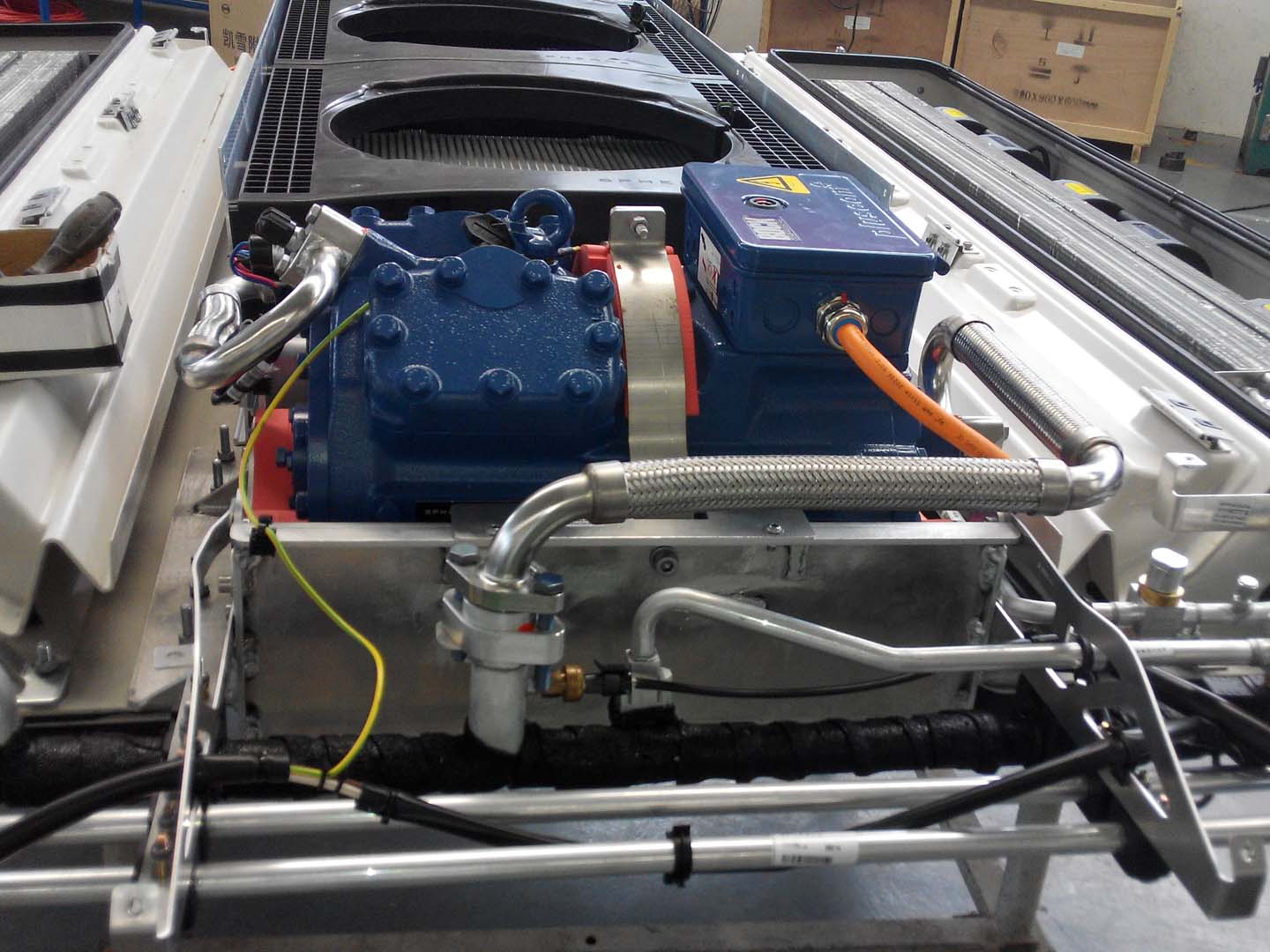
I. Basic Pressure Holding Test
High-purity nitrogen (purity ≥99.99%) is introduced into the closed system connected to the compressor and condenser, with the initial pressure controlled within the range of 1.3-1.6 MPa.
The pressure holding process must meet two core requirements:
Holding time: At least 24 hours, and the initial and final ambient temperatures must be recorded (temperature difference should be ≤5℃ to avoid pressure errors caused by temperature changes);
Pressure drop: The pressure drop within 24 hours must be ≤0.02 MPa, which translates to an absolute leakage rate of **<0.5g/year**, far below the industry average of 1.0g/year.
II. High-Precision Helium Mass Spectrometry Leak Detection
A helium mass spectrometer is used for localized leak detection at critical connection points (such as compressor intake and exhaust ports, condenser interfaces), achieving a sensitivity of 5 × 10⁻⁹ Pa·m³/s. During detection, a helium-containing gas mixture (5-10% helium concentration) is introduced into the system, and an external probe scans for potential leak points to ensure:
Welded joint leakage rate < 1 × 10⁻⁸ Pa·m³/s;
Sealing ring leakage rate < 5 × 10⁻⁸ Pa·m³/s.
III. Dynamic Operating Condition Verification
3% of the finished products from each batch are randomly selected for load-bearing operation testing: Simulating compressor operation at 10-100% frequency conversion in a high-low temperature environment chamber (-30℃~55℃), the following is monitored:
High-pressure side pressure fluctuation range 1.42-1.47 MPa;
Low-pressure side pressure fluctuation range 0.15-0.20 MPa.
After two hours of operation, the static pressure is checked again; the pressure drop must be ≤0.01MPa to ensure sealing reliability under dynamic vibration.
This testing system not only meets the basic requirements of the “Refrigeration System Installation Specification” but also, through high-precision instruments and dynamic verification, controls the leakage risk of the Mini Bus Air Conditioner to a near-zero leakage level, providing core assurance for the Minibus Air Conditioning 6000+ hour mean time between failures (MTBF). In actual Mini Bus Air Conditioner production, all test data is recorded via RFID chips, enabling full lifecycle traceability.