
Bus AC clutch not engaging is the primary symptom leading to a complete lack of cooling in the air conditioning system, essentially an interruption in the compressor’s power transmission path.
A study published in the 2025 issue of the journal *Commercial Vehicle Powertrain and Accessories*, titled “Failure Modes of Electromagnetic Clutches and Their Chain Reaction Effects on Air Conditioning Systems,” indicates that “in clutch non-engagement faults, purely mechanical damage accounts for less than 40%, while over 60% originate from electrical control, system protection signals, or external interference.” This paper breaks down clutch faults into five dimensions: electrical control signals, clutch body state, system protective locking, electromagnetic compatibility, and basic operating conditions. Following a logic from signal to execution and from external to internal, a systematic diagnostic process is constructed.
Content Module 1: Bus AC clutch not engaging – Interruption of electrical control signal path – Lack of power “command”
Problem Status:
After pressing the A/C switch, the clutch does not engage or make any sound. The most common cause of this phenomenon is a break in the control circuit, preventing power transmission to the clutch coil.
Problem Analysis: Diagnosis requires a step-by-step investigation along the signal and power supply paths:
1) Basic Circuit: Check for blown or faulty fuses and relays in Bus AC; this is the most common point of failure.
2) Control Signals: Use a diagnostic tool to read the data stream of the air conditioning control unit (ECU) to confirm whether the A/C request signal has been issued and whether the ECU has output a clutch engagement command. If the ECU has no command, trace back to the temperature control signal, pressure switch signal, etc.
3) Wiring and Connectors: Check for open circuits or loose connections in the clutch coil power supply line, and for corrosion or loosening of the connectors.
Busclima Senior Electrical Engineer Li Ming points out: “The first step in diagnosis should be to measure whether there is 12V/24V voltage at the clutch coil plug when the A/C is engaged. No voltage indicates a fault at the control end; voltage indicates a fault at the actuator end (the clutch itself). This simple test can immediately clarify the direction of troubleshooting.”
Conclusion: For symptoms with no response, a complete electrical path check must be performed first. From fuses, relays, and control signals to wiring connections, segmented measurement is the most efficient method for pinpointing control-end faults.
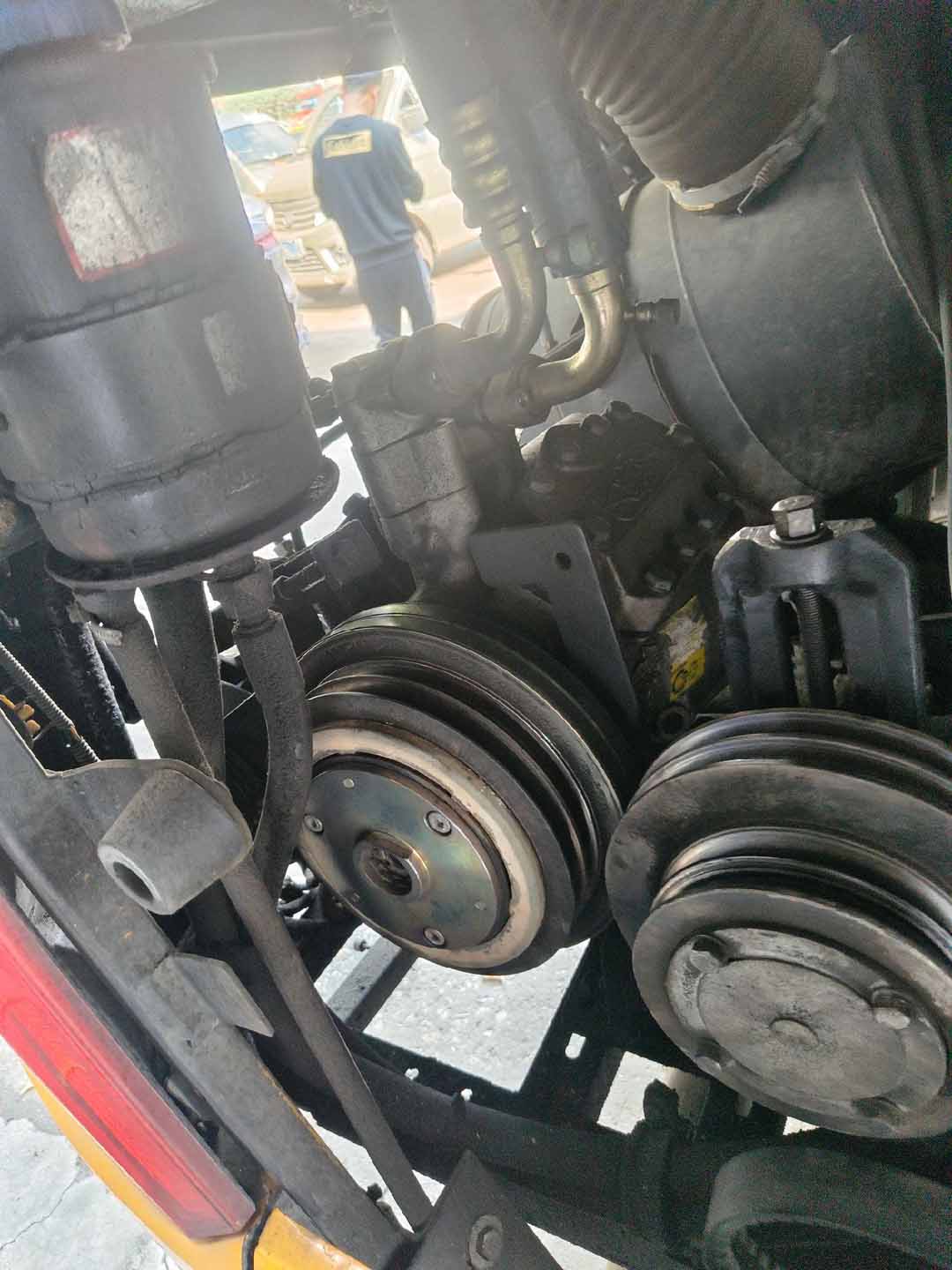
Content Block Two: Bus AC clutch not engaging – Clutch body mechanical and magnetic circuit faults – Failure of the power “actuator”
Problem Status:
The clutch coil power supply voltage is confirmed to be normal, but the clutch still does not engage, or after engaging, it emits a harsh noise and quickly disengages.
Problem Analysis: This fault is concentrated in the clutch assembly itself:
1) Electromagnetic coil open circuit/short circuit: Use a multimeter to measure the coil resistance. Infinite resistance (open circuit) or resistance far below the standard value (short circuit) requires replacement.
2) Improper clutch clearance: Excessive air clearance between the drive disc and pulley (standard value is usually 0.3-0.6mm) results in insufficient electromagnetic attraction; insufficient clearance may cause drag wear. A feeler gauge is needed for measurement and adjustment.
3) Mechanical jamming: Damaged drive disc bearings or a jammed compressor shaft prevent the clutch from rotating even when engaged.
The “2025 Bus Maintenance Technical Specifications” clearly requires that: “After replacing or repairing the clutch, the air gap must be precisely adjusted to the original factory standard using a feeler gauge, and the drive disc must be manually rotated to confirm there is no jamming. This is a mandatory completion inspection step.”
Problem Conclusion: If the power supply is normal but the clutch is not working, the fault must lie within the clutch itself. The diagnostic sequence is: first measure the coil resistance, then check the mechanical clearance and rotational flexibility to accurately determine whether the problem is coil damage, improper adjustment, or a related compressor mechanical fault.
Content Block Three: Bus AC clutch not engaging – System protective lock-up – A “prohibition” from other subsystems
Problem Status:
Under certain operating conditions (such as high engine load or low-temperature start-up), the air conditioning system clutch does not engage or suddenly disengages during operation, but the relevant electrical components themselves are not faulty.
Problem Analysis: This is a manifestation of modern vehicle intelligent management and falls under the category of “functional non-operation”:
1) Pressure Protection: When the system pressure is too high (poor heat dissipation) or the pressure is too low (severe refrigerant leakage), the high/low pressure switch cuts off the clutch circuit. This is the most important protection mechanism.
2) Temperature Protection: When the evaporator temperature sensor detects that the clutch is near freezing, the ECU will instruct the clutch to periodically disengage or completely disengage to prevent icing.
3) Engine Load Management: In some models, the ECU will temporarily disengage the clutch to ensure power and cooling during rapid engine acceleration or when the coolant temperature is too high.
Zhang Hua, an expert from the China Society of Automotive Engineers, emphasizes: “Repair personnel must adopt a ‘systems perspective.’ The clutch is the final actuator, and its operation is ‘arbitrated’ by many conditions. It is necessary to read all relevant sensor data (pressure, temperature) and ECU prohibition codes using a diagnostic tool to understand why the system issued a ‘no-execution’ command.”
Conclusion: Intermittent non-engagement or sudden disengagement is highly likely due to the system’s protection function being triggered. The core of diagnosis lies in using specialized tools to read real-time data streams and historical fault codes to identify the root cause of the protection trigger (such as abnormal pressure or sensor signal distortion), rather than simply checking the clutch itself.
Content Block 4: Bus AC Clutch Not Engaging – Electromagnetic Compatibility (EMC) and Signal Interference – The Hidden “Electronic Barrier”
Problem Status:
Under specific vehicle operating conditions (such as headlights on, windshield wipers running at high speed, or alternator excitation changes), the clutch intermittently engages or fails to engage, while routine circuit checks are normal.
Problem Analysis: This is a relatively hidden soft fault stemming from the vehicle’s complex electromagnetic environment:
1) Voltage Fluctuations and Spikes: A faulty generator regulator or the instantaneous switching of high-current equipment can cause abnormal voltage supply to the clutch coil or interference with the control signal.
2) Interference in Control Circuits: If the clutch control signal line is routed parallel to the high-voltage harness, it may induced interference signals. Connecting a freewheeling diode in parallel at the clutch coil control terminal (note the polarity) can absorb the back electromotive force, sometimes resolving intermittent engagement issues.
Problem Conclusion: When all routine checks are ineffective and the fault is related to a specific electrical load, electromagnetic interference should be considered. The key points to check are the vehicle’s grounding wires for proper function, measuring system voltage stability, and investigating any interference caused by the installation of high-power electrical appliances.
Content Block Five: Bus AC clutch not engaging – Basic Operation and External Conditions – Eliminating “False Faults” First
Problem Status:
The driver reports that the air conditioning is not cooling. Inspection reveals the clutch is not engaged, but the actual cause is improper operation or failure to meet basic operating conditions.
Problem Analysis:
Before initiating complex diagnostics, the following must be confirmed:
1) Air Conditioning Switch and Temperature Control Settings: Is the A/C switch actually turned on? Is the temperature set to the lowest (or low enough) setting? Some automatic air conditioning systems will not start the compressor when the set temperature is higher than the actual interior temperature.
2) Ambient Temperature: In some models, the ECU will prevent the compressor from starting when the ambient temperature is lower than the set value (e.g., 3°C) to prevent compressor liquid slugging.
3) Engine Status: Some vehicles are designed to only allow the air conditioning compressor to operate when the engine is running (generator generating electricity).
Problem Conclusion: Before starting any sophisticated diagnostics, the most basic functional and operating condition verification must be performed. Eliminating operational errors and environmental limitations is the first step in avoiding ineffective repairs and improving diagnostic efficiency.
Summary of Bus AC Clutch Not Engaging Fault Diagnosis
Diagnosing a bus air conditioning clutch not engaging fault requires a systematic process that proceeds “from the surface to the core, from the simple to the complex, and from conditions to execution.” First, basic operation and condition confirmation are performed; then, the core path of “measuring power supply → checking the unit → reading data → tracing protection” is followed: measuring coil voltage to distinguish between control and execution faults, checking the clutch unit’s condition, reading system data streams and protection signals using a diagnostic tool, and finally, considering complex factors such as the electromagnetic environment when necessary. This structured approach ensures efficient and accurate fault location, breaking down complex system problems into verifiable independent modules, which is key to achieving rapid repair and restoring cooling function.
Related posts:
 Bus air conditioner not turning on: In-depth diagnostic logic
 Diagnosis and Repair of Bus AC Electrical Issues
 Bus AC evaporator coil Fault Diagnosis
 Bus AC not blowing air
 Bus AC fan not working
 Bus Air Conditioner is used for buses and medium-sized commercial vehicles
 Bus Air Conditioner Repair Manual
 Bus air conditioner diagnostic
 Bus air conditioner overheating
 Diagnostic Logic for Bus AC Pressure Problems
 Bus Air Conditioning Compressor Replacement Technical Guide
 Acc Bus Air Conditioning
 Carrier Bus Air Conditioner
 Introduction to Ac For Bus
 Bus Air Conditioner Troubleshooting: A Systematic Diagnosis from Climate Adaptability to Passenger Experience
 Bus AC not cooling – A Comprehensive Troubleshooting Guide
 Rv Ac Unit Repair
 Analysis and Solutions to Bus AC Pressure Problems