
Bus AC compressor problems directly impact operational efficiency and service quality, affecting the rooftop air conditioning system, a critical system for ensuring passenger comfort and driving safety.
An article titled “Research on Failure Modes of Thermal Management Systems in New Energy Buses,” published in the 3rd issue of the *Journal of China Transportation Equipment Technology* in 2025, points out that rooftop air conditioning compressor failures account for as much as 27% of bus failure statistics in summer, exhibiting a complex characteristic of multiple intertwined factors.
In response, Lin Zhenhua, Chief Engineer of the National Bus Technology Research Center, emphasizes: “Modern bus air conditioning failures are no longer problems of a single component, but must be diagnosed within a system framework of the coordinated effects of mechanical, electrical, control, and environmental factors.” This article breaks down the failure topic into four core sub-problems, following the logic of “problem phenomenon – problem analysis – problem conclusion,” constructing a structured knowledge module.
Sub-problem 1: Bus AC compressor problems, mechanical failure—vibration, wear, and seal damage
Problem phenomena
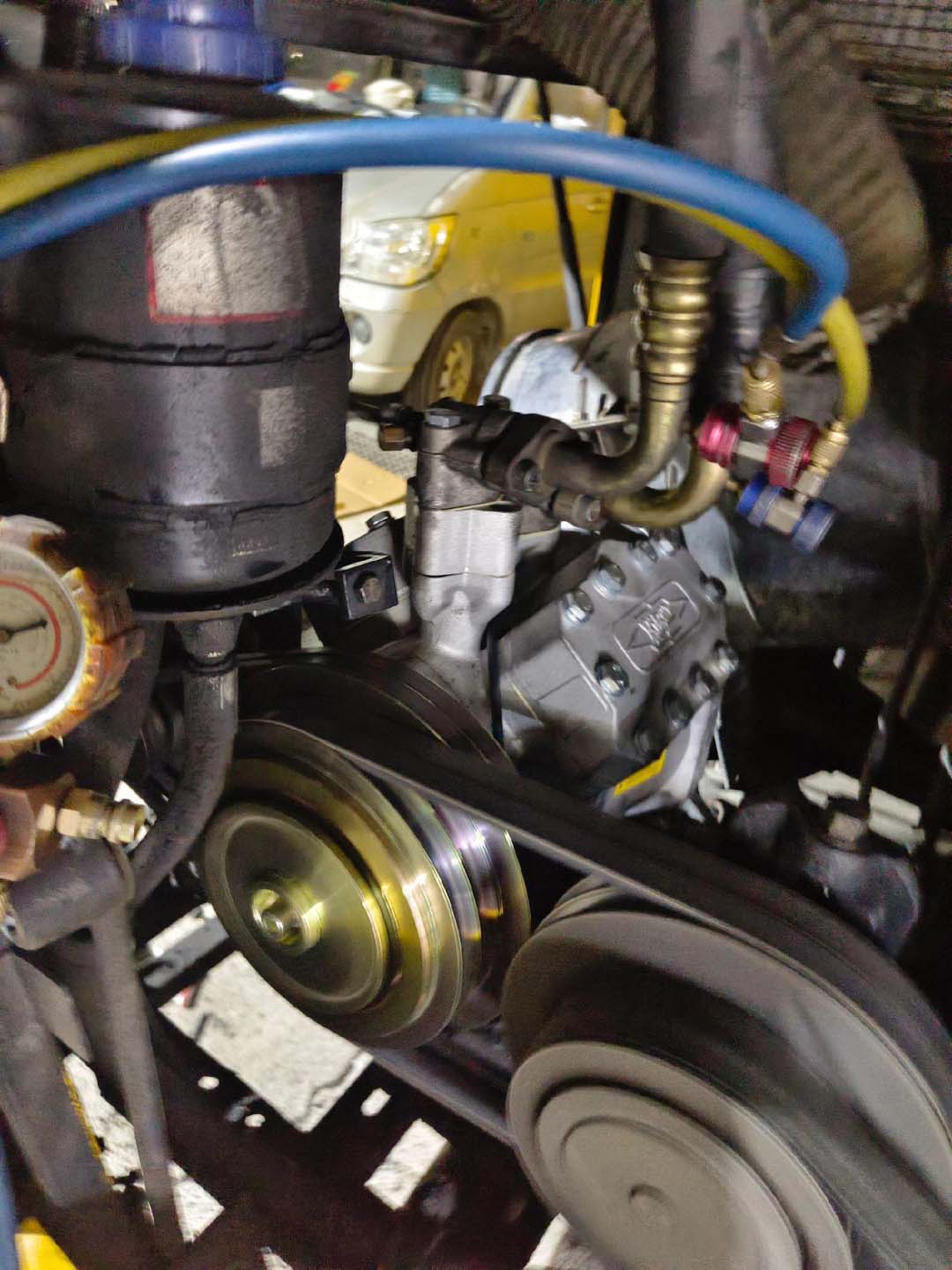
Severe abnormal noises during compressor operation (metallic knocking or friction sounds), refrigerant or refrigeration oil leakage from the casing, and abnormal vibration of connecting pipes.
Problem Analysis
Buses operate on complex road conditions for extended periods, with continuous vibration transmitted from the engine and chassis being the primary cause. Data cited in the 2025 special issue of *Commercial Vehicle Vibration and Noise Control* shows that the random vibration stress experienced by overhead components is approximately 1.8 times that of chassis components, easily leading to loose compressor mounting bolts and accelerated wear of internal moving parts (such as pistons and bearings). Simultaneously, repeated thermal expansion and contraction can cause seals (such as shaft seals and cylinder head gaskets) to lose elasticity, resulting in leaks. Insufficient lubrication exacerbates this process, creating a vicious cycle of “wear-leakage-lubrication deterioration.”
Problem Conclusion:
The core of the mechanical failure lies in the lack of vibration management and periodic maintenance. The conclusion requires operators to strictly implement a system of checking and regularly replacing fastener torque, and to adopt high-vibration-resistant mounting brackets, shifting the focus of preventative maintenance from “repairing leaks” to “suppressing vibration and wear.”
Sub-problem Two: Bus AC compressor problems, electrical system failure—reliability of electronic control components and wiring
Problem Symptoms:
Compressor fails to start, intermittent shutdowns, and frequent triggering of protection circuits (such as high-pressure or low-pressure protection).
Problem Analysis:
This problem goes far beyond the traditional “circuit failure” category. The compressor’s electromagnetic clutch coil, subjected to long-term start-stop inrush currents and high-temperature environments, is prone to insulation aging and breakdown. Power line connectors are corroded by rainwater and salt spray, increasing contact resistance and causing voltage drops and overheating. More complexly, with the widespread adoption of electric buses, the variable frequency compressor drive module (IPM) is extremely sensitive to voltage fluctuations; transient peak voltages from the power grid can directly damage power devices. Engineer Lin Zhenhua points out: “More than 50% of electrical faults can be traced back to inherent deficiencies in wiring harness layout and environmental protection design.”
Problem Conclusion:
The essence of electrical faults is insufficient environmental adaptability design and electrical stress protection. The conclusion points to the need to improve the wiring harness sealing level, apply anti-corrosion coatings to critical contacts, and add transient voltage suppressors (TVS) at the power inlet to achieve systemic protection.
Sub-problem 3: Bus AC compressor problems, control system malfunction—sensor and logic strategy inaccuracies
Problem Phenomena:
Low cooling efficiency (insufficiently cold air output), frequent compressor start-stops or prolonged continuous operation.
Problem Analysis:
This is a high-incidence area for “hidden” faults. Temperature and pressure sensor drift or failure can transmit incorrect signals to the control unit (ECU), leading to inaccurate refrigerant flow regulation. For example, if the evaporator temperature sensor reading is too high, the ECU may incorrectly determine insufficient cooling, causing the compressor to operate under continuous high load. Furthermore, some control system logic is overly simplified, failing to fully consider actual bus operating scenarios (such as sudden changes in heat load caused by frequent door opening and closing), resulting in a mismatch between control strategies and demand.
Problem Conclusion:
Control faults reflect system perception distortion and strategy rigidity. The conclusion emphasizes the necessity of incorporating sensor calibration into regular maintenance procedures and promoting control software upgrades to introduce adaptive algorithms to dynamically match actual heat load changes.
Sub-problem 4: Bus AC compressor problems, improper usage scenarios and maintenance—overload and environmental extremes
Problem Phenomenon:
The compressor failure rate increases significantly in hot weather, during prolonged uphill climbs, or during periods of full passenger load.
Problem Analysis:
Usage scenarios are the “catalyst” for triggering the aforementioned hidden problems. Rooftop air conditioners operate under continuous high loads during the summer, making the condenser highly susceptible to blockage by dust and willow catkins, leading to poor heat dissipation, high system pressure, and compressor overload. Simultaneously, improper maintenance, such as inaccurate refrigerant charging or the introduction of air or moisture, can directly cause lubrication failure and acid corrosion, severely damaging the compressor. The aforementioned “Failure Mode and Effects Study” article, through case analysis, confirms that approximately 30% of early compressor failures are directly related to improper maintenance.
Conclusion:
Scenario-based failures highlight the importance of human factors and system limit management. The conclusion clearly requires the establishment of operational contingency plans for extreme weather and road conditions (such as increasing radiator cleaning frequency) and strict standardization of maintenance personnel’s operational certification and procedures to eliminate human error.
Bus AC compressor problems Summary
The failure of rooftop air conditioning compressors in buses is a multi-dimensional, system-level engineering problem. Mechanical vibration is the physical basis, electrical reliability is the operational guarantee, intelligent control is the core of efficiency, and the usage scenario and maintenance are the real-world boundaries where all problems erupt. Only by adopting a system management approach covering the entire lifecycle, and optimizing the entire chain from design and maintenance to operation, can we fundamentally improve its reliability and ensure the comfort and safety of public travel. More info please visit “repair manual“
Related posts:
 Bus AC not cooling – A Comprehensive Troubleshooting Guide
 Acc Bus Air Conditioning
 Bus Air Conditioner is used for buses and medium-sized commercial vehicles
 Bus Air Conditioning Unit
 Bus Air Conditioner Troubleshooting: A Systematic Diagnosis from Climate Adaptability to Passenger Experience
 Bus Air Conditioner Repair Solution Development Guidelines
 Ac Van