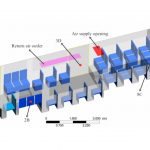
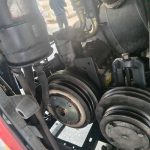
Bus AC electrical design is the core of ensuring the efficient and reliable operation of the system, covering all dimensions from hardware architecture and software logic to network security. The following analysis focuses on five core dimensions to present its systematic nature.
Bus AC Electrical Design – Modular and Integrated Design
Hardware forms the skeleton of the electrical system. Modern bus air conditioning electrical hardware generally adopts a modular design, typically including a power supply module, main control module (microcontroller/PLC), drive module, and human-machine interface module.
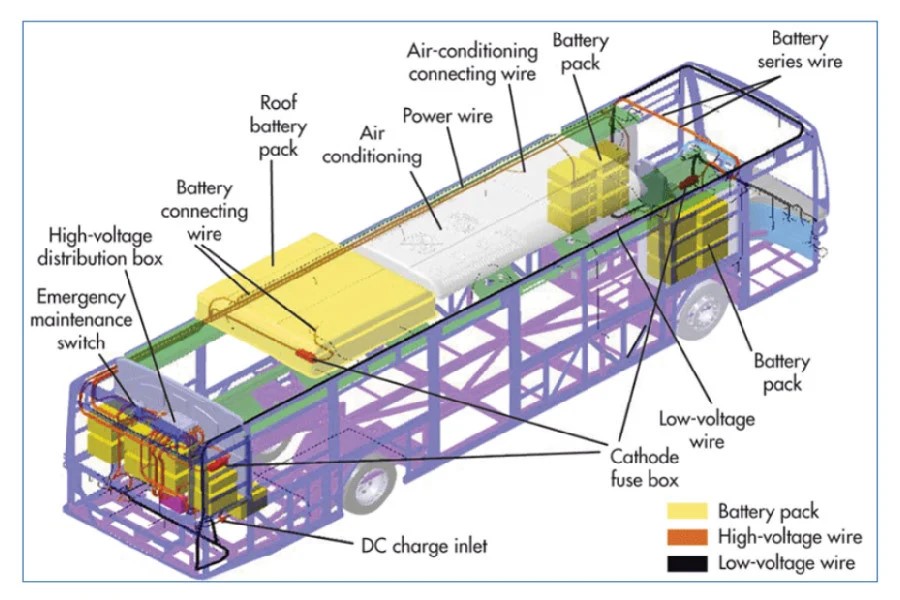
Power Management: Considering the differences between traditional buses (24V DC) and new energy buses (high-voltage platform), the design must include DC-DC converters, inverters, and filters. For example, 600VDC high voltage is converted to 27VDC to power the control circuit, or driven by a frequency converter to drive the compressor.
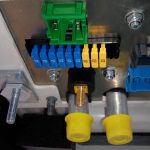
Core Hardware Integration: The main control board (ECU) integrates a microprocessor, AD acquisition circuit (for temperature/pressure sensing), optocoupler-isolated input/output, PWM output (for speed control), and stepper motor drive (for the electronic expansion valve). Simultaneously, relays, fuses, and thermostats must be properly arranged within the top-mounted electrical box.
Bus AC Electrical Design – Intelligence and Precision
The core of electrical design lies in control logic.
Full Function Coverage: The software must implement multiple functions including cooling, heating (including PTC auxiliary heating), ventilation, automatic mode, defrosting (in cooling/heating modes), and reverse dust removal.
Advanced Algorithm Application: To improve energy efficiency, PID control, or even PID parameter adjustment based on genetic algorithms, is used, which can improve cooling efficiency by approximately 4%. For variable frequency systems, stepless energy regulation is achieved through PLCs or frequency converters, reasonably matching the energy requirements of the entire vehicle.
Protection Logic: The design must include a complete fault detection and handling mechanism, such as compressor phase loss/overload protection, sensor open/short circuit diagnosis, high/low pressure alarms, etc.
Bus AC Electrical Design – Reliability and Real-Time Performance
The bus environment is complex, and communication design is the “neural network” of information transmission.
Dual Communication Protocol Support: To address signal attenuation and interference caused by the long vehicle length, the design must support both current loop communication (point-to-point, similar to the ModBus protocol) and CAN bus communication (compliant with the SAE-J1939 protocol, used for interaction with the vehicle network), with flexible switching capabilities.
Isolation and Interference Suppression: Optical isolation technology is employed in the circuit design to effectively isolate high and low voltage circuits, preventing interference signals from entering the control core.
Bus AC Electrical Design – Electromagnetic Compatibility and Electrical Safety
The comprehensive design must include responses to harsh electromagnetic environments.
Electromagnetic Compatibility (EMC) Design: Electric buses contain numerous power electronic components in a complex electromagnetic environment. The electrical design must include anti-interference modules (such as filtering circuits and shielding), and the PCB layout must consider zoned isolation to prevent malfunctions of the control unit due to electromagnetic influences.
AD Sampling Interference Suppression: Analog signals such as temperature acquisition are susceptible to interference. Hardware-wise, enhanced filtering circuits are required, and software-wise, digital filtering algorithms must be employed to ensure the accuracy of the sampled values.
Special Safety Protections: To address the potential induced voltage issues arising from the metal components of bus AC, modern electrical designs may include rectifier sampling units and control units. These units can eliminate induced voltage through negative compensation or absorption methods, preventing electric shock hazards.
Bus AC Electrical Design – Reliability and Ergonomics Dimensions
Diagnosis and Maintenance: The design should include circuit fault detection modules and self-diagnostic functions to facilitate quick problem location by maintenance personnel. Simultaneously, a remote monitoring system should be available to analyze air conditioning operation data in real time.
Human-Machine Interaction: The control panel design should be intuitive, featuring parameter query, setting, and power-off storage functions for easy adjustment by the driver or passengers.
In summary, bus air conditioning electrical design is a comprehensive systems engineering project encompassing high-voltage and low-voltage circuits, hardware and software, local control and remote communication, and functional implementation and safety protection.