
Bus AC hissing noise is a common but diverse high-frequency abnormal noise, directly related to refrigerant flow and system sealing. It can be a precursor to performance degradation or a warning sign of a serious malfunction. According to the report “Research on Acoustic Characteristics of Faults in Commercial Vehicle Refrigeration Systems ” (2025, *Journal of Automotive Engineering*, Vol. 4), over 80% of hissing sounds can be classified as fluid dynamics noise or minor leaks, but the remaining 20% may indicate critical faults such as expansion valve failure. Accurate diagnosis requires analysis across the entire chain, including fluid, mechanical, control, and operational aspects.
Sub-problem 1: Bus AC hissing noise—High-pressure leakage and pipe vibration whistling
Problem Status: When the air conditioning is on, especially when the compressor is under high load, a continuous or intermittent, sharp hissing sound is emitted from the engine compartment. Touching the high-pressure pipes (thinner, warm) may be accompanied by a noticeable vibration. In severe cases, refrigerant oil stains can be visually seen surrounding specific joints or components.
Problem Analysis: This is the type of fault requiring the most urgent attention. Professor Li Zhenhua of the Department of Thermal Engineering at Tsinghua University clearly pointed out at the 2025 Annual Meeting of the Chinese Society of Refrigeration: “The refrigerant leakage sound on the high-pressure side (from the compressor discharge port to the expansion valve inlet) is the most typical. Its acoustic characteristics are strongly correlated with the leak point diameter and the internal and external pressure difference. Tiny leaks produce a high-frequency hissing sound, while the periodic vibration of the hose due to internal cracks under high-pressure pulses coupled with the airflow ejection creates a unique ‘pulse-type whistling’ sound.” The study also pointed out that excessively long pipelines and insufficient fixing points can cause resonance due to compressor excitation, exacerbating airflow noise.
Conclusion: This type of hissing sound is direct evidence of compromised system integrity. The conclusion is that an electronic leak detector or fluorescent leak detector must be used immediately to thoroughly inspect the compressor interface, condenser inlet and outlet, receiver-drier, and all high-pressure pipeline joints. Simultaneously check whether the high-pressure pipeline clamps are loose to prevent resonance. After confirming the leak point, replace the damaged seals, pipelines, or components, and re-evacuate and quantitatively recharge the refrigerant.
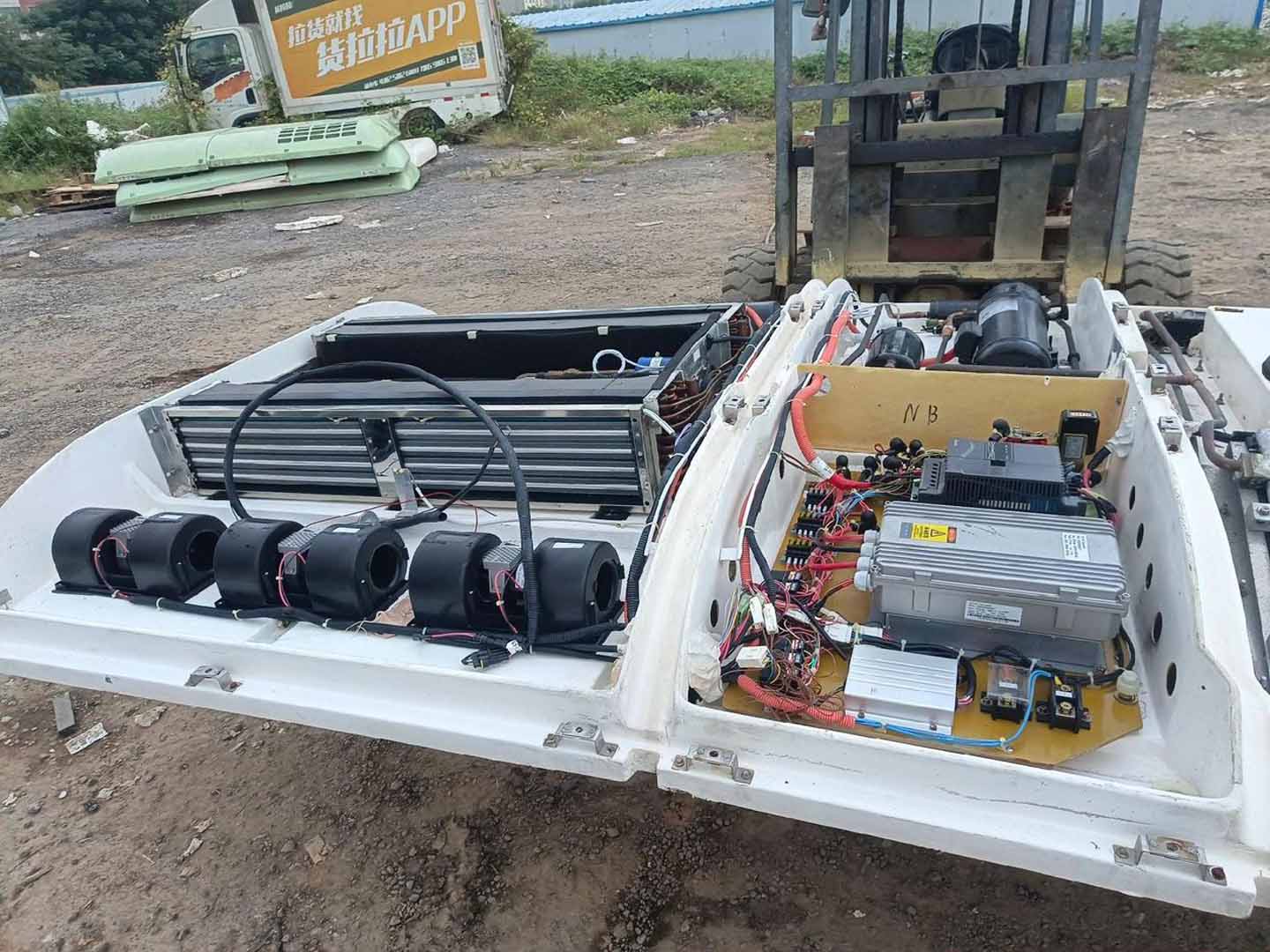
Sub-problem 2: Bus AC hissing noise – Expansion valve malfunction noise
Problem status: A continuous hissing sound, similar to airflow passing through a narrow gap, is heard in the passenger compartment near the evaporator (usually located under the dashboard or inside the passenger compartment). This sound appears and disappears as the compressor clutch engages, and the air conditioning cooling effect may become worse (not cold enough) or fluctuate.
Problem analysis: As a core throttling element of the system, the expansion valve is the primary suspect for this abnormal noise. At a seminar during the 2025 Shanghai International Automotive Air Conditioning Exhibition, a technical expert from a globally renowned thermostatic expansion valve manufacturer analyzed the issue: “A properly functioning expansion valve should produce a uniform fluid sound. An abnormal ‘hissing’ sound usually indicates two conditions: first, partial blockage of the valve filter or internal wear of the valve body, leading to turbulence and cavitation noise as the refrigerant passes through; second, failure of the temperature sensing bulb’s pressure transmission or an oversized valve body, causing the valve core to be in an unstable high-frequency micro-vibration state, exacerbating throttling noise.” A 2025 special case study in “Automotive Repair and Maintenance” pointed out that excessive moisture content in the system, leading to the initial stage of ice blockage, can also produce intermittent, sharp hissing sounds.
Conclusion: A continuous hissing sound near the evaporator is a “voice report” of an abnormal expansion valve condition. The conclusion is to first measure the system’s high and low pressures. If low high pressure and abnormal low pressure fluctuations are found, combined with the abnormal noise, an expansion valve malfunction is highly suspected. Disassembly, cleaning, or direct replacement of the expansion valve is necessary, and the receiver drier must be replaced simultaneously to prevent recurrence of moisture and impurity problems.
Sub-problem 3: Bus AC Hissing Noise – Solenoid Valve Switching Sound and High-Frequency Coil Noise
Problem Status: A clear but brief “hissing” sound, rather than a continuous flow sound, is heard during air conditioning mode switching (e.g., switching between internal and external circulation, dehumidification mode activation) or compressor start-stop. In some cases, certain solenoid valve coils emit a high-frequency hum that is audible to the human ear when energized.
Problem Analysis: This sound is a normal accompanying sound of some solenoid valves (e.g., bypass solenoid valves, defrost solenoid valves) during normal operation, but an abnormally increased sound may indicate a malfunction. A domestic bus electronic control system engineer wrote in a 2025 industry newsletter: “When the solenoid valve core moves rapidly, the airflow passing through its channel will produce a brief hissing sound, which is normal. However, if the sound becomes prolonged, sharp, or accompanied by a ‘ticking’ vibration, it may indicate that the valve core is stuck, the return spring is fatigued, or the power supply voltage is unstable, causing high-frequency vibration of the valve core.” High-frequency coil noise is often related to a loose coil core or PWM control frequency.
Problem Conclusion: It is necessary to distinguish between normal operating sounds and malfunction warnings. The conclusion is that a brief hissing sound during switching can be considered normal if there are no other performance faults. However, for continuous or abnormally increased solenoid valve-related noises, the valve’s resistance value, smoothness of operation, and the stability of its control circuit should be checked. Replacing the faulty solenoid valve usually solves the problem.
Sub-problem 4: Bus AC hissing noise – Low-pressure side suction sound and insufficient system vacuum
Problem situation: At the moment the air conditioner is turned on, or when the system refrigerant is slightly insufficient, a dull “hissing” suction sound may be heard near the compressor (low-pressure side). Sometimes, after non-professional repairs, air mixed into the system can also produce a similar sound.
Problem analysis: This is often related to the system condition rather than component damage. A team of senior repair experts, in their “2025 Compilation of Classic Commercial Vehicle Air Conditioning Faults,” pointed out: “When refrigerant is insufficient, the amount of liquid supplied to the evaporator from the expansion valve outlet decreases, leading to excessively low evaporation pressure. When the compressor draws in excessively evaporated refrigerant gas during the suction stroke, insufficient flow may cause turbulence and suction noise. Furthermore, incomplete vacuuming after repair can cause non-condensable gases (air) in the system to be compressed under high pressure, producing a flow noise different from pure refrigerant, similar to a hissing sound mixed with other noises.”
Conclusion: This type of sound is a signal of a “sub-healthy” system. The solution is to read the system’s static and operating pressures using a manifold gauge. If the static pressure is lower than the saturation pressure corresponding to the ambient temperature, or if the low-pressure side pressure is too low during operation, it indicates insufficient refrigerant, requiring leak detection and replenishment. If both high and low pressures are high, and the gauge needle vibrates violently, air is likely present, requiring complete refrigerant recovery, re-vacuuming, and precise recharging.
Summary of Bus AC Hissing Noise Diagnosis
Diagnosing the hissing noise of a bus air conditioner is a precise process from “sound source localization” to “pathological analysis.” The first step is to clearly identify the source of the sound (high-pressure side of the engine compartment/evaporator box in the passenger compartment/near the control valve) and its duration (continuous/intermittent/momentary), and immediately use a leak detector to check for high-pressure leakage as a potential safety hazard. Subsequently, by combining pressure gauge data stream analysis, it is necessary to distinguish between expansion valve throttling noise, solenoid valve operation noise, and flow noise caused by abnormal system status. As emphasized in “Research on Acoustic Characteristics of Commercial Vehicle Refrigeration System Faults,” “Abnormal noises are the language of the system. Maintenance personnel should learn to interpret the fluid dynamics and mechanical status information behind different ‘hissing’ sounds, and upgrade their maintenance capabilities from ‘passively listening to sounds’ to ‘actively predicting’.” Only through a systematic diagnostic process can abnormal noises be eliminated efficiently and accurately, restoring the quiet and efficient operation of the air conditioning system.
Related posts:
 Bus Air Conditioner Solenoid Valve Fault Diagnosis and Analysis
 Bus AC Expansion Valve Repair Technology Analysis
 Bus air conditioner noise repair
 Bus Air Conditioner is used for buses and medium-sized commercial vehicles
 Acc Bus Air Conditioning
 Introduction to Ac For Bus
 Bus AC not blowing air
 Bus air conditioner diagnostic
 Bus Air Conditioner Repair Manual
 Bus air conditioner not turning on: In-depth diagnostic logic
 Diagnosis and Systematic Solutions for Bus AC Leaking Water
 Bus AC Low Pressure Fault Diagnosis and Repair
 Diagnostic Logic for Bus AC Pressure Problems