
Bus air conditioner filter design is a crucial barrier to ensuring cabin air quality and the reliability of the air conditioning system itself. A filter is not simply a “screen,” but a comprehensive system engineering project involving filtration efficiency, airflow resistance, installation layout, materials science, and regulatory compliance.
Bus Air Conditioner Filter Design – Three-Stage Progressive Filtration Architecture
The primary dimension of modern bus air conditioning filter design is the overall system filtration architecture layout. Traditional single-stage filtration is insufficient to meet the air quality requirements of the post-pandemic era. Current advanced designs employ a three-stage progressive filtration system:
Stage 1 – Pre-filter: Installed at the external air intake of the air conditioning unit or in the driver’s area at the front of the bus, it performs preliminary filtration of the air entering the air conditioning system, intercepting large particles such as leaves, catkins, and insects, protecting downstream core components.
Stage 2 – Recirculating Air Filter: Installed at the return air vents in the ceiling or the inlet of the recirculating air duct, it immediately filters the air exhaled by passengers. This stage focuses on capturing larger aerosols and particles, preventing them from entering the air conditioning system, while also preventing the recirculating air filter from clogging too quickly.
The third stage—air conditioning system fine filtration: Located inside the overhead Bus air conditioner (usually before the evaporator), this stage performs a final “fine-tuning” on the air about to enter the passenger compartment, removing even smaller particles, including viral aerosols.
This three-stage layout, through careful measurement and precise arrangement, achieves full-space filtration coverage.
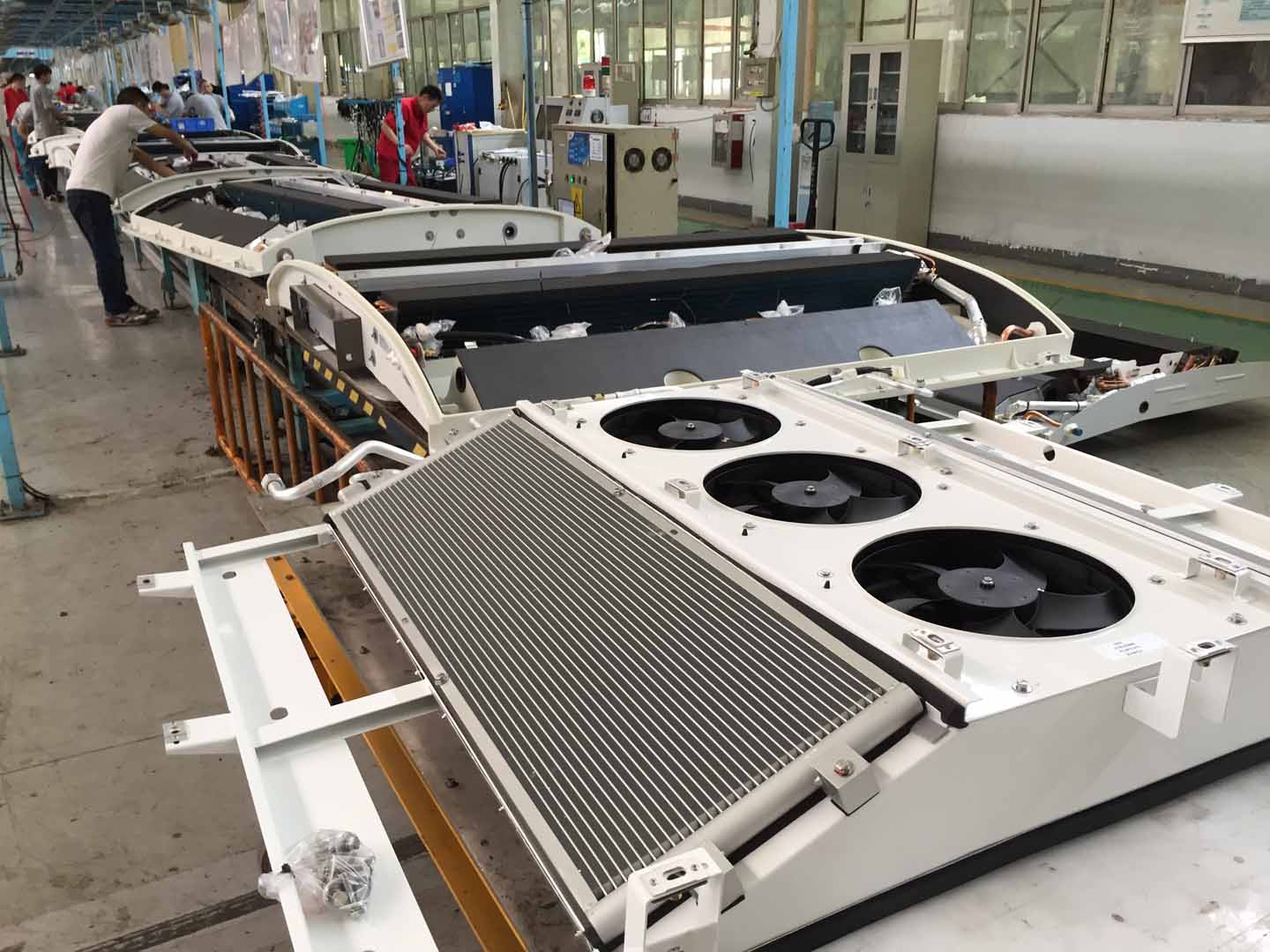
Bus air conditioner filter design—three-stage progressive filtration architecture and filter material dimensions
The selection of filter materials directly determines the filter’s performance ceiling. Modern bus air conditioning filters generally employ a multi-layer composite structure:
Coarse layer: Typically composed of synthetic fibers or metal mesh with large pore sizes, used to intercept large particles. A purification device proposed in patent CN201920708818.7 uses a concentrically arranged purification ring structure, with air intake channels formed between adjacent purification rings, achieving preliminary filtration while ensuring sufficient airflow.
Fine particle filtration layer: Employs an ultra-fine fiber layer for highly efficient filtration of viral aerosols (droplet nuclei) with a diameter less than 5μm. Freudenberg’s micronAir Blue product features two layers that capture approximately 90% of viral aerosols.
Functional Adsorption/Inactivation Layer: Built-in activated carbon adsorbs gaseous pollutants such as formaldehyde and TVOCs, as well as odors. A more advanced bio-functional layer, impregnated with fruit extracts, enables near 100% inactivation of captured viruses, effectively preventing active pathogens from contaminating the cabin air.
Bus Air Conditioner Filter Design – Balancing Efficiency and Resistance
The core performance indicator of a filter is the balance between filtration efficiency and airflow resistance. The purpose of the return air filter is to capture airborne particles, preventing them from accumulating on the surface of the evaporator fins or circulating within the passenger compartment after passing through the coils.
Filtration Efficiency Requirements: For bus applications, the filter media must be able to capture particles ranging in size from 20 microns to 3 microns. Research has found that a filtration efficiency of approximately 90% achieves a good balance between health protection and system load.
Resistance Control Red Line: When the resistance to airflow through the filter exceeds 1.0 inch of water column (approximately 249 Pa), airflow is adversely affected. At this point, reduced airflow in the unit leads to insufficient hot air flowing through the evaporator coils, incomplete refrigerant evaporation, potentially causing the expansion valve to close, poor refrigerant oil return, and ultimately compressor failure.
Dust Holding Capacity and Lifespan: The filter media must maintain its filtration capacity throughout its entire lifespan. Using a filter with high initial filtration capacity but low dust accumulation capacity will result in increased compressor operation and more frequent filter replacements; conversely, a poorly performing filter will cause evaporator coil contamination and reduced cooling capacity.
Bus Air Conditioner Filter Design – Compactness and Ease of Maintenance
Due to limited interior space in buses, the filter’s structural design must balance maximizing filtration area with ease of installation and maintenance.
Folded Structure: Using alternating layers of flat and T-shaped folded filter media significantly increases the filtration area within a limited space.
**Snap-fit Design:** Patent CN201920708818.7 employs a snap-fit connection structure between the filter screen and the connecting seat, allowing the filter screen to be easily removed from the connecting seat for cleaning or replacement.
**Modular Units:** Utilizing a modular filter unit design, the units can be interconnected to adapt to the space constraints of different vehicle models while reducing airflow resistance.
Bus Air Conditioner Filter Design – Material Flame Retardancy and Standard Compliance
As a public transportation vehicle, safety is always paramount for buses. The filter design must strictly comply with regulations and standards.
**Latest Industry Standard:** QC/T 998-2023, “Automotive Air Conditioning Filters,” officially came into effect on July 1, 2024, replacing the 2015 version. This standard provides detailed specifications for the technical requirements and test methods of automotive air conditioning filters and is the basis that must be followed in the design process.
**Material Flame Retardancy:** Since the filter material is used in the passenger compartment of buses, it must comply with the requirements of Federal Motor Vehicle Safety Standard 302 (49 CFR 571.302). This standard requires all materials within 13 mm of the passenger compartment to be fire-resistant—the materials must be self-extinguishing or burn at an extremely slow rate to protect passenger safety in the event of a thermal event.
Third-Party Verification: Close collaboration with leading international testing organizations to achieve third-party verification of product performance is a crucial step in ensuring design reliability.
Bus Air Conditioner Filter Design – Life Cycle Cost
Filter design must also consider the convenience and economy of operation and maintenance.
Extended Maintenance Cycles: Traditional bus air conditioning filters typically require at least four maintenance sessions per year, necessitating skilled workers and vehicle downtime, increasing maintenance costs. Modern designs, through staged filtration and electrostatic enhancement technology, extend filter clogging time and increase maintenance intervals.
Condition Monitoring: Advanced designs integrate differential pressure sensors to monitor filter resistance in real time, automatically prompting replacement when resistance exceeds a set value, enabling on-demand maintenance.
Cleanerability: Some pre-filters are designed to be washable and reusable, reducing operating costs.
Related posts:
 Bus air conditioner design
 Bus Air Conditioner Refrigerant Design
 Bus air conditioner fan motor selection
 Bus air conditioner fan motor design
 Bus AC electrical design
 Bus air conditioner filter replacement
 Bus Air Con Supplier Analysis Future HVAC Structure Trends in Buses
 Bus Air Conditioner is used for buses and medium-sized commercial vehicles