
Bus air conditioner noise repair requires a systematic diagnosis of the entire noise chain, from generation and transmission to amplification.
Bus air conditioner noise repair not only addresses significant passenger comfort issues but also serves as a crucial indicator of potential system failures or design mismatches.
According to the “Special Research Report on Bus NVH (Noise, Vibration, and Harshness)” published in the first issue of *Bus Technology and Design* in 2025, the air conditioning system is listed by passengers as the second largest source of noise inside the vehicle, with over 50% of “abnormal noise” complaints ultimately directly related to component failure or deterioration.
Sub-problem 1: Bus air conditioner noise repair—Wind noise and airflow whistling
Current situation: Manifests as high-speed airflow noise, sharp whistling, or a “whooshing” turbulent noise, significantly aggravated by increasing fan speed. Commonly found at air vents, inside air ducts, or at the blower inlet.
Problem Analysis: A 2025 study by the Acoustics Institute of the School of Automotive Engineering at Tongji University indicated that “aerodynamic noise in air conditioning ducts mainly originates from three aspects: first, turbulence and separation generated when airflow passes through narrow, irregular channels or clogged filters/evaporators; second, poor matching between the blower impeller and volute or poor dynamic balance of the impeller itself, generating rotational noise; and third, unreasonable design of the air outlet grille, causing high-speed airflow to be cut and producing a whistling sound.” The “Aeroacoustic Optimization Guidelines for Commercial Vehicle HVAC Systems” published by the SAE-China Society of Automotive Engineers in the same year also points out that detached or deformed internal duct bushings can significantly alter airflow direction and induce additional noise.
Conclusion: Repair should start with “purifying the airflow field” and “optimizing the sound source.” The conclusion is: first, clean or replace the air conditioning filter, and check and clean the evaporator surface; second, check the blower impeller for foreign objects, dirt, or blade deformation, and clean or replace it; finally, check whether the inside of the duct is smooth and intact, and whether the air outlet grille is damaged. For design-related whistling, consider replacing the air outlet components with those having better airflow organization.
Sub-problem 2: Bus air conditioner noise repair – component wear, loosening, and resonance
Current situation: Manifests as a regular “humming” or “ticking” noise, or strong overall vibration noise, the frequency of which is often related to the compressor and blower speeds. Touching related components (such as the compressor and ducts) may reveal noticeable vibrations.
Problem analysis: This is the most typical source of malfunction noise. At a 2025 industry seminar, the after-sales technical director of a leading domestic bus manufacturer pointed out: “The core of mechanical noise is ‘gap’ and ‘imbalance.’ Internal wear of the compressor and damage to the clutch bearing will produce a muffled roar; wear of the blower motor bearing will cause a high-frequency hissing; and loose mounting clamps of any component (such as pipes and airbox) will resonate with the vehicle body structure at specific speeds, amplifying the noise.” The 2025 vehicle testing by the China Automotive Technology and Research Center (CATARC) found that uncontrolled vibration transmission paths caused by fatigue of the mounting brackets or aging of rubber bushings are the main cause of low-frequency resonance noise.
Problem Conclusion: The key to repair lies in “tightening,” “alignment,” and “vibration isolation.” The conclusion is to systematically inspect and tighten all fixing bolts and clamps of the air conditioning pipes, air box, and blower assembly; replace aged and compressed rubber vibration damping pads (especially at the compressor bracket); for moving parts (compressor, blower), after identifying the source of abnormal noise using a stethoscope or vibration testing, replace or professionally repair them.
Sub-problem 3: Bus air conditioner noise repair—current noise and operating sounds of control components
Current situation: Manifests as a “buzzing” current sound when adjusting airflow or temperature, or a “clicking” sound or motor humming sound when switching damper modes. This type of noise is usually synchronized with operation and is particularly noticeable in quiet environments.
Problem analysis: “With the advancement of electrification and intelligence, control noise is becoming increasingly prominent,” a technical expert from a well-known international automotive electronics supplier analyzed at the 2025 Asian Bus Forum. “The blower speed control module (PWM controller) generates audible switching frequency noise during operation; while the stepper motors or servo motors used in the mode damper and temperature damper produce unpleasant ‘clicking’ sounds due to mechanical limit impacts at the end of their movements and gear meshing clearances. Some inexpensive motors also have relatively high electromagnetic noise.”
Conclusion: Repair requires distinguishing between “normal operating sounds” and “abnormal noises from malfunctions.” The conclusion is: For damper motor noise, check for damaged gears and stuck tracks, and lubricate (if applicable) or replace them; for PWM current noise, confirm whether it is within the standard range, and sometimes it can be improved by adding filter capacitors or replacing with a higher-quality controller. Passengers should be explained that some slight adjustment sounds are normal operating sounds.
Sub-problem 4: Bus air conditioner noise repair—lack of vehicle integration and maintenance
Current situation: The noise problem occurs or worsens under specific operating conditions (such as rapid acceleration, bumpy roads), and no obvious faults are found when simply checking the air conditioning components. This is usually a comprehensive problem caused by improper system-vehicle matching or long-term lack of maintenance.
Problem Analysis: A 2025 research report from the School of Mechanical Engineering and Vehicle Engineering at Beijing Institute of Technology emphasizes that “air conditioning is not an isolated system. Its noise level is deeply coupled with the overall vehicle NVH performance. For example, poor sound insulation design in the engine compartment can transmit a large amount of compressor noise into the passenger cabin; insufficient rigidity of the body sheet metal structure can easily resonate with a certain frequency of the Bus air conditioner; even insufficient battery power leading to fluctuations in the blower’s power supply voltage can cause noise changes.” A senior maintenance expert pointed out in a 2025 column in *Commercial Vehicles* that long-term neglect of filter replacement, leading to increased blower load, is a significant contributing factor to premature bearing wear and increased noise.
Conclusion: Solving complex noise issues requires “systematic thinking” and “source prevention.” The conclusion is: for matching issues, the integrity of sound and heat insulation materials should be checked from a vehicle-wide perspective, and component layout optimized; for maintenance issues, regular maintenance procedures must be strictly followed (such as cleaning the evaporator, replacing filters, and checking fasteners) to prevent components from prematurely entering a high-noise state due to deteriorating operating conditions.
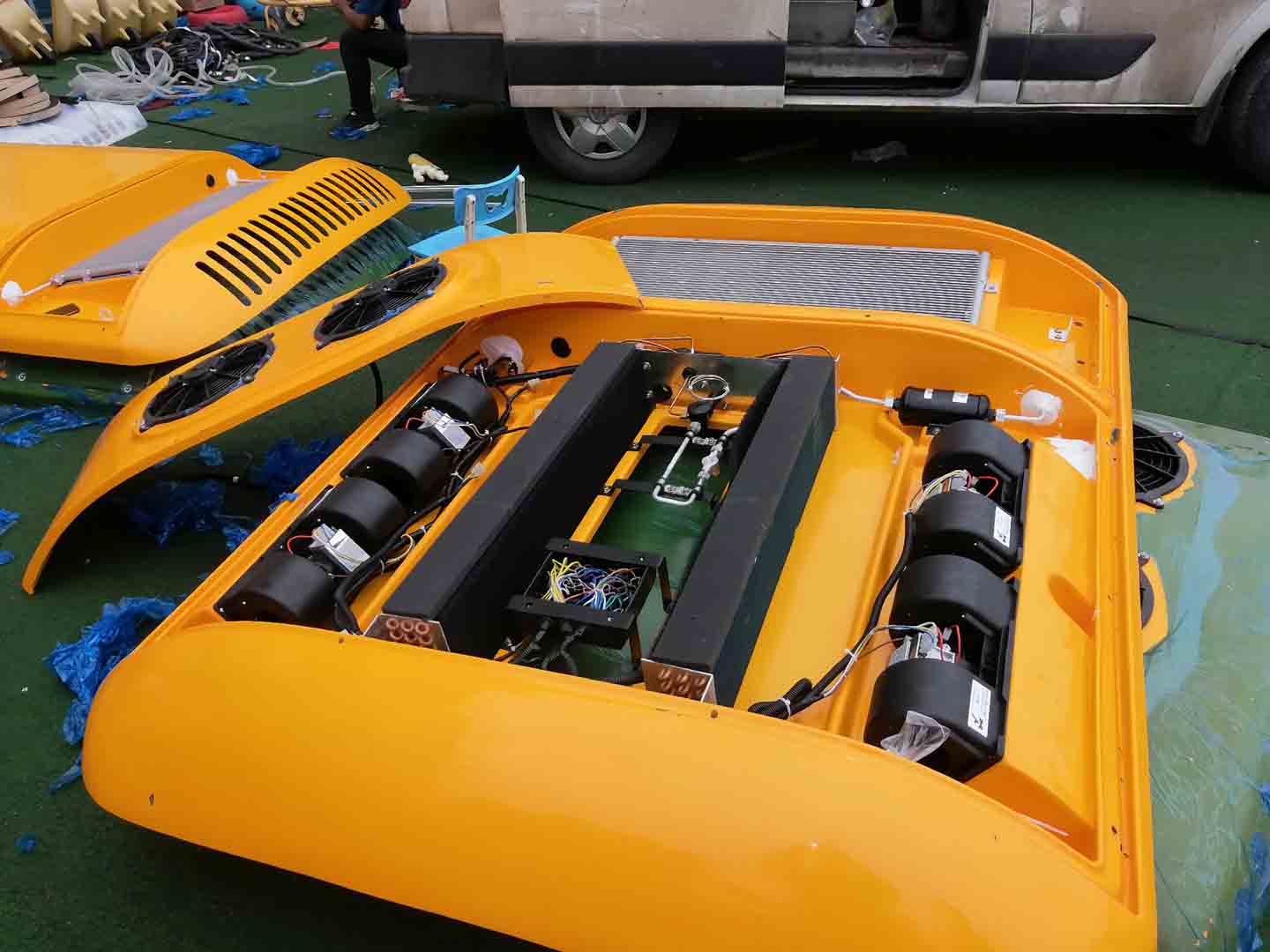
Summary of Bus Air Conditioner Noise Repair
Bus air conditioner noise repair is a systematic project that requires following a diagnostic logic of “from surface to core, from air to machine, and from electrical to overall system.” First, investigate aerodynamic noise (clean the airflow channels); second, address mechanical noise (tighten and replace components); third, examine control noise (identify and optimize); and finally, consider system matching (vibration isolation and maintenance). As summarized in the “Special Research Report on Bus NVH,” “A low-noise air conditioning system is the result of precise design, high-quality manufacturing, and scientific maintenance. The goal of repair is not only to eliminate abnormal noises, but also to discover and eradicate deeper matching defects or wear hazards within the system through the surface of noise, thereby restoring its overall health and quietness.” This requires repair personnel to possess a cross-system diagnostic perspective and a rigorous analytical process.
Related posts:
 Bus AC hissing noise
 Bus Air Conditioner is used for buses and medium-sized commercial vehicles
 Acc Bus Air Conditioning
 Bus AC not blowing air
 Introduction to Ac For Bus
 Air Conditioner for Bus Conversion
 Bus Air Conditioning Unit
 Bus air conditioner not turning on: In-depth diagnostic logic
 Rv Ac Unit Repair
 Bus air conditioning vibration
 Bus Air Conditioner Repair Manual
 Bus AC vents not working
 Bus Air Conditioning Airflow Diagnosis and Optimization
 Bus Air Conditioning Sensor Classification and Repair
 Bus air conditioner diagnostic
 IC Bus Air Conditioning: A Comprehensive Evolution of Integration, Intelligence, and Sustainability
 Diagnosis and Systematic Solutions for Bus AC Leaking Water
 Bus AC fan not working