
Bus Air Conditioner Troubleshooting: A Systematic Diagnosis from Climate Adaptability to Passenger Experience
Bus air conditioning is not merely a comfort device; it is a critical system concerning public health, operational efficiency, and urban image. Troubleshooting it requires transcending traditional technical boundaries and analyzing it within a broader context of urban ecology and passenger behavior. This article will integrate the latest industry trends and multi-dimensional perspectives to construct a comprehensive framework for troubleshooting and optimization.
Dimension 1: Adaptability Analysis of Local Climate Characteristics and Air Conditioning System Load
Question:
Do regional extreme climates pose a recurring challenge to the design load and durability of existing Bus Air Conditioner?
Evidence:
According to the “2025 White Paper on Climate Adaptability of Urban Public Transportation in China,” the frequency of extreme high temperatures and humidity in summer has increased significantly in recent years, placing demands on the continuous cooling capacity and condenser heat dissipation efficiency of onboard air conditioning systems that exceed existing industry standards. For example, in the hot and humid southern regions, frequent reports of “insufficient cooling” are often directly related to a sharp drop in condenser heat dissipation efficiency under high-temperature and congested conditions. At the 2025 International Transportation Equipment Forum, Professor Li, a leading expert in thermal management from the School of Vehicle Engineering at Tsinghua University, pointed out: “The current public transportation operating environment has shifted from ‘standard operating conditions’ to ‘extreme operating conditions.’ The design benchmark for air conditioning systems must shift from ‘meeting standards’ to ‘redundancy,’ focusing on improving their stability and energy efficiency ratio under peak loads.”
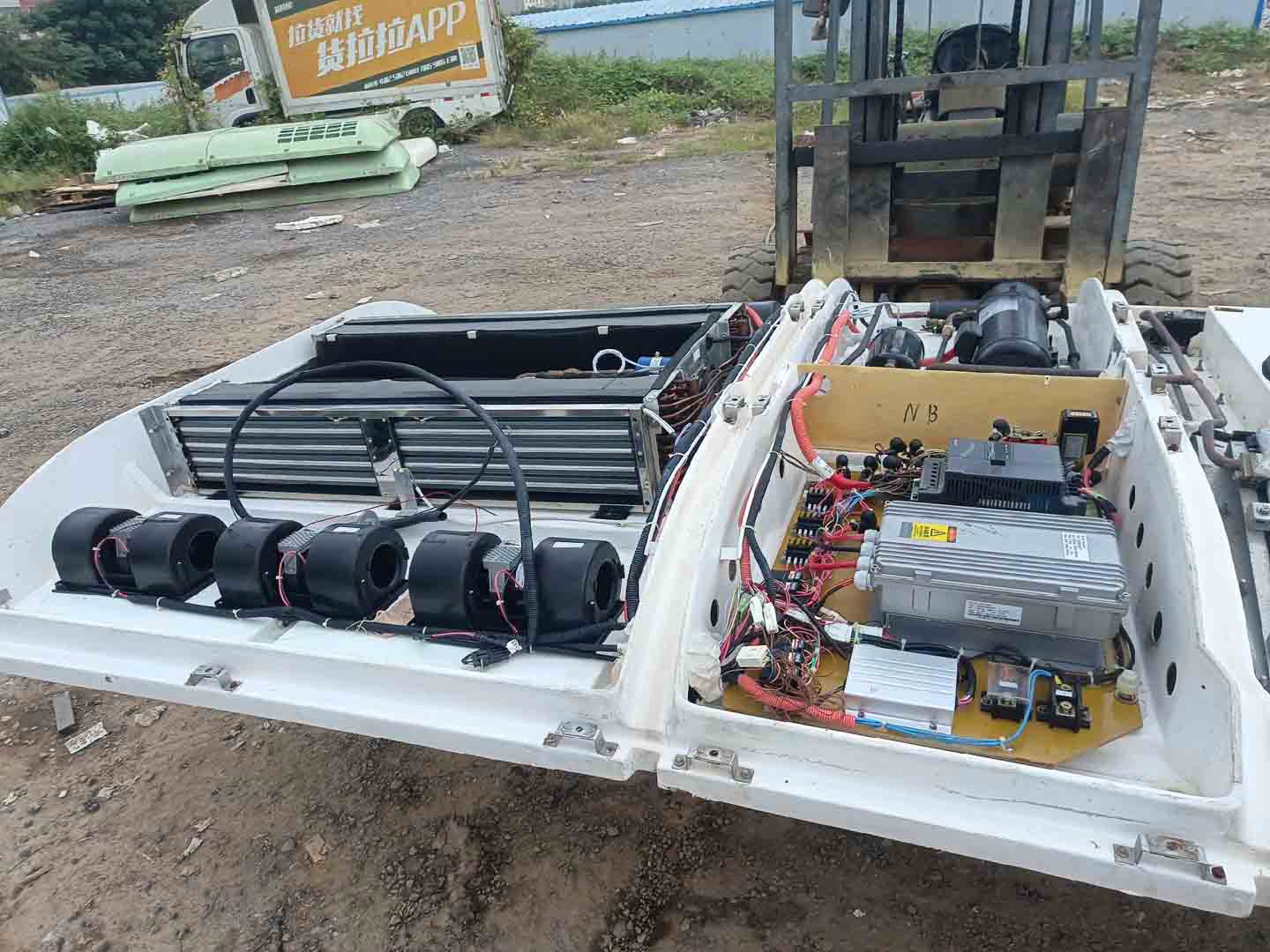
Conclusion: Climate factors are the fundamental cause of Bus Air Conditioner Troubleshooting. Troubleshooting requires first assessing the climate profile of the operating route, specifically checking condenser cleanliness, refrigerant charging accuracy, and the compressor’s continuous operating performance at high temperatures, and considering upgrading components with high heat dissipation performance.
Dimension 2: The Relationship Between Public Transportation Operation Schemes and Air Conditioning Usage Intensity
Question:
How do complex operational scheduling (such as combining long and short routes, and increasing peak-hour frequency) exacerbate the wear and tear and failure risk of air conditioning systems?
Evidence:
According to the interpretation meeting of the latest “Urban Public Bus and Trolleybus Operation Management Standards” released by the Ministry of Transport in 2025, many cities have adopted a hybrid operation model of “mainline + connecting micro-circulation” to improve network efficiency. This means that the same vehicle may operate continuously under high intensity under different loads and road conditions. Frequent starts and stops, and prolonged low-speed creep (leading to insufficient airflow from the condenser fan), subject the compressor and fan motor to irregular impact loads, significantly increasing the failure rate. Captain Wang, the head of bus maintenance, confirmed in an industry exchange: “Vehicles undertaking all-weather, multi-mode operation tasks typically have 30% shorter maintenance intervals for key components of their air conditioning systems compared to vehicles on fixed routes.”
Conclusion: Operating mode is an accelerator of failures. Troubleshooting should focus on the burning of components related to high-frequency starts and stops (such as electromagnetic clutches and starting relays), as well as condenser blockage caused by prolonged low-speed operation. Differentiated preventative maintenance cycles should be developed based on operational intensity.
Dimension 3: The Dynamic Influence of Passenger Travel Habits and the Carriage Microenvironment
Question:
How do passenger boarding and alighting behaviors and passenger volume fluctuations interfere with the temperature balance set by the air conditioning system and mask actual system failures?
Evidence:
The 2025 “Urban Commuter Travel Habits Survey Report” shows that in hot weather, passengers tend to stand directly under the air vents when the doors are open, leading to significant differences in perceived temperature and potentially misinterpreting it as “air conditioning not cooling.” Simultaneously, overcrowding during peak hours causes the air conditioning heat load to far exceed its design limit (usually designed based on the number of seats). The Expert Committee of the China Urban Public Transport Association points out: “The dynamic flow of passengers constitutes the largest source of thermal interference. Simple temperature sensor readings cannot reflect perceived comfort; Bus Air Conditioner Troubleshooting must introduce the dynamic parameter of ‘passenger load change rate.'”
Conclusion: Passenger habits are a confounding variable for malfunctions. Engineers need to distinguish between “perception malfunctions” and “performance malfunctions.” They should check whether the return air filter is rapidly clogged due to high passenger volume, assess the rationality of the temperature sensor location (it should avoid areas directly exposed to airflow from the doors), and educate drivers and conductors on how to correctly set the temperature to cope with changes in passenger load.
Dimension 4: Diversified Customer Base and Definition of Comfort Standards
Question:
How to meet the diverse temperature needs of passengers of different ages and health conditions (such as the elderly, children, and the frail) and reduce complaints arising from “difficult to satisfy everyone” being misjudged as system malfunctions?
Evidence:
The deepening of an aging society and the promotion of the “people-friendly travel” concept have made the temperature control standards of public transportation increasingly complex. Data from a first-tier city bus group’s customer service center in 2025 showed that approximately 40% of complaints about air conditioning came from elderly passengers, who were more afraid of direct cold air. Dr. Chen, a leading ergonomics expert, emphasized in his research: “The ‘thermal comfort’ of public transportation is not a fixed temperature value, but a ‘microclimate zone’ that allows for personalized choices. Air outlet design, wind speed gradient, and the ability to independently control different areas become crucial.”
Conclusion: Customer differences represent a cognitive gap in Bus Air Conditioner Troubleshooting. Technical troubleshooting should be combined with complaint analysis to check the effectiveness of zoned temperature control functions and the flexibility and adjustability of air outlet guide vanes. The solution needs to shift from purely technical repair to a “technology + service” approach. For example, clear signage can guide passengers to choose suitable seats, or a “quiet and gentle breeze” mode can be piloted.
Systematic Troubleshooting Strategy Integration: In summary, troubleshooting modern bus air conditioning is a systematic project. It requires maintenance personnel to:
Establish Climate-Operation Files: Correlate fault data with weather, routes, and schedules to predict high-risk fault locations.
Implement Condition Monitoring Maintenance: Utilize IoT sensors to monitor system pressure, current, wind speed, and other parameters in real time, transforming “post-fault repair” into “condition-based early warning maintenance.”
Implement a Multi-Dimensional Diagnostic Process: When faced with a repair request, diagnose the problem sequentially through the path of “climate load → operating mode → daily passenger flow → specific passenger feedback” to accurately pinpoint whether it’s a hardware fault, performance deficiency, or comfort setting issue.
Promote Human-Centered Design Upgrades: Drive the procurement and upgrading of next-generation air conditioning systems with intelligent zoning, gentle breeze sensing, and self-cleaning functions.
Only by examining the technological hardware within the socio-physical environment in which it operates can a truly efficient, robust, and human-centered bus air conditioning system be built.
Related posts:
 Acc Bus Air Conditioning
 Bus Cond System Comprehensive Analysis Report
 Bus AC not cooling – A Comprehensive Troubleshooting Guide
 Bus Air Conditioner Repair Solution Development Guidelines
 Bus Air Conditioner is used for buses and medium-sized commercial vehicles
 IC Bus Air Conditioning: A Comprehensive Evolution of Integration, Intelligence, and Sustainability
 Van Aircon Unit
 Bus Roof Ac Unit – A Look at Bus Comfort in China
 Electric Bus Ac System – Comprehensive Technological Revolution Towards a “Dual-Carbon” Goal