
Bus air conditioning vibration is a critical issue affecting passenger comfort, component lifespan, and driving safety.
Vibration not only generates noise, but long-term effects can also lead to pipe cracking, component loosening, and even damage to mounting bases.
According to data from the “2025 China Bus Vibration Analysis and Control White Paper,” complaints about low-to-mid-frequency vibrations caused by the air conditioning system account for approximately 28% of all vehicle-wide complaints. Repairing this requires a systemic approach from the perspective of “vibration source-path-response” for precise diagnosis and intervention.
Sub-problem 1: Bus air conditioning vibration—Imbalance of rotating components and liquid slugging
Current situation: Manifests as periodic, strong vibrations synchronized with the compressor or blower speed. A noticeable pulse can be felt by touching the compressor housing or pipes. Common causes include internal compressor wear (such as bearings and pistons), dynamic imbalance, or liquid slugging caused by excessive/insufficient refrigerant (the compressor drawing in liquid refrigerant, causing a violent impact).
Problem Analysis: A research report published in 2025 by the Dynamics Laboratory of the School of Vehicle Science and Technology at Tsinghua University pointed out that: “The compressor, as the primary source of rotational vibration in an air conditioning system, is directly affected by both its internal mechanical state and the system’s operating conditions. Our tests show that belt-driven compressors produce significant second-order vibrations when the belt tension is uneven; while electric compressors are more susceptible to power supply harmonics and control strategies, resulting in torque pulsation.” A senior industry repair expert emphasized in the same year’s “Commercial Vehicle Repair” column: “Replacing the compressor without checking system pressure often leads to recurring liquid slugging problems. Vibration is a symptom of system imbalance, not the cause itself.”
Conclusion: To fundamentally resolve vibration, the source must be accurately identified and addressed. The conclusion is: First, use specialized equipment to check the pressure values of the high and low pressure lines to rule out liquid slugging or eddies caused by abnormal refrigerant charge or system blockage; second, check the compressor mounting base and belt tension (if applicable); finally, use vibration spectrum analysis to confirm whether the vibration peak matches the compressor’s rotational speed frequency, thereby determining its internal mechanical state and performing repairs or replacement.
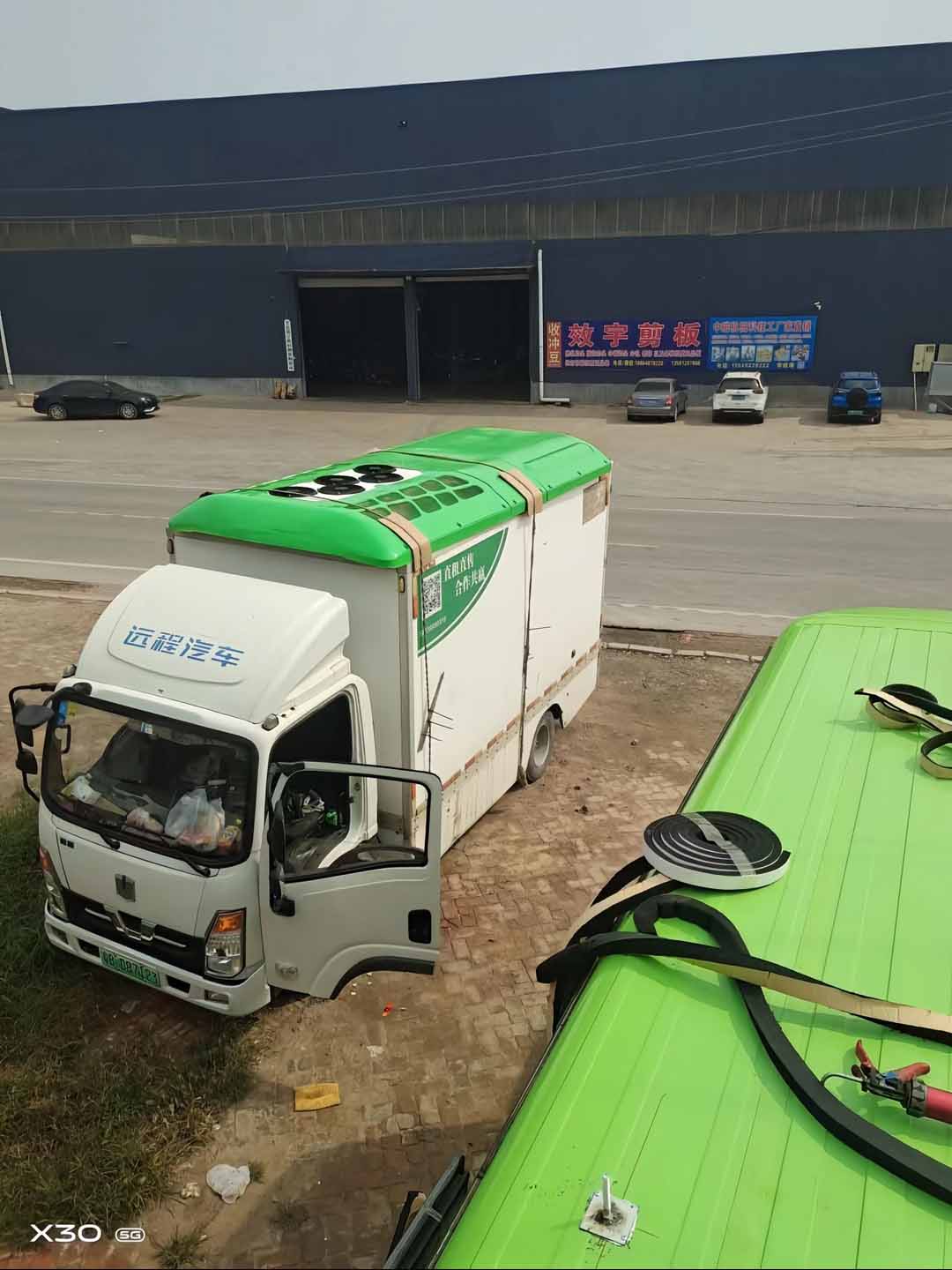
Sub-problem 2: Bus air conditioning vibration – Rigid connection and resonance of pipes and supports
Current situation: The compressor itself vibrates within a reasonable range, but this vibration is amplified after being transmitted to the passenger compartment through the connecting pipes. At certain engine speeds (vehicle speeds), this causes strong resonance in the body panels or interior trim, producing a “humming” sound. The main causes are loose pipe clamps along the vibration transmission path, direct rigid connection between the supports and the vehicle body, and aging and failure of the rubber damping pads.
Problem Analysis: A paper presented at the 2025 SAE China Technical Conference clearly states: “The attenuation of isolation effectiveness in the vibration transmission path is the main cause of soaring vibration complaints. The high-pressure air conditioning piping acts as a ‘vibration transmission line.’ If its fixed intervals are too long or the clamps do not use rubber liners, it will efficiently transmit compressor vibrations to the vehicle frame. More complexly, the piping itself may also generate bending resonance at specific frequencies under engine or road excitation.” A chief NVH engineer from an international parts supplier added: “The stiffness of rubber damping pads changes with time, temperature, and oil contamination. Once their natural frequency coincides with the excitation frequency, they will transform from vibration dampers into amplifiers.”
Conclusion: The core of repair is to “interrupt” or “attenuate” vibration transmission. The conclusion is to systematically check all air conditioning piping clamps to ensure they are tight and contain effective vibration damping pads at contact points; replace all aged, hardened, or compressed rubber damping pads (especially compressor brackets and piping hangers); for long piping, consider adding additional support points or changing their fixing positions to alter the natural frequency and avoid resonance.
Sub-problem 3: Bus air conditioning vibration – Insufficient local body stiffness and looseness
Current situation: The vibration is not continuous, but appears suddenly at specific vehicle speeds or engine RPMs, manifesting as severe shaking and abnormal noises in local components such as interior panels, dashboards, and air vents. The root cause lies in the insufficient stiffness of these components or the connected local body structures, which, under external excitation from the bus air conditioning system or the entire vehicle, are “excited” to produce local resonance.
Problem analysis: An internal technical bulletin released in 2025 by the body engineering department of a top domestic bus manufacturer analyzed: “Structural response problems are highly misleading and are often misjudged as vibration source problems. Our cases show that air vents, due to their few mounting points and the low stiffness of their plastic material, are extremely prone to becoming vibration ‘loudspeakers.’ Similarly, if the evaporator housing is only fixed by a few flexible connections, its entire structure may experience swaying modal resonance at a certain frequency.” A 2025 article in *Bus Technology and Design* recommended using a vibration exciter for modal testing to accurately locate weak points.
Problem Conclusion: The solution addresses the “response point,” not the “source point.” The conclusion is: For interior components causing abnormal noise due to vibration (such as air vents and duct panels), inspect and reinforce their mounting points, and add soft cushioning pads; for evaporator housings or large air ducts suspected of structural resonance, consider adding reinforced supports or changing their connection points to the vehicle body to alter their structural modes.
Sub-problem 4: Bus air conditioning vibration—Vehicle integration defects and condition deterioration
Current situation: Air conditioning vibration is present in new vehicles and difficult to eliminate, or the vibration problem becomes widespread and frequent after a period of vehicle operation. This points to systemic initial matching design defects, or overall condition deterioration due to long-term lack of maintenance (e.g., simultaneous aging of multiple vibration damping pads, widespread loosening of component mounting points).
Problem Analysis: A 2025 assessment report from the National Engineering Laboratory for Electric Vehicles at Beijing Institute of Technology emphasized that “in new energy buses, the coupled superposition of vibration spectra between the electric compressor and the drive motor poses a greater challenge to the overall vehicle NVH integration. If multi-source matching simulation is not fully conducted in the initial design phase, the resulting vibration problems are extremely difficult to eradicate later.” Meanwhile, a 2025 industry guidance document from an agency under the Ministry of Transport pointed out that “the lack of regular inspection and maintenance procedures for vibrating components in the air conditioning system is a major management gap leading to vibration problems escalating from small to large and from localized to systemic issues.”
Conclusion: Complex vibration problems need to be examined from the “design source” and prevented through “preventive maintenance.” The conclusion is that for generalized, design-related vibrations, systemic modifications may be necessary, such as replacing the compressor bracket assembly with one that has better stiffness matching and rearranging the routing of key pipelines. For maintenance-related issues, a regular maintenance program must be established, including “checking the torque of pipeline clamps” and “checking the condition of rubber components,” to prevent problems before they occur.
Summary of Bus Air Conditioning Vibration Repair
Bus air conditioning vibration repair is a sophisticated diagnostic process that encompasses the entire system, from source to path to impact and system performance. Effective repair must follow a clear logical chain: first, measure and locate the vibration source (compressor/blower); second, inspect and optimize the vibration transmission path (pipelines, supports, vibration damping pads); third, address the amplified local structural response (reinforce loose components); and finally, seek fundamental solutions from the perspective of system matching and maintenance. As the “2025 China Bus Vibration Analysis and Control White Paper” ultimately recommends: “Air conditioning vibration management should be viewed as a dynamic system health management process, rather than isolated fault diagnosis. By introducing data-driven vibration status monitoring and preventative maintenance, we can shift from passive repair to proactive intervention, ultimately achieving a dual improvement in passenger comfort and system reliability.”
Related posts:
 Bus Air Conditioner is used for buses and medium-sized commercial vehicles
 Bus air conditioner noise repair
 Acc Bus Air Conditioning
 Bus Air Conditioning Unit
 Bus air conditioning system maintenance
 Introduction to Ac For Bus
 Bus air conditioner not turning on: In-depth diagnostic logic
 Air Conditioner for Bus Conversion
 Diagnosis and Systematic Solutions for Bus AC Leaking Water
 Bus Air Conditioning Airflow Diagnosis and Optimization
 Bus Air Conditioning Sensor Classification and Repair
 IC Bus Air Conditioning: A Comprehensive Evolution of Integration, Intelligence, and Sustainability
 Bus AC not blowing air
 Bus Air Conditioner Troubleshooting: A Systematic Diagnosis from Climate Adaptability to Passenger Experience
 Bus air conditioner diagnostic
 Bus AC refrigerant leak: Systematic diagnosis and treatment
 Bus Con Supplier reminds all bus owners to clean BUS AC
 Bus Air Conditioner Repair Solution Development Guidelines