
Camper Air Conditioner 12V
Camper Air Conditioner 12V distributed temperature control solution is becoming a key technological path to address the challenges of large spaces and complex energy systems in buses.
With the booming market for high-end recreational and business custom buses, there is a growing demand for independent, stable, and long-lasting comfortable environments when the vehicle is parked.
Compared to traditional 24V or higher voltage systems, the 12V solution aims for deep compatibility with the vehicle’s basic electrical system, but its high-power application also presents unique engineering and technical challenges.
1. Technical Challenges and Core Configuration – Camper Air Conditioner 12V
Reason: Compatibility advantages and high current challenges coexist
The fundamental driving force lies in the direct compatibility with the electrical system. Most bus basic low-voltage electrical systems are 12V, supplying power to vehicle lighting, control systems, etc. Using a 12V rooftop air conditioning unit means that existing vehicle batteries or additional batteries can be used directly, eliminating the need for complex and expensive boost converters, simplifying the system architecture, and reducing initial modification costs and potential failure points.
The core contradiction stems from the laws of physics (P=UI). Buses have large spaces and require high cooling power. For example, a single rooftop air conditioner designed for a medium-sized bus can have a cooling capacity of 19 to 22 kilowatts. If such a high-power device is driven by 12V voltage, the system will need to carry a continuous current of over 1500 amperes. This places extremely demanding requirements on cable specifications, connectors, fuses, and batteries, leading to significant line losses, increased safety hazards, and a substantial increase in the demand for power system capacity.
Process: System Configuration and Solution Selection
To balance compatibility and power requirements, in practice, 12V Rv Ac usually adopt a “multi-unit, medium-to-low power, intelligent collaborative” configuration strategy, rather than pursuing ultra-high power in a single unit.
| Model | E-Clima2200 | E-Clima3000 | E-Clima4000 | E-Clima6000 | E-Clima8000 | E-Clima2600S |
| Voltage (V) |
DC12V/24V | DC12V/24V | DC12V/24V | DC12V/24V | DC12V/24V | DC12V/24V |
| Cooling Capacity (W/BTU) |
2200W//7500 | 3000W/10000BTU | 4000W/15000BTU | 6000W/20472BTU | 8000W/27300BTU | 2600W/78870BTU |
| Installation | Rooftop Mounted | Rooftop Mounted | Rooftop Mounted | Rooftop Mounted | Rooftop Mounted | Split Mounted |
| Evaporator Air Volume (m³/h) |
650 | 700 | 650 | 650 | 1500 | 450 |
| Condenser Air Volume (m³/h) |
1050 | 1400 | 1050 | 1700 | 3600 | 1400 |
| Refrigerant | R134a | R134a | R134a | R134a | R134a | R134a |
| Dimension (mm*mm*mm) |
700*580*263 | 885*710*290 | 700*580*263 | 1580*385*180/ 920*928*250 |
1260*1030*180 | 682*465*192 540*362*165 |
| Weight (KG) |
32 | 35 | 18/47 | 18/47 | 31 |
Key technological support includes:
High-efficiency DC inverter compressor: This is the core of making the 12V solution feasible. For example, Boyang’s 12V DC inverter compressor has a rated input power of 555W and a current of 46.3A, reducing average power consumption and current through frequency conversion adjustment.
Compact and lightweight design: To reduce the impact on roof load-bearing capacity and wind resistance, the air conditioning unit needs to adopt a compact and streamlined design. Patented technologies, such as optimizing the indoor fan position, can reduce the overall size and adapt to more vehicle models.
Intelligent power management and thermal management: The system must integrate an intelligent controller to dynamically adjust the operating strategy (such as staggered start, power limitation) based on battery power, ambient temperature, and multi-unit status to protect the power system.
Result: Formation of a customized, highly redundant temperature control network
Through the above technological path, the 12V rooftop air conditioning unit has transformed from an “impossible” idea into a feasible solution requiring highly customized engineering implementation. It ultimately builds a temperature control network that is compatible with the vehicle’s basic electrical system, has zone control capabilities, and improves system reliability through multi-unit backup. However, its successful implementation heavily relies on oversized power system components (such as ultra-large capacity lithium battery packs and ultra-low internal resistance, high-safety wiring harnesses) and sophisticated energy management strategies.
2. Deep Collaboration between Application Scenarios and Energy Systems – Camper Air Conditioner 12V
Reason: Scenarios determine configuration, and energy determines endurance.
The application scenarios for buses range from luxury travel to high-end business reception, and their air conditioning usage patterns (duration, temperature control accuracy, and noise requirements) vary significantly. The core constraint in all scenarios ultimately boils down to energy. Due to its high current characteristics, the 12V system places more stringent demands on the battery’s discharge capacity (C-rate) and capacity.
Process: Scenario-based Energy and Temperature Control Strategies
Long-distance Luxury Travel:
Requirements: Requires all-day, multi-day off-grid comfortable living, with extremely high demands on continuous air conditioning operation time and quietness.
Strategy: Must be equipped with an independent, large-capacity, high-discharge-rate 12V lithium battery pack (usually hundreds to thousands of ampere-hours), and linked with high-power vehicle charging and solar power supplementary systems. The air conditioning unit primarily uses an ultra-low power variable frequency mode, only activating peak cooling when necessary.
High-end Business Reception and Meetings:
Requirements: The vehicle serves as a mobile meeting room, requiring rapid attainment of a comfortable temperature before guests arrive, and extremely quiet operation with no direct airflow during use.
Strategy: External mains power can be used for pre-cooling/pre-heating before guests arrive. During operation, the air conditioning unit operates in a low-airflow, multi-outlet uniform air supply mode. The requirements for the continuous high-load capacity of the power system are slightly lower, but the requirements for instantaneous response and stability are high.
Specialized Vehicle Parking:
Requirements: Such as mobile command vehicles and medical testing vehicles, require air conditioning to maintain constant temperature for equipment and comfort for personnel when the vehicle is parked; reliability is the primary consideration.
Strategy: Emphasize system redundancy. Multiple 12V air conditioning units can be configured in an “N+1” backup mode. A hybrid power supply scheme of “main battery + auxiliary generator” may be used to ensure foolproof operation. Result: A Systems Engineering Approach from “Function Implementation” to “Experience Assurance”
Regardless of the scenario, a successful 12V rooftop air conditioning system application delivers not just cooling functionality, but a complete mobile environment assurance system integrating temperature control, energy management, and intelligent control. The quality of the user experience directly depends on the level of collaborative design across the entire system.
3. Target Customers and Comprehensive Value Assessment – Camper Air Conditioner 12V
Reason: The Value Logic Behind High Costs
Adopting a 12V rooftop air conditioning system, especially with the oversized power system required to meet the demands of large buses, means significant additional costs and engineering complexity. This naturally filters out customers who have a strong demand for its specific value.
Process: Customer Profile and Decision Drivers
Highly customized bus conversion companies and high-end vehicle owners: They are early adopters of technology and seekers of ultimate experiences. Their core demand is “ultimate integration while maintaining the consistency of the vehicle’s underlying electrical architecture.” They are willing to pay a premium for a high-power comfort upgrade that doesn’t disrupt the original 12V system and is “invisible,” and accept the resulting technical challenges and customization period.
Fleet operators with strict requirements for “standardization” and “simplified maintenance”: If their existing fleet is entirely based on a 12V architecture, introducing a 12V air conditioning system for new special buses (such as luxury reception vehicles) avoids the need to maintain multiple voltage standards for spare parts and training systems. The value lies in reducing long-term maintenance complexity and total cost of ownership.
Those requiring compliance under specific regulations or scenarios: In some regions or for specific uses (such as certain special vehicles modified from standard bus chassis), there may be clear restrictions or preferences regarding the voltage system of the electrical system, making the 12V solution the only or best compliant option.
Result: Clear Application Boundaries and Rational Choices
Overall, the 12V bus rooftop air conditioning system is not a general, economical solution, but a high-end customized engineering option for specific technical routes and value propositions. It provides technical possibilities for customers who consider “uniform 12V system throughout the vehicle” as one of their highest priorities, but the cost is facing and solving all the resulting power engineering challenges.
4. Summary and Outlook – Camper Air Conditioner 12V
The 12V bus rooftop air conditioning system represents an engineering approach that seeks optimal compatibility under technological limitations. Its core advantage lies in the potential for direct integration with the vehicle’s basic electrical system, while the biggest challenge stems from the high current problem at high power levels.
In the future, the development of this technology will rely more on breakthroughs at the component level: such as higher efficiency, higher power density 12V DC inverter compressors; wide-bandgap semiconductor power devices capable of handling ultra-high currents with lower losses; and new battery technologies with higher energy density and discharge rates. Simultaneously, vehicle-level intelligent energy management will become crucial, using AI algorithms to accurately predict and schedule the power consumption of all electrical appliances in the vehicle (including multiple air conditioners), becoming the last line of intelligent defense to ensure stable system operation.
Camper Air Conditioner 12V Distributed Temperature Control Solution
For decision-makers, choosing between a 12V system and upgrading to a 24V/48V system is a strategic decision that requires a comprehensive balance of initial modification costs, long-term operation and maintenance complexity, system performance limits, and reliability. In most bus applications that seek a balance between performance and efficiency, higher voltage platforms remain the more mainstream and rational choice. The 12V rooftop air conditioning system, however, is a professional solution that demonstrates engineering flexibility under specific constraints, but also clearly defines its application boundaries.
Related posts:
 Air Conditioning Units for Motorhomes: A Distributed Temperature Control System
 4 sets of Rooftop AC Units for Campers for a 15m bus
 Aircon Units For Motorhomes
 12V Camper Air Conditioner used in medicalmobile
 Modular Temperature Control Solution for Motorhomes
 RV Rooftop Air Conditioning Units, 2 stes, Golden Partner for Minibus RV
 Air Conditioning Units For Motorhomes
 12 Volt Camper Ac
 12 Volt RV Air Conditioning Units represent an energy and technological revolution
 Camper Aircon Unit – Modular Design Leads to a New Comfortable Travel
 Technical White Paper on Multi-Unit Roof AC for Campers and Buses
 15000 BTU Camper AC Multiple units
 15000 Btu Air Conditioner Rv
 15000 Btu Camper Air Conditioner
 Air Conditioning Units for RV and Minibus Air Conditioner
 Air Conditioning Units for Campers Installation Process
 Similarities between RV Camper Air Conditioner and Minibus AC
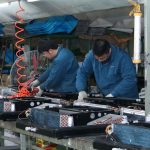 Air Conditioning for Motorhomes Manufacturing Process