
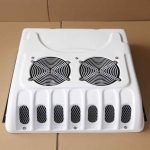
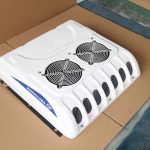
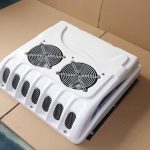
Camper Roof Ac Unit is an integrated climate control system that is directly mounted on the roof of a motorhome or campervan.
Its core design feature is the compact integration of all key components into a single waterproof housing to save interior space.
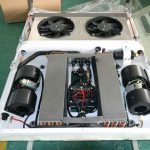
Standard components include a compressor, condenser, evaporator, centrifugal fan, and electronic control panel.
Its operating logic involves drawing in outside air through the roof grille to cool the condenser, while simultaneously drawing in air from inside the vehicle, cooling it through the evaporator, and then returning it.
This integrated design makes it the most common and standardized temperature control solution for motorhomes and travel trailers. 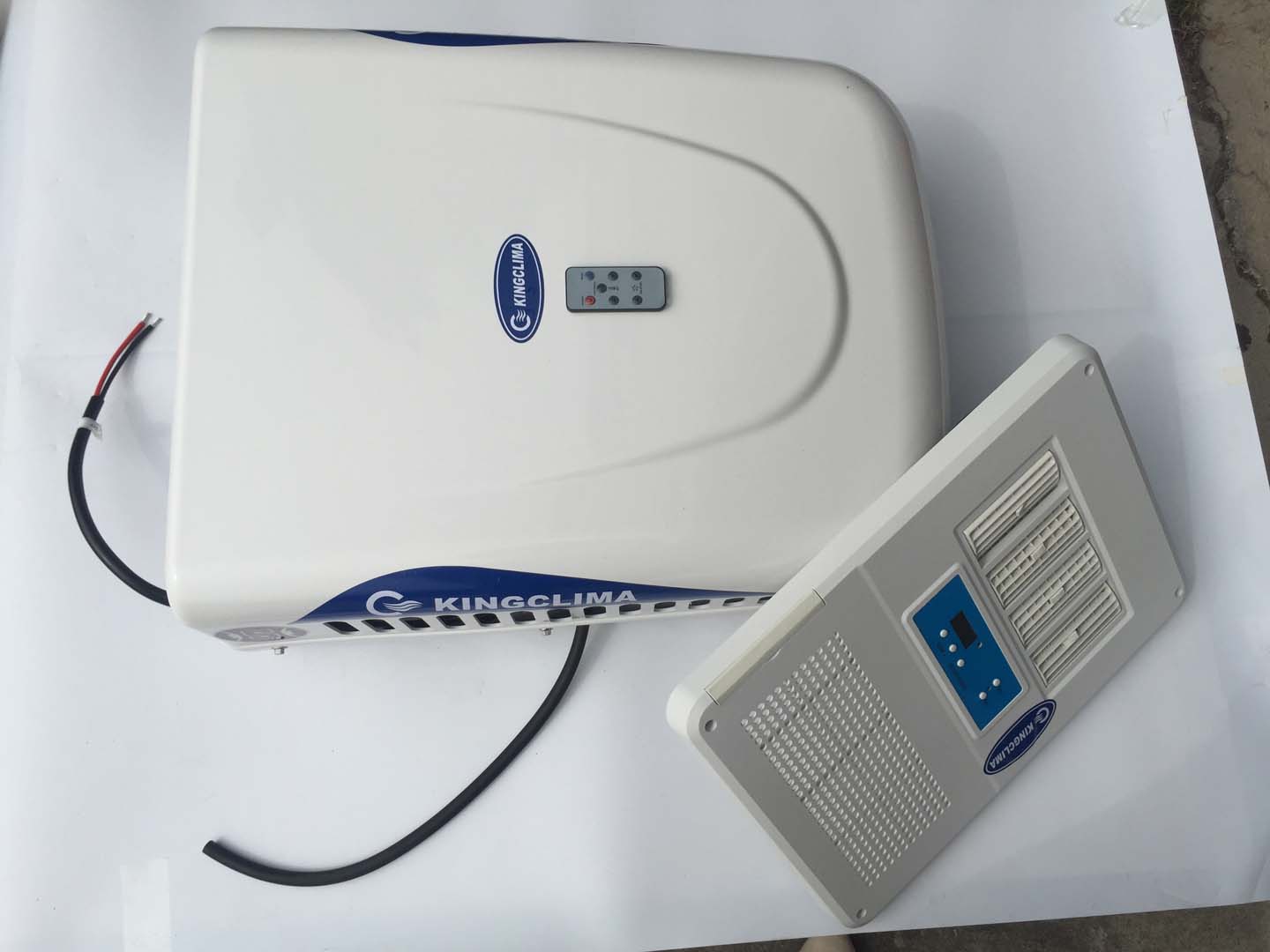
| Model | E-Clima2200 | E-Clima3000 | E-Clima4000 | E-Clima6000 | E-Clima8000 | E-Clima2600S |
| Voltage (V) |
DC12V/24V | DC12V/24V | DC12V/24V | DC12V/24V | DC12V/24V | DC12V/24V |
| Cooling Capacity (W/BTU) |
2200W//7500 | 3000W/10000BTU | 4000W/15000BTU | 6000W/20472BTU | 8000W/27300BTU | 2600W/78870BTU |
| Installation | Rooftop Mounted | Rooftop Mounted | Rooftop Mounted | Rooftop Mounted | Rooftop Mounted | Split Mounted |
| Evaporator Air Volume (m³/h) |
650 | 700 | 650 | 650 | 1500 | 450 |
| Condenser Air Volume (m³/h) |
1050 | 1400 | 1050 | 1700 | 3600 | 1400 |
| Refrigerant | R134a | R134a | R134a | R134a | R134a | R134a |
| Dimension (mm*mm*mm) |
700*580*263 | 885*710*290 | 700*580*263 | 1580*385*180/ 920*928*250 |
1260*1030*180 | 682*465*192 540*362*165 |
| Weight (KG) |
32 | 35 | 18/47 | 18/47 | 31 |
Technological Evolution and Energy Efficiency Core – Camper Roof Ac Unit
The history of rooftop air conditioning technology is a history of pursuing higher energy efficiency and lower noise.
Early fixed-frequency models used simple start-stop controls, resulting in significant compressor noise and large temperature fluctuations.
Modern mainstream models have fully adopted inverter technology, achieving smooth operation and precise temperature control by adjusting the compressor and fan speeds.
According to data from the 2025 RV Technology Yearbook, the quarterly energy efficiency ratio of the new generation of inverter rooftop air conditioners is on average more than 50% higher than that of products from ten years ago. The use of environmentally friendly refrigerants such as R32 significantly reduces the system’s potential impact on global warming while improving heat transfer efficiency.
The intelligent control module communicates with the RV’s battery management system, automatically adjusting power to protect the energy system when power is low.
Professional Installation Considerations – Camper Roof Ac Unit
The installation quality of the roof-mounted Camper Air Conditioner directly determines its performance ceiling and vehicle safety.
The installation position must be precisely aligned with the pre-reserved reinforced frame area inside the roof to ensure structural load-bearing capacity.
Professional sealing techniques require the use of matching gaskets and self-leveling sealant that meets RV standards to prevent water leakage.
Internal air ducts and roof openings must be precisely aligned; any misalignment or leakage will lead to cooling loss and reduced efficiency.
Electrical connections must use cables of the specified diameter and be equipped with independent circuit breaker overload protection to ensure safe operation under high current.
Authoritative installation manuals emphasize that post-installation drainage testing is essential; it must be confirmed that condensate can be smoothly drained to the outside of the vehicle through dedicated piping.
Maintenance and Troubleshooting – Camper Roof Ac Unit
Systematic preventative maintenance is key to ensuring the long-term reliable operation of roof-mounted air conditioners.
Monthly cleaning or replacing the return air filter is the most effective way to prevent reduced airflow and evaporator scaling.
Before each operating season, clean the roof condenser fins with a soft brush and a specialized cleaning agent to ensure optimal heat dissipation.
For long-term parking, it is recommended to use a specialized rain cover to protect the exterior casing from direct UV radiation and debris.
Listen for abnormal sounds: Early bearing wear or fan blade imbalance usually manifests first as vibrations and noise at specific frequencies.
When experiencing a decline in cooling performance, professional diagnosis should begin with measuring the system’s high and low pressures, rather than blindly adding refrigerant.
Market Trends and Future Outlook – Camper Roof Ac Unit
Roof-mounted air conditioners are evolving towards high integration, intelligent quiet operation, and energy self-adaptation.
Heat pump functionality has become standard on mid-to-high-end models, enabling efficient heating even in low-temperature environments.
Aerodynamically optimized ultra-low profile designs meet users’ urgent needs for reduced fuel consumption and wind noise. By connecting with the RV’s smart home system via a Wi-Fi module, users can remotely preset the temperature and monitor energy consumption.
The exploration of solar direct-drive technology aims to prioritize solar power generation for air conditioning, reducing the impact on battery storage.
Its future form will not only be a cooling device but also a smart core unit for overall vehicle energy management and environmental comfort.
Related posts:
 Camper Air Conditioning Unit
 Camper Air Conditioner
 Camper Ac
 Air Conditioning Units for RV and Minibus Air Conditioner
 Similarities between RV Camper Air Conditioner and Minibus AC
 Air Conditioning Units for Campers Installation Process
 Ac For RV Camper Market Analysis Report
 Air Conditioning for Motorhomes Manufacturing Process
 Small Air Conditioner for Camper
 12 Volt Air Conditioner For Rv
 Low Profile Rv Ac
 Ac For Camper and Mini Bus Ac Installation Steps
 Air Conditioner for RV Installation Steps
 Motorhome Air Conditioning and Minibus Manufacturer Matching
 Ac Unit For RV Camper: Air Conditioning System for Minibuses and Motorhomes
 Installing an RV Air Conditioner on a Minibus
 RV Air Conditioning Units to bus manufacturers in North Africa
 Ac In Camper for Minibus to Motorhome Conversion