
Camper Roof Air Conditioners continue to win over the market in minibus motorhomes with their high cost-effectiveness and flexible modification potential. The efficiency and adaptability of their parking comfort system are key to the success of any modification. The “2025 China RV Industry Development Report” clearly states that “the ‘DC-ization’ of the power system and the ‘precision’ of the thermal management system are two clear trends in the current upgrade of RV modification technology.” In this trend, the 12V DC inverter roof air conditioner is not an isolated cooling option, but a core system deeply integrated with the characteristics of the minibus platform, reshaping the energy logic of travel and living.

Optimal Solution for Electrical Architecture Compatibility and Energy Efficiency – Camper Roof Air Conditioner
The original electrical circuits of minibus chassis and the later-installed battery packs are generally based on a 12V DC system. If a traditional 220V AC air conditioner is used, it must undergo inverter boost conversion, a process accompanied by significant energy loss (typically 10%-20%), and additional stress on the battery management system.
The 12V DC inverter air conditioner achieves “direct drive from the source,” with the shortest energy path and lowest loss. Its variable frequency compressor can steplessly adjust power according to the cabin’s heat load, avoiding the high starting current surges caused by frequent start-stop cycles of fixed frequency compressors, significantly improving system stability and battery life. At the 2025 New Energy Commercial Vehicle Technology Communication Conference, Senior Engineer Chen Li pointed out: “For vehicles like minibuses with limited battery installation space, using DC direct-drive Camper Air Conditioner can improve the utilization efficiency of every precious unit of electricity by more than 25%, which is the most crucial technical path to achieving ‘off-grid comfort.'”
Choosing a 12V DC air conditioner is the most efficient solution for achieving native compatibility with the minibus’s electric system from a top-level design perspective, and is the cornerstone of ensuring energy security and range.
| Model | E-Clima2200 | E-Clima3000 | E-Clima4000 | E-Clima6000 | E-Clima8000 | E-Clima2600S |
| Voltage (V) |
DC12V/24V | DC12V/24V | DC12V/24V | DC12V/24V | DC12V/24V | DC12V/24V |
| Cooling Capacity (W/BTU) |
2200W//7500 | 3000W/10000BTU | 4000W/15000BTU | 6000W/20472BTU | 8000W/27300BTU | 2600W/78870BTU |
| Installation | Rooftop Mounted | Rooftop Mounted | Rooftop Mounted | Rooftop Mounted | Rooftop Mounted | Split Mounted |
| Evaporator Air Volume (m³/h) |
650 | 700 | 650 | 650 | 1500 | 450 |
| Condenser Air Volume (m³/h) |
1050 | 1400 | 1050 | 1700 | 3600 | 1400 |
| Refrigerant | R134a | R134a | R134a | R134a | R134a | R134a |
| Dimension (mm*mm*mm) |
700*580*263 | 885*710*290 | 700*580*263 | 1580*385*180/ 920*928*250 |
1260*1030*180 | 682*465*192 540*362*165 |
| Weight (KG) |
32 | 35 | 18/47 | 18/47 | 31 |
Installation Integration and Spatial Aesthetics Impact – Camper Roof Air Conditioner
Minibuses have a compact body structure, and the roof needs to integrate multiple devices such as solar panels and satellite antennas, making the interior vertical height particularly valuable. A bulky or poorly designed air conditioner will disrupt the roof’s streamlined appearance, increase wind noise, and encroach on interior overhead cabinet space.
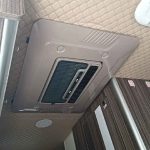
The 12V DC rooftop air conditioner, specifically designed for RVs, features a low-profile, integrated design, eliminating the need to occupy any living space within the vehicle. Following the guidelines of the “Installation and Testing Specifications for Rooftop Air Conditioners for RVs” (2025 Revised Edition), proper installation should include structural reinforcement at the roof opening and multi-layered waterproof sealing to ensure safety and durability. Its compact shape facilitates modular layout on the roof, maintaining a low drag coefficient.
Proper installation achieves an “invisible” integration of the equipment with the vehicle body, ensuring the integrity of the vehicle structure and aerodynamic performance during driving without encroaching on interior space.
Adaptability to Multiple Usage Scenarios – Camper Roof Air Conditioner
RV usage scenarios are highly dynamic, encompassing rapid cooling under the summer sun, continuous quiet operation during nighttime sleep, stable heating in high-altitude environments with significant temperature differences, and the need for temperature balance between the front and rear cabins during travel.
DC inverter technology enables the air conditioner to operate stably and continuously at power levels as low as several hundred watts, with noise levels controlled to around 40 decibels at night for deep sleep. Its wide voltage operating range and adaptive control system better cope with voltage fluctuations and complex weather conditions. Wang Man, a well-known RV lifestyle practitioner, shared in her documentary column: “The biggest change after equipping it with a 12V DC inverter air conditioner is ‘composure.’ Whether in the sweltering summer nights of the south or the cold spring and autumn of the north, it works quietly and continuously, allowing us to truly achieve ‘climate freedom,’ and our travel plans are no longer constrained by temperature.”
Through intelligent inverter technology and optimized air duct design, this product proactively adapts to all scenarios and all-weather comfort needs, from extreme climates to tranquil nights, enhancing the certainty and quality of RV living.
Core User Profile and Value Recognition – Camper Roof Air Conditioner
Phenomenon: The campervan user group exhibits a clear dual characteristic of pragmatism and exploration. They value both the daily practicality of the vehicle and the autonomy and in-depth experience of medium- and long-distance travel.
Analysis: These users are typically families with strong technical knowledge, couples seeking a simple travel lifestyle, or small and medium-sized entrepreneurs. Their equipment choices are based on in-depth research, with a strong emphasis on system reliability, energy efficiency, and long-term operating costs. An article in the 8th issue of the journal *Outdoor Equipment & Technology* in 2025 analyzes that: “Currently, mature RV consumers are shifting from ‘feature stacking’ to ‘system efficiency’ driven. They are willing to pay a premium for solutions with higher integration and lower energy consumption, essentially purchasing ‘undisturbed peaceful time’ and ‘energy confidence to extend the boundaries of exploration.'”
Conclusion: The core proponents of 12V DC inverter rooftop air conditioners are rational practitioners who view RVs as mobile homes, are proficient in energy management, and consider efficiency and tranquility as high-end luxuries. It represents a modern travel and living value that transcends material possessions, pursuing system optimization and prioritizing experience.
Camper Roof Air Conditioner Summary
The application of 12V DC inverter rooftop air conditioners in minibus RVs is a systematic decision that permeates vehicle engineering, energy management, and lifestyle aesthetics. Through the compatibility of underlying electrical logic, intelligent integration within a compact space, and precise response to complex scenarios, it fundamentally enhances the upper limit of the travel and living capabilities of minibus RVs. This is not just an equipment upgrade, but a key step towards an efficient, autonomous, and tranquil modern travel lifestyle.
Related posts:
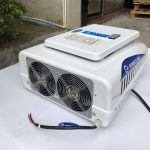 12V Ac Unit For Rv
 12 Volt Rv Ac Unit
 Small Air Conditioner For Rv
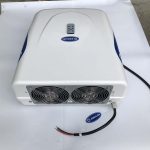 12V Rv Ac Unit
 Camper Air Conditioner
 Small Ac For Camper
 Camper Ac
 Camper Roof Ac Unit
 Best Ac For Rv
 Small Rv Ac
 Camper Air Conditioning Unit
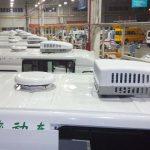 Low Profile Rv Ac Unit
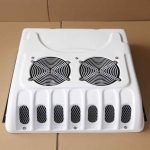 Air Conditioning Units for RV and Minibus Air Conditioner
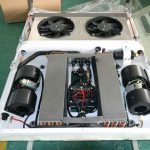 Air Conditioning Units for Campers Installation Process
 Similarities between RV Camper Air Conditioner and Minibus AC
 Air Conditioning for Motorhomes Manufacturing Process
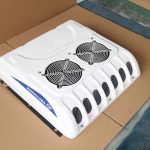 Ac For RV Camper Market Analysis Report
 Small Air Conditioner for Camper