
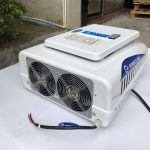
15000 BTU Camper AC
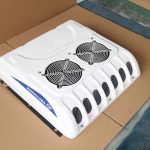
15000 BTU Camper AC Multiple units are revolutionizing temperature control in large motorhomes and buses, with distributed temperature control solutions becoming the standard for buses in the US and Europe.
In 2025, sales of recreational vehicles (RVs) in China increased by over 20% year-on-year, with a significant increase in the proportion of large motorhomes based on buses and large passenger vehicles.
Unlike compact RVs, these vehicles boast spacious interiors of 30 to 50 square meters and complex compartment layouts.
However, this vast space also presents unprecedented temperature control challenges. A single traditional vehicle air conditioner not only struggles to achieve rapid and even cooling, but its high energy consumption and noise during full-power operation seriously impact the vehicle’s battery life and living comfort.
To address this contradiction, a distributed temperature control solution integrating multiple 15000 BTU Camper AC units has become the authoritative solution in the design and modification of bus-based motorhomes. According to data disclosed at the 2025 Asia-Europe RV Modification Technology Summit, the adoption rate of this configuration in newly manufactured high-end large motorhomes has exceeded 75%.
1. 15000 BTU Camper AC Configuration Rationale: Why is a multi-unit parallel solution necessary?
Reason: Fundamental contradiction between physical space and heat load
The temperature control needs of bus-based motorhomes are fundamentally different from those of residential homes. Their interior space is usually divided into multiple independent or semi-independent areas such as the driving area, living room, bedroom, and bathroom, and there are numerous windows, resulting in a very high and unevenly distributed heat load. A 40-square-meter living area in a motorhome may have a peak heat load exceeding 45,000 BTU in summer sunlight. Relying on a single high-power air conditioner would require complex and lengthy ductwork, leading to poor cooling and high noise levels in distant rooms. Furthermore, a system failure would result in the entire vehicle losing temperature control, posing a safety risk.
Evolution: From centralized to distributed technology
Early large motorhomes attempted to use single commercial rooftop air conditioners, but the results were unsatisfactory. The industry has shifted to a distributed solution: installing independent air conditioning units in the front, middle, and rear of the vehicle roof, targeting the main living areas. Each 15000 Btu Camper Ac can efficiently cover an area of approximately 15-20 square meters. Multiple units operating in parallel not only enable “zone control,” allowing different areas to have different temperature settings, but also provide system redundancy—even if one unit fails, the remaining air conditioners can still maintain basic comfort. This solution was recognized by several modification experts at the 2025 World Motorhome Expo (Düsseldorf, Germany) as the “cornerstone of comfort in large motorhomes.”
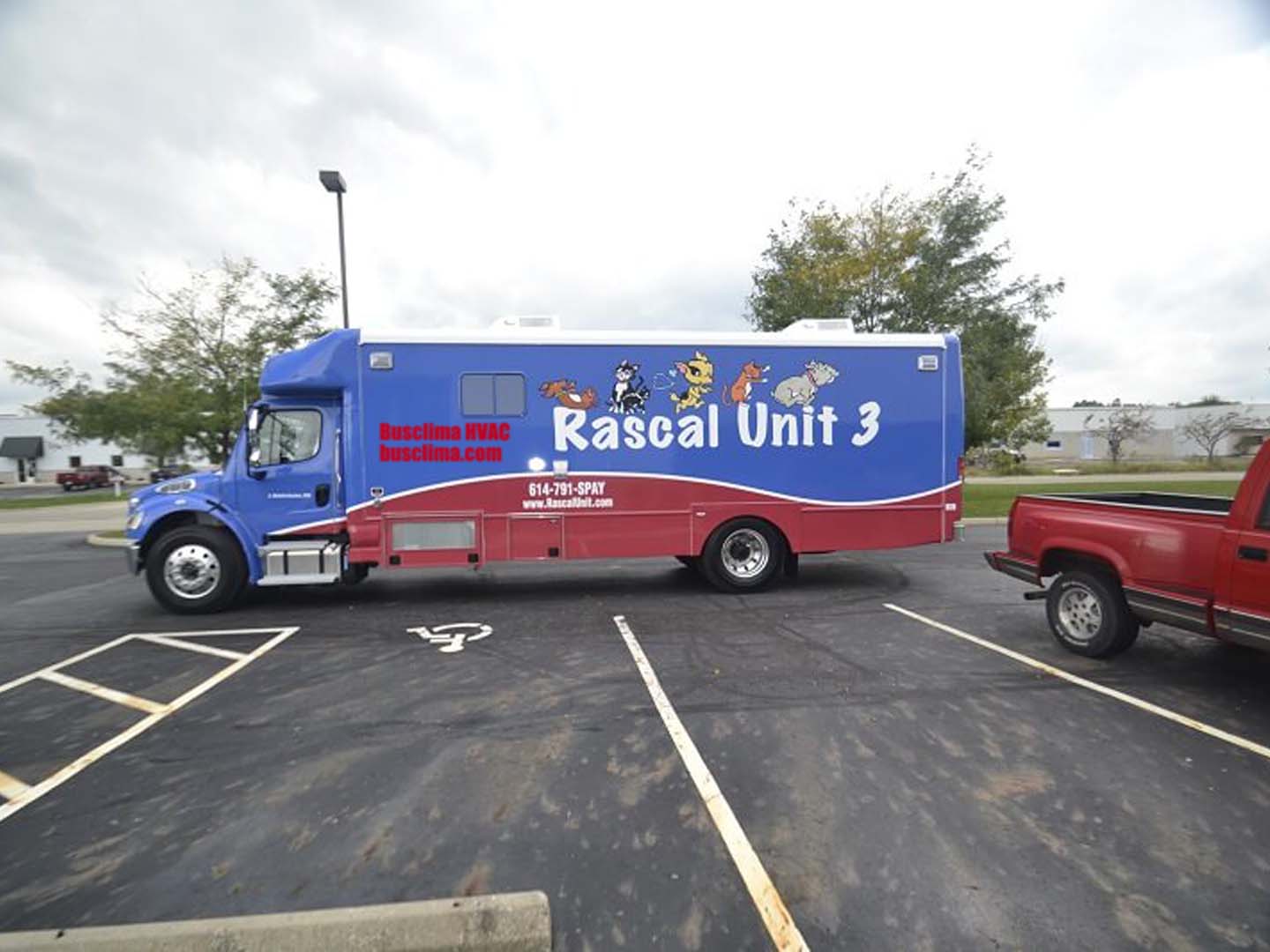
Result: Precise, flexible, and reliable temperature control experience
With multiple air conditioners, users can set the bedroom to a cool sleeping temperature while maintaining a comfortable temperature in the living room. According to the “2025 China RV User Comfort White Paper” survey, user satisfaction with the zone temperature control solution is 34% higher than with traditional solutions. Cooling speed is also significantly improved, able to reduce the entire vehicle’s temperature from extreme heat to a comfortable range within 10-15 minutes after boarding.
2. 15000 BTU Camper AC Core Parameter Analysis: Key Performance Dimensions of the 15000 BTU Air Conditioner
Reason: Performance indicators directly determine feasibility and experience
Choosing a 15,000 BTU air conditioner suitable for a bus-based motorhome requires more than just considering cooling capacity. Power consumption, energy efficiency, noise, extreme environment adaptability, and installation compatibility all determine the success of the solution.
Process: In-depth analysis of key parameters
| Model | E-Clima2200 | E-Clima3000 | E-Clima4000 | E-Clima6000 | E-Clima8000 | E-Clima2600S |
| Voltage (V) |
DC12V/24V | DC12V/24V | DC12V/24V | DC12V/24V | DC12V/24V | DC12V/24V |
| Cooling Capacity (W/BTU) |
2200W//7500 | 3000W/10000BTU | 4000W/15000BTU | 6000W/20472BTU | 8000W/27300BTU | 2600W/78870BTU |
| Installation | Rooftop Mounted | Rooftop Mounted | Rooftop Mounted | Rooftop Mounted | Rooftop Mounted | Split Mounted |
| Evaporator Air Volume (m³/h) |
650 | 700 | 650 | 650 | 1500 | 450 |
| Condenser Air Volume (m³/h) |
1050 | 1400 | 1050 | 1700 | 3600 | 1400 |
| Refrigerant | R134a | R134a | R134a | R134a | R134a | R134a |
| Dimension (mm*mm*mm) |
700*580*263 | 885*710*290 | 700*580*263 | 1580*385*180/ 920*928*250 |
1260*1030*180 | 682*465*192 540*362*165 |
| Weight (KG) |
32 | 35 | 18/47 | 18/47 | 31 |
Result: Formation of rigorous selection standards
Li Zhenfeng, a senior modification engineer in the industry, pointed out: “For bus-based motorhome projects, every air conditioner we choose must have a ‘perfect score.’ Especially the combination of low current and high energy efficiency directly determines the capacity of the lithium battery pack and solar panels we need to equip, which is the source of the entire vehicle’s energy system design.”
3. 15000 BTU Camper AC System Integration Solution: Synergy of Energy, Control, and Installation
Reason: Multiple units are not simply added together, but a system engineering
Integrating multiple high-performance air conditioners into a bus-based motorhome, a mobile “micro-grid,” involves complex energy matching, intelligent control, and structural adaptation.
Process: A three-in-one integration practice
Energy system matching: This is the most critical link. Taking three air conditioners as an example, if they are all cooling simultaneously, the peak current can reach 42 amperes (at 115V). Considering other household appliances, the inverter’s continuous output power is recommended to be no less than 8000 watts. The battery pack capacity typically needs to be 30-40 kilowatt-hours or more, coupled with a solar panel array of over 3000 watts, to support long-term use without external power. The internationally renowned RV manufacturer Winnebago has already deeply integrated a 48V lithium battery system with inverter air conditioning in its 2025 large RVs, achieving intelligent dynamic energy consumption adjustment.
Smart Control Integration: Modern solutions abandon the practice of equipping each air conditioner with a separate remote control. Instead, a central touch panel or mobile app is used to uniformly control the mode, temperature, and fan speed of all air conditioners. The system can be set to various scenarios such as “away mode” (all air conditioners operate at low power), and “sleep mode” (bedroom air conditioner operates silently, living room air conditioner is off).
Installation and Structural Adaptation: The roof of a bus is not perfectly flat, and space needs to be reserved for solar panels, satellite antennas, etc. Custom brackets are required during installation to ensure the outdoor unit of the air conditioner is stable and level, and strict waterproofing and sealing are essential. Ducted installation requires professional design of the air ducts to ensure balanced airflow at each outlet.
Result: Achieving a stable and comfortable system where “1+1>2”
Through systematic integration, multiple air conditioners are transformed from independently operating devices into a collaborative smart temperature control network. Users receive a seamless, convenient, stable, and energy-efficient overall comfort experience, rather than the cumbersome management of multiple devices.
4. 15000 Btu Camper AC Target Customers and Value Proposition: Who is it for? Why is it worthwhile?
Reason: Clear High-End Market Demand
This solution is expensive, and its target customer profile is clear: serious travelers seeking the ultimate long-distance travel experience, high-end custom RV rental companies, and business users who need mobile offices or display spaces.
Process: Value Calculation Behind the High Investment
The cost of modifying a system with three high-quality 15000 BTU air conditioners and integrated system can be as high as 100,000-200,000 RMB. However, the value it creates is comprehensive:
Comfort Value: The interior maintains a consistently pleasant temperature and fresh air in any climate, enhancing the overall travel experience.
Range Value: High-efficiency air conditioning significantly reduces power consumption, extending off-grid parking time in the wilderness and expanding travel possibilities.
Asset Value: Large RVs equipped with top-tier temperature control systems retain significantly higher resale value in the used market.
Commercial Value: For rental or business use, a stable and comfortable environment is key to winning customer satisfaction.
Result: Becoming the “value anchor” for high-end large RVs
As a sales director of a certain brand stated at the 2025 Shanghai International RV Show: “Today’s high-end customers are not just buying a vehicle, but a reliable, free, and comfortable lifestyle. The quiet and efficient air conditioners on our roof, and the powerful energy system, are the most powerful physical guarantee of this promise.”
5. 15000 Btu Camper AC Maintenance and Future Outlook: Sustainable Cooling
Reason: Ensuring the long-term reliability of complex systems
Multiple systems mean more potential maintenance points; regular maintenance is essential for long-term stable operation.
Process: Standardized Maintenance Procedures
It is recommended that before each quarter or long-distance trip: clean or replace the indoor air filters of each air conditioner; check if the outdoor unit radiator is blocked by dust or debris; listen for any abnormal noise or vibration from each unit. At the same time, the operating current of each unit should be checked through the system controller to detect potential problems early.
Outlook: The Future of Technological Integration
In the future, the temperature control system of bus-type RVs will be more deeply integrated with the overall vehicle intelligence. Using IoT technology, the air conditioning system can predict the climate based on GPS location and adjust automatically; it can also link with the battery management system to automatically enter ultra-energy-saving mode when power is insufficient. The continuous improvement of the conversion efficiency of renewable energy (such as solar energy) will further support the multi-air conditioning system to achieve true “energy freedom”.
15000 Btu Camper AC Conclusion
For bus-type RVs that pursue a “mobile castle” experience, the distributed temperature control solution using multiple 15000 BTU air conditioners has evolved from a luxury option to a technological necessity for solving fundamental problems. It represents a profound shift in the large RV market, from addressing basic needs to pursuing quality, and is the culmination of engineering ingenuity and a philosophy of comfortable living, leading the future trend of high-end travel and leisure.
Related posts:
 15000 Btu Air Conditioner Rv
 12 Volt Camper Ac
 12V Camper Air Conditioner used in medicalmobile
 15000 Btu Camper Air Conditioner
 Air Conditioning Units for RV and Minibus Air Conditioner
 Air Conditioning Units for Campers Installation Process
 Air Conditioning for Motorhomes Manufacturing Process
 Similarities between RV Camper Air Conditioner and Minibus AC
 Ac For RV Camper Market Analysis Report
 Camper Air Conditioner
 Camper Ac
 12V Air Conditioner For Motorhome
 Motorhome Rooftop Air Conditioners
 Small Air Conditioner For Rv
 Camper Roof Air Conditioner
 12V Ac Unit For Rv
 12V Camper Ac
 12 Volt Rv Ac Unit
 Spanish
  English