
As global public transportation and long-distance passenger transport transition towards electrification and intelligentization, vehicle energy efficiency and passenger comfort have become core competitive advantages. Against this backdrop, the choice of technology path for Motorhome Roof Ac, a major consumer of vehicle energy, is particularly crucial. According to the “Technical Roadmap for Commercial Vehicle Thermal Management Systems” released by the China Society of Automotive Engineers in 2024, improving the integration of air conditioning energy efficiency and vehicle thermal management is one of the core links in achieving the “dual carbon” goal in the transportation sector. Multiple roof-mounted air conditioning units, with their unique design and high efficiency, are becoming a mainstream technological solution to address these challenges and drive industry upgrades.
I. Motorhome Roof Ac Core Parameters: Defining the Underlying Logic of System Performance
Reason: Traditional single high-power air conditioning units in buses suffer from energy waste (“overpowered engine for underpowered vehicle”), uneven heating and cooling, and a high risk of single-point failure. With vehicle electrification, air conditioning energy consumption directly impacts battery power, placing unprecedented demands on the system’s precise temperature control, lightweight design, and high energy efficiency.
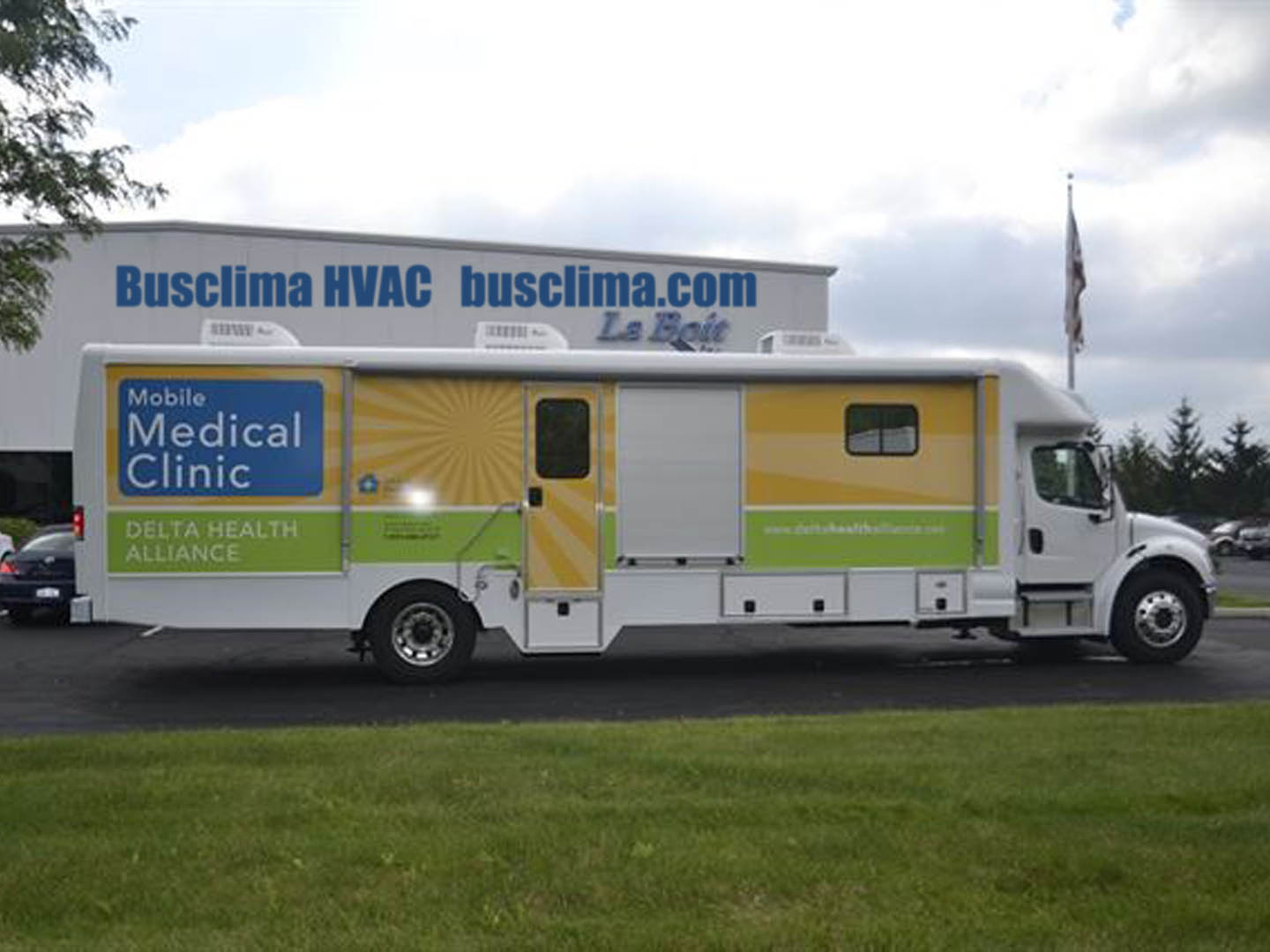
Process: The technical specifications of multiple roof-mounted air conditioning units are built around modularity and high efficiency. Taking a typical Toyota Coaster rooftop air conditioner as an example, its core parameters represent the current mainstream level in the industry: It adopts a high-capacity cooling system design, ensuring rapid cooling in scenarios with high comfort requirements, such as business receptions. To achieve energy conservation, its heat pump system achieves a heating efficiency ratio of 3.0, and its operating temperature limit exceeds -20℃, significantly reducing reliance on high-power electric auxiliary heating in winter. In terms of integration, the system adopts a modular design and lightweight design, facilitating installation and maintenance and reducing vehicle weight. More importantly, it can integrate with the battery thermal management system, using technologies such as dual electronic expansion valves to collaboratively manage battery and cabin temperatures, which is estimated to extend the vehicle’s range by more than 10%.
Result: These parameters collectively define a highly efficient, reliable, and intelligent temperature control system. It is no longer an isolated cooling component, but a core intelligent node in the vehicle’s thermal management network, meeting the stringent standards of energy consumption and comfort for new energy commercial vehicles through refined and scalable control of cooling output.
II. Motorhome Roof Ac Use Cases: Precisely Matching Diverse Operational Needs
Reason: Commercial vehicle operation scenarios are highly complex, ranging from frequent starts and stops and peak-hour overloading in urban public transport, to continuous operation and cross-temperature-difference regions in long-distance passenger transport, and the quiet and comfortable requirements of high-end business receptions. These scenarios present differentiated challenges to the load response speed, reliability, and user experience of air conditioning systems.
Process: The flexibility of multiple roof-mounted units allows for precise adaptation to various scenarios. In urban public transport and group commuting scenarios, multiple units can be independently started and stopped in zones and at different times based on real-time passenger flow sensor data. During off-peak hours, only some modules operate, achieving “on-demand cooling” and avoiding energy waste. For long-distance passenger transport and tourist charter buses, the system needs to ensure reliability and uniform temperature throughout the cabin over extended periods. The modular design provides natural redundancy; a single unit failure does not affect the overall system operation, meeting the rigid requirements of the passenger transport industry for attendance rates. In the high-end business reception sector, such as the conversion of Coaster models, there are extreme demands for large cooling capacity, rapid cooling, low operating noise, and intelligent temperature control. The compact design and efficient system of the rooftop unit quickly create a comfortable environment, and the intelligent control system can preset multiple comfort modes.
Result: Therefore, the rooftop multi-unit air conditioner has evolved from a “standardized component” into a deeply customizable scenario-based thermal management solution. Through adjustments to hardware and software configurations, it directly serves the core needs of different operating models—improving energy efficiency, ensuring reliability, or optimizing the user experience.
III. Motorhome Roof Ac Product Advantages: Building a Full Lifecycle Value Barrier
Reason: Operators’ procurement decisions have shifted from initial cost-oriented to a comprehensive consideration of total cost of ownership (TCO), vehicle availability, and brand value. Air conditioning systems need to demonstrate their long-term value.
Process: The advantages of this technology are reflected in three dimensions: economy, reliability, and intelligence. In terms of economy, the high-efficiency heat pump and precise control technology directly reduce air conditioning energy consumption by up to 30%, which translates to a significant increase in range for electric buses. The modular structure reduces maintenance complexity and spare parts inventory costs. In terms of reliability, the physically distributed multi-unit layout avoids the failure of the entire vehicle’s air conditioning system due to a single point of failure, significantly improving system availability. In terms of intelligence, the system integrates expert self-diagnostic functions, enabling early warning of faults and guidance for maintenance. As industry experts pointed out at the 2025 China EV100 Forum, “The key to competition in the next generation of commercial vehicles lies in transforming energy management from ‘passive adaptation’ to ‘proactive prediction and optimization.'” The rooftop multi-unit system is precisely the practical embodiment of this concept.
Result: The combination of these advantages transforms the rooftop multi-unit air conditioning system from a purely “cost center” into a value creation center that helps operators reduce TCO and enhance service competitiveness, achieving a win-win situation for both operational efficiency and passenger experience.
Related posts:
 Air Conditioning Units for Motorhomes: A Distributed Temperature Control System
 Technical White Paper on Multi-Unit Roof AC for Campers and Buses
 Bus Air Conditioner is used for buses and medium-sized commercial vehicles
 4 sets of Rooftop AC Units for Campers for a 15m bus
 12 Volt RV Air Conditioning Units represent an energy and technological revolution
 12V Rv Air Conditioning Units
 Motorhome Aircon 12V
 Camper Aircon Unit – Modular Design Leads to a New Comfortable Travel
 Camper Rooftop Air Conditioning Units
 Acc Bus Air Conditioning
 RV Rooftop Air Conditioning Units, 2 stes, Golden Partner for Minibus RV
 12 Volt Dc Rv Air Conditioner
 Best Rv Air Conditioner
 Modular Temperature Control Solution for Motorhomes
 12 Volt Rv Air Conditioner
 Motorhome Roof Air Conditioner
 Aircon Units For Motorhomes
 Motorhome Rooftop Air Conditioners
 Spanish
  English