
Travel Trailer Air Conditioners are a very mainstream and common choice. Compared to motorhomes, trailer-mounted caravans have their own unique advantages, disadvantages, and installation considerations.
Advantages of Travel Trailer Air Conditioners
Good Structural Compatibility – Most mass-produced trailer-mounted caravans are designed and manufactured with pre-installed mounting locations and reinforcement structures for roof-mounted air conditioners. The roof is usually flat, making the installation and installation process much more standardized and safer than modifying a minibus.
No Concerns about Center of Gravity and Passability – Trailers are not driven, and the slightly higher center of gravity has a far less impact on stability than motorhomes. The vehicle height is usually fixed, and installing a roof-mounted air conditioner does not introduce additional height restriction risks (as this is already factored in at the factory).
Relatively Simple Power Supply – Once connected to the mains power at a campsite, the trailer can directly power the roof-mounted air conditioner, without the need to worry about battery consumption during driving like with motorhomes (although a powerful battery system is still required for offline camping). Easy Maintenance and Replacement – As a standardized component, repair or complete replacement is relatively easy in case of failure.
busclima@kingclima.com
| Model | KK-30 | KK-50 | KK-100 | KK-120 | KK-140 | |
| Cooling Capacity | 3KW/10300BTU | 5KW/17166 | 10KW/34121 | 12Kw/42000BTU | 14KW/48000BTU | |
| Voltage | DC12V/24V | DC12V/24V | DC12V/24V | DC12V/24V | DC12V/24V | |
| Driven Type | Engine Driven | Engine Driven | Engine Driven | Engine Driven | Engine Driven | |
| Installation | Rooftop | Rooftop | Rooftop | Rooftop | Rooftop | |
| Condenser | Fan Qty | 1 | 2 | 2 | 2 | 2 |
| Air Flow Volume | 600m³/h | 680m³/h | 3800m³/h | 3200m³/h | 3800m³/h | |
| Evaporator | Blower Qty | 1 | 1 | 2 | 2 | 4 |
| Air Flow Volume | 750m³/h | 850m³/h | 2000m³/h | 2000m³/h | 2000m³/h | |
| Condenser Fan | Axial Flow | Axial Flow | Double axle and centrifugal flow | Double axle and centrifugal flow | Double axle and centrifugal flow | |
| Compressor | KC 5H14, 138cc/r | 5H14, 138cc/r | HL22, 212cc/r | Valeo TM21, 215 cc/r | HL32, 313cc/r | |
| Refrigerant | R134a, 0.8KG | R134a, 0.9KG | R134a | R134a | R134a | |
| Dimensions (mm) | 750*680*196mm | 755*745*190 | 1010*975*180 | 1660*1240*210 | 1520*1100*175 | |
| Application Vehicles | Rv Camper Motorhomes & Minibus | Rv Camper Motorhomes & Minibus | 6-6.5m minibus or caravans | 6-6.5m minibus or caravans | 6-6.5m minibus or caravans | |
Challenges and Considerations for Travel Trailer Air Conditioners in Southeast Asian Environments
High Temperature Exposure and Efficiency Degradation (Core Issue) – Trailers parked for extended periods in unshaded campsites have their roofs completely exposed to the scorching sun, creating extremely harsh conditions for the air conditioner’s outdoor unit to dissipate heat. A model specifically designed for high-temperature environments with excellent heat dissipation performance must be chosen.
Heavy Rain and Sealing – While original installation is more reliable, sealing is still crucial. Southeast Asian torrential rains test any seams, requiring the use of high-quality sealant and proper installation.
Electric System Configuration (Off-Power Camping) – If you want to use the air conditioner in the wilderness without external power, the requirements for the battery, inverter, and solar system are extremely high. Trailer campers typically have a larger roof area for solar panels, which is an advantage.
Vibration and Wind Resistance During Transport – Trailers experience significant vibration when towed on rough terrain. All internal screws and wiring must be securely fastened to prevent loosening.
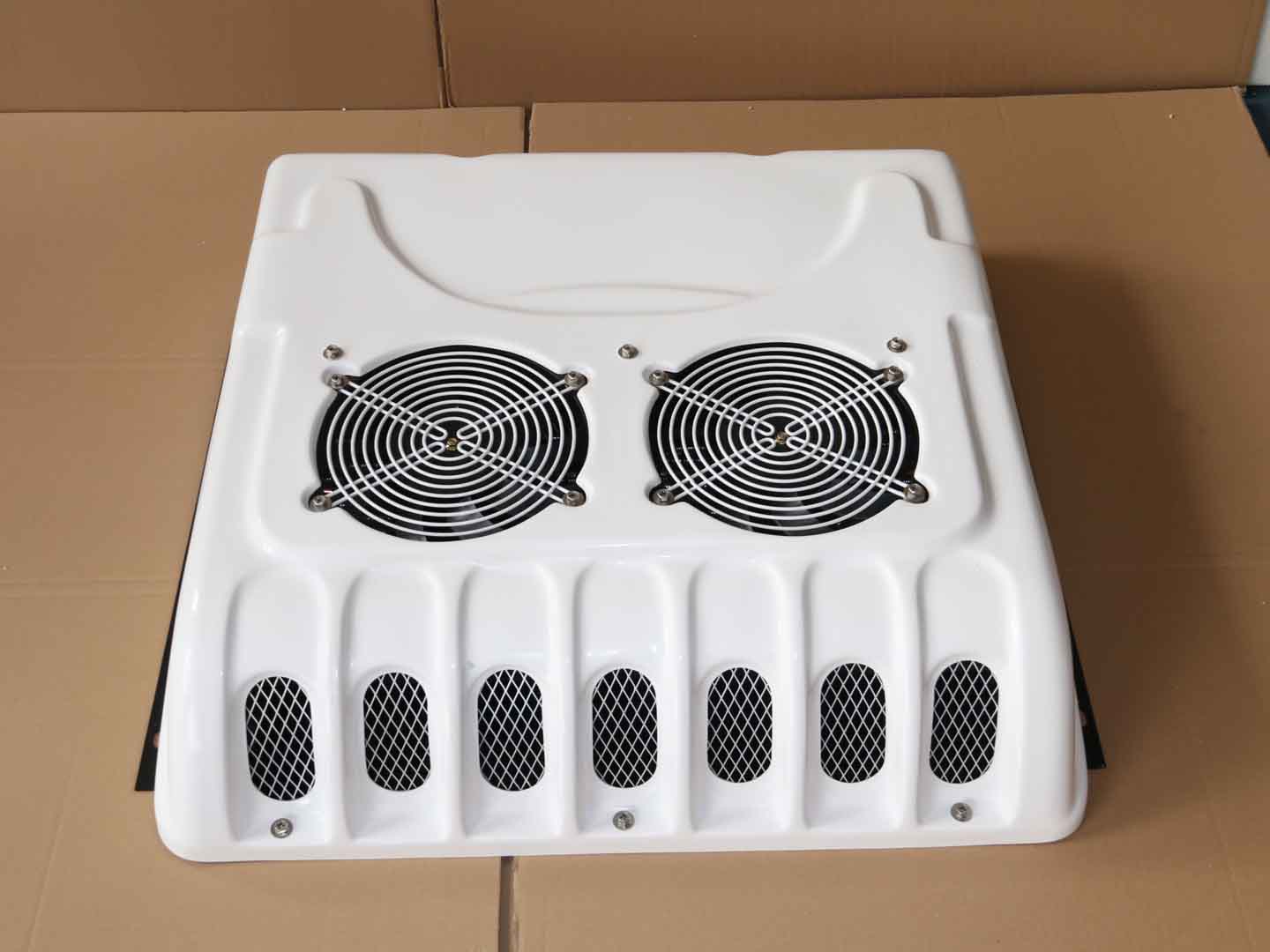
For trailer-mounted motorhomes used in Southeast Asia, installing a Travel Trailer Air Conditioner is a perfectly feasible and mainstream option, but it must be optimized “according to local conditions,” prioritizing installation in the factory-pre-installed mounting spaces.
Choose a motorhome-specific rooftop air conditioner model that is heat-resistant, has a high cooling capacity, and is energy-efficient.
Ensure the installation is reinforced and waterproofed to the highest standard, and seek out an experienced motorhome service provider for the installation.
If your usage scenario includes a significant amount of camping without external power, be sure to invest heavily in building a robust “lithium battery + high-power solar panel + high-power inverter” power ecosystem. Otherwise, your air conditioner will be useless after leaving the campsite.
If you have extremely high requirements for quiet operation and a sufficient budget, consider a floor-mounted air conditioner as a more advanced solution.
Finally, it is recommended that you consult local Southeast Asian motorhome forums or owner communities to learn about the brands and models commonly used by local motorhome owners, as well as their recommended installation service providers. This localized information is often the most valuable.


 Spanish
  English