
Van Air Conditioner is a comprehensive decision involving engineering, energy, and lifestyle philosophy.
The compact size of a van and the limitations of its electrical system make air conditioning selection crucial for balancing comfort and survival.
This article breaks down the topic into four core dimensions, each following a logical chain of “problem-evidence-conclusion,” and citing the latest industry data and authoritative opinions to build a clear decision-making framework for you.
Dimension 1: Electrical Architecture and Energy Management – The “Survival Foundation” of Air Conditioning Systems
Problem
How can a van’s limited electrical system support the continuous operation of an energy-guzzling air conditioner? Is this a prerequisite for choosing an air conditioner unit?
Evidence
1. Industry Data: According to the “2025 China Vanlife Energy White Paper,” over 65% of van users cite “summer air conditioning battery anxiety” as their primary concern for long-distance travel. Without an external power source, a traditional fixed-frequency air conditioner can deplete its common 600Ah lithium battery system within 2-3 hours.
2. Technical Report: At the 2025 North American RV Retrofit Technology Summit, energy expert Dr. Lisa Wang, in her keynote speech “Mobile Living in a Microgrid,” pointed out: “For vans, the coefficient of performance (COP) of air conditioning takes precedence over its absolute cooling capacity. DC inverter technology is not only a matter of comfort, but also a matter of energy survival. Every 1% increase in the DC conversion efficiency of the system means a considerable extension of parking time for vans that rely on solar power.”
3. Product Evolution: Since 2024, mainstream van air conditioner manufacturers such as Dometic and Truma have shifted their R&D focus to “low starting current” and “wide voltage operating range” to better adapt to lithium battery systems and on-the-go charging scenarios.
Conclusion: The first step in choosing a van air conditioner must be to assess and upgrade your electrical system. The conclusion is: DC inverter air conditioning is almost the only viable energy-friendly option for vans. You must calculate and configure sufficient battery capacity (lithium battery recommended) and solar panel power based on the rated and continuous power consumption of the air conditioner you plan to purchase. Discussing air conditioning performance without considering the electrical infrastructure is like trying to draw water from a dry well.
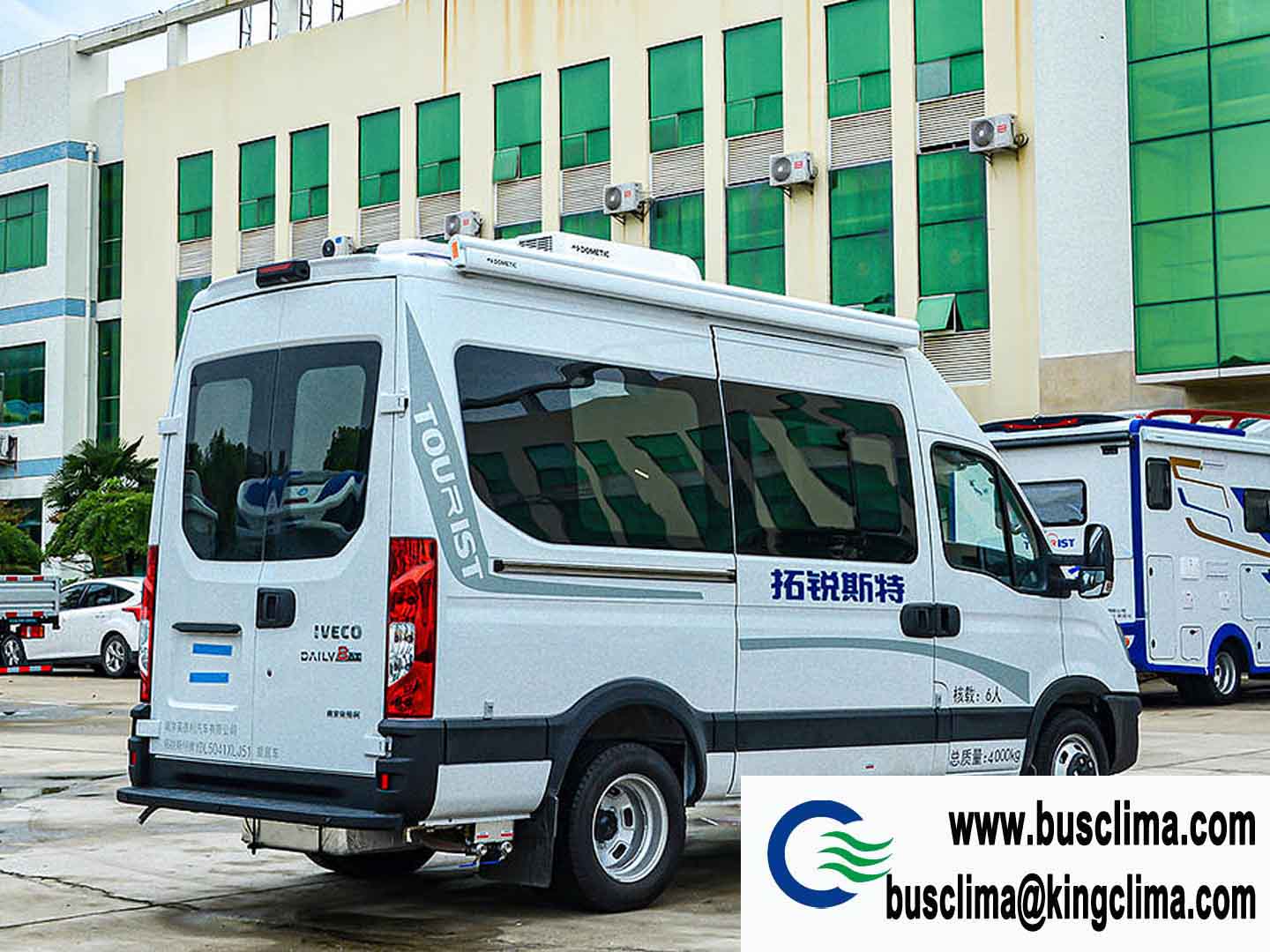
Dimension Two: Spatial Characteristics and Installation Methods – The “Physical Constraints” of Comfort
Question
How do the compact, irregular spaces of a van and the limited load-bearing capacity of the roof affect the choice of air conditioning type and the final comfort effect?
Evidence:
1. Test Report: In its first comparative test in 2025, the European outdoor vehicle testing organization *Camp & Van* placed three mainstream van air conditioners (roof-mounted integrated, split, and floor-mounted) in the same high-roof Sprinter for testing. The results showed that the split air conditioner scored highest in the overall evaluation of temperature uniformity, noise level, and space intrusion. Its design, placing the compressor outside the vehicle and leaving only the evaporator inside, isolates the main sources of noise and vibration.
2. Authoritative Opinion: Renowned van modification designer Mark Jansen wrote in his column, “In a van, every inch of space and every kilogram of weight must be carefully calculated. Rooftop air conditioners sacrifice valuable roof storage or solar panel space and introduce wind resistance and a higher center of gravity. Split-type air conditioners can cleverly integrate their indoor units above cabinets or under seats, offering greater concealment and efficiency.”
3. Safety Regulations: According to the 2024 updated “Technical Guidelines for Motor Vehicle Modification Safety,” the weight and drag coefficient of roof-mounted equipment in vans are explicitly emphasized; improper installation may affect driving stability.
Conclusion: For most mid-sized vans (such as the Sprinter, Transit, and V-Class), split-type DC inverter air conditioners are the optimal solution overall. They achieve the best balance in space utilization, quietness, and cooling efficiency. For small vans (such as the NV200) or users who extremely prioritize a low center of gravity and roof freedom, ultra-compact rooftop inverter or floor-mounted air conditioners can be considered alternatives, but compromises in noise or foot space intrusion must be accepted.
Dimension Three: Usage Scenarios and Climate Challenges – A Real-World Test of System Performance
Question:
How do your travel destination’s climate and parking habits determine your specific needs for air conditioning dehumidification, heating, and performance in extreme weather?
Evidence
1. Climate Research: The China Meteorological Service Association, in its “2025 Self-Driving Tour Climate Adaptability Index Report,” listed “sultry summers in the Yangtze River Basin” and “dark diurnal temperature variations in the Northwest Plateau” as two major climate challenges faced by Van users. The report points out that in high-humidity environments, the latent heat (dehumidification) processing capacity of air conditioners is as important as their sensible heat (cooling) capacity.
2. User Survey: A 2025 survey of experienced users by *Vanlife Global* magazine showed that users who frequently travel in rainy areas such as Yunnan, Guizhou, and Sichuan gave extremely high weight to the “independent dehumidification mode” and “anti-mold circulation” functions of their air conditioners. Users who mainly operate in dry areas, however, focused more on rapid cooling and heating efficiency.
3. Expert Advice: Experienced van adventurer “Wilderness Traveler,” sharing his experience traversing the Amazon rainforest, emphasized: “Here, a van air conditioner is not just a cooling device, but also a core survival tool to protect electronic equipment and prevent clothing from getting moldy. I chose a model with a powerful dehumidification mode and an antibacterial coating.”
Conclusion: Your travel itinerary directly defines the performance focus of your air conditioner. Users who frequently travel in humid southern regions must choose an air conditioner model with a powerful independent dehumidification function and internal anti-mold design. Users traveling in northern or high-altitude areas, and also considering spring and autumn travel, should choose a dual-purpose (cooling and heating) model, paying attention to its heating efficiency at around zero degrees Celsius. For users planning to challenge extreme high temperatures (such as in the desert), it is necessary to choose an air conditioner with at least 20%-30% cooling capacity redundancy.
Dimension Four: User Profile and Comfort Philosophy – The “Personalized Definition” of Experience
Question
As a user, how do you ultimately determine the specific model based on your personalized requirements for “quietness,” “air quality,” and “ease of operation”?
Evidence
1. Market Analysis: The 2025 Global Outdoor Recreation Electronics Consumer Trends report indicates a clear “refined” market segment within the Vanlife consumer group. This group is 45% more willing to pay for features like “quiet night mode” (typically referring to operating noise below 40 decibels) and “remote control via mobile app” for air conditioners compared to traditional camping groups.
2. Health Concerns: The World Health Organization (WHO), in its 2024 Updated Guidelines for Indoor Air Quality, emphasized the risks of prolonged exposure to air pollution in enclosed spaces. This has prompted Van Air Conditioner to highlight HEPA filtration, air quality sensors, and automatic ventilation as new selling points. 3. Design Philosophy: Ella Song, a leading figure in Van culture and a designer, stated in an interview: “A Van is a mobile home, and the core of a home is livability. For me, an air conditioner that is so quiet I forget it exists and brings in mountain-like fresh air is far more important than how low it can lower the temperature.”
Conclusion: After meeting all the aforementioned hard requirements, the final choice should return to personal preference: Digital nomads who are extremely sensitive to noise or light sleepers should prioritize “lowest operating decibel level”; families with young children, pets, or allergy sufferers should prioritize models with high-efficiency air filtration systems; users seeking technological convenience can choose products that support smart ecosystem integration. At this point, comfort transcends technical parameters and becomes a personalized living experience.
Ultimate Conclusion: System Integration, Not Component Purchase
In conclusion, choosing the best air conditioner for a Van is a decision-making journey that starts from “electrical infrastructure,” traverses “spatial physical constraints,” withstands “external climate tests,” and ultimately arrives at a “personal philosophy of comfort.” It’s not just about selecting isolated products, but a comprehensive review of your entire Vanlife system—including energy, space, travel, and personal habits.
The ultimate answer points to an integrated solution: a high-performance DC inverter split-type air conditioner deeply integrated with a precisely calculated, redundant lithium battery and solar power system. In this system, the air conditioner is no longer a consumer of electricity, but a smartly managed, highly efficient core comfort unit within the entire mobile microgrid. Only in this way can you always have a comfortable and cool haven while traveling the world.

 Spanish
  English