
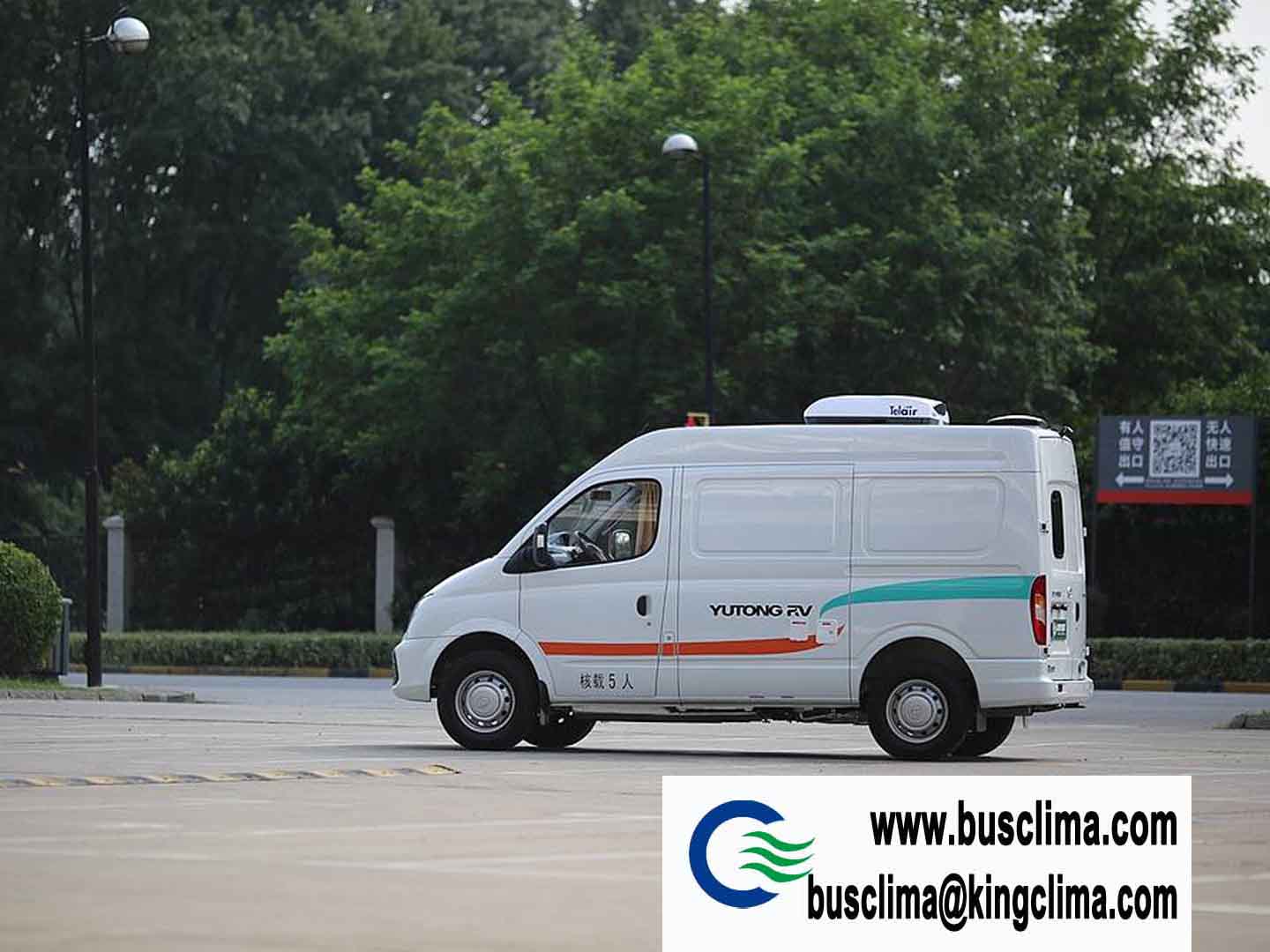
Ac Van is a cooling solution independent of the vehicle’s engine. Its advantages, such as not occupying interior space, large cooling capacity, and the ability to be used while parked, have made it a rigid choice in certain application scenarios.
Assessing its value must go beyond the product’s specifications and be examined within a broader operational environment and user ecosystem.
This article will systematically analyze the market positioning and development trends of rooftop air conditioning units from four core dimensions: local climate adaptability, integration with public transportation solutions, compatibility with emerging travel habits, and customer decision-making logic, combined with the latest industry trends and authoritative analysis.
Sub-question 1: What challenges do diverse climatic conditions pose to the design and reliability of rooftop Ac Vans?
Question:
Because the condenser and evaporator of a rooftop air conditioning unit are integrated into the roof and completely exposed to the external environment, are its performance degradation, weather resistance, and protection levels sufficient to cope with China’s complex climate, ranging from high salt spray along the coast to strong sandstorms in the northwest, and from sustained high temperatures in the south to extreme temperature differences in the northeast?
Evidence:
1. Environmental Test Data: According to the “Weather Resistance Test Report for Rooftop Air Conditioners” disclosed at the Chinese Association of Refrigeration Annual Meeting in March 2025, in cyclic testing under simulated Northwest dust storm conditions (dust concentration 1.5g/m³), condenser fins without special dustproof design experienced a 35% reduction in airflow within 48 hours, leading to a high-pressure alarm in the system. Professor Zhang of the Thermal Management Laboratory at the School of Vehicle and Transportation, Tsinghua University, the report’s main drafter, pointed out: “The standard configuration of future rooftop Van Air Conditioner must include a condenser ‘self-cleaning’ or ‘easy-to-disassemble and clean’ design; otherwise, its performance advantages will be rapidly lost in harsh environments.”
2. Material Process Progress: An article in the April 2025 issue of *Commercial Vehicle News*, titled “The Test from Above: The Evolution of Rooftop Air Conditioner Shell Materials,” mentioned that to address the high corrosion issues in coastal areas, leading manufacturers have begun promoting shells made of aluminized zinc-plated steel sheets with cathodic electrophoretic coatings. Compared to ordinary galvanized sheets, their salt spray corrosion resistance time is improved by more than 300%. 3. Regional Failure Statistics: Maintenance data from a large passenger transport company shows that in South China, where the average summer temperature exceeds 35℃, the main failure mode of its rooftop air conditioning units is compressor overheating protection. In North China, where willow catkins are prevalent in spring, severe condenser blockage is the primary cause of reduced cooling efficiency.
Conclusion: Climate is the primary constraint on the reliability design of rooftop air conditioning units. Their technological development must evolve from “general-purpose” to “environmentally enhanced,” developing specialized models with high protection levels (such as dustproof, corrosion-resistant, and waterproof) for different climate zones, and publicly disclosing environmental adaptability and ease of maintenance as core performance indicators.
Sub-question 2: What new “non-technical” constraints does rooftop air conditioning face when integrated into modern public transportation networks?
Question:
In intercity passenger transport, bus-like connecting routes, and the tourism rental market, how can the installation of rooftop AC Vans be coordinated with vehicle regulations, operating costs, passenger experience, and city image?
Evidence:
1. Regulatory and Standard Restrictions: According to the latest revision of the “Regulations on Technical Management of Road Transport Vehicles” issued by the Ministry of Transport at the end of 2024, stricter compliance requirements have been imposed on vehicle modifications. At the “Urban Passenger Vehicle Standardization Work Seminar” held in January 2025, relevant officials clearly stated: “For newly added operating vehicles, after installing roof-mounted air conditioners, the total height of the vehicle must not exceed the product announcement limit, and it must not affect the vehicle’s safety and stability test results. This directly limits certain design schemes that excessively increase the height and weight of the unit in pursuit of greater cooling capacity.”
2. Operational Economic Analysis: A survey report on tourism rental companies (“2025 White Paper on the Operating Costs of Tourist Charter Buses”) points out that roof-mounted air conditioners, due to their increased drag coefficient, will lead to an average increase of 0.8-1.5 liters per 100 kilometers in fuel consumption during high-speed cruising. This is a significant long-term cost for operating vehicles with an annual mileage exceeding 100,000 kilometers.
3. Passenger Experience and Urban Aesthetics: In some historical and cultural tourism cities that pursue a unified landscape, the overly conspicuous appearance of roof-mounted air conditioners may be subject to restrictions. Meanwhile, if the unit’s vibration isolation and noise reduction design is inadequate, the low-frequency noise transmitted into the vehicle will severely impact the comfort of long-distance travel.
Conclusion: In the public transportation sector, the selection of rooftop air conditioners is a systematic engineering decision that requires a comprehensive balance between regulatory compliance, total cost of ownership (TCO), and social acceptance. Future product optimization must focus on low-drag streamlined design, lightweighting, and high efficiency to balance cooling needs with energy consumption and regulatory constraints.
Sub-question 3: How do new travel and lifestyle models such as fresh food delivery and camping RVs reshape the functional requirements for rooftop AC vans?
Question:
With the development of new retail and leisure lifestyles, the van’s dual function as a production tool and living space presents unprecedented new requirements for the cooling mode, control method, and energy supply of rooftop air conditioners.
Evidence:
1. Cold chain delivery scenario: According to the “2024 China Cold Chain Logistics Urban Delivery Vehicle Demand Report,” electric vans used for community fresh food delivery have extremely high requirements for parking cooling time. The report points out that vehicles equipped with DC inverter rooftop air conditioners directly connected to the vehicle’s power battery exhibit 40% better cargo compartment temperature stability compared to traditional fuel-powered air-conditioned vehicles. They also achieve zero-emission, low-noise “silent delivery,” making them particularly suitable for nighttime operations.
2. Camping and Multi-Purpose Vehicle Conversion Boom: In its February 2025 issue, *Automotive & Parts* magazine, in a special feature titled “Vanlife’s Evolution in China,” described how rooftop air conditioners with low-voltage start-up, remote pre-cooling via an app, and a sleep/silent mode have become a “must-have” when converting camper vans. Users not only need cooling, but also an intelligent and user-friendly climate control experience that is independent of the engine.
3. Authoritative Industry Assessment: A member of the Expert Committee of the China Automotive Aftermarket Accessories Association predicted in a recent interview that “‘Multi-functionality’ will be the next breakthrough point for rooftop air conditioning. For example, integrating a fresh air purification module to address outdoor air quality issues, or developing multiple modes such as ‘rapid cooling’ and ‘economical dehumidification’ to adapt to different outdoor activity scenarios.”
Conclusion:Emerging scenarios are driving the transformation of rooftop air conditioning from a single “temperature regulator” to a comprehensive “mobile space environment manager.” The key path for its technological development is electrification, intelligence, and mode diversification, as well as deep integration with the vehicle secondary modification ecosystem to meet the needs of all scenarios, from commercial delivery to personal life.
Sub-question 4: What are the essential differences in the core considerations of different customer groups when purchasing rooftop AC Vans?
Question:
For individual vehicle owners, logistics fleets, modification shops, and other different purchasing decision-makers, what are their different priorities regarding cost, performance, brand, and service when choosing rooftop air conditioning units?
Evidence:
1. Price-sensitive individual customers: These customers (such as individual freight drivers and small travel agencies) primarily focus on initial investment costs and ease of installation. Market research shows they often choose mid-to-low-end brands priced between 3,000-5,000 yuan, but lack sufficient foresight regarding subsequent maintenance frequency and costs.
2. Total Cost of Ownership (TCO) oriented fleet customers: Large logistics or passenger transport companies have dedicated equipment procurement departments. A fleet manager from a well-known express delivery company, in an interview with *Transport Manager World*, calculated: “When choosing a rooftop air conditioning brand, we prioritize the Mean Time Between Failures (MTBF) and nationwide service network coverage. The cost of a breakdown leading to loss of cold chain goods or passenger complaints far exceeds the price difference of the equipment.” They are typically willing to pay a premium for the high reliability of well-known brands.
3. Value-integrating modification shop customers: As integrators in the industry chain, modification shops value whether air conditioning manufacturers can provide flexible technical support, a comprehensive library of compatible brackets, and a stable supply cycle. Reputable rooftop air conditioning brands are considered core “component partners” for achieving high-quality vehicle modification solutions.
Conclusion: Differences in customer decision-making logic necessitate market segmentation. Rooftop AC van suppliers should provide a clear product and service matrix: cost-effective “tool-type” products for price-sensitive markets; highly reliable “operational support-type” products and nationwide warranty services for fleet customers; and in-depth technical cooperation and customized support solutions for modification shops.
Summary: Rooftop air conditioning units for vans are not a universally applicable standard component. Their technological form and market survival space are shaped by harsh natural environments, refined operational regulations, burgeoning emerging scenarios, and diverse customer economic models. Their future lies in whether they can evolve from “a cooling unit on the roof” into an intelligent environmental module that is highly adaptable to the environment, deeply integrated into the operational system, precisely empowers new scenarios, and flexibly matches the customer value chain. Only through this comprehensive perspective in product definition and technological breakthroughs can rooftop air conditioning establish its irreplaceable professional value amidst fierce market competition and rapidly changing demands.




 Spanish
  English