
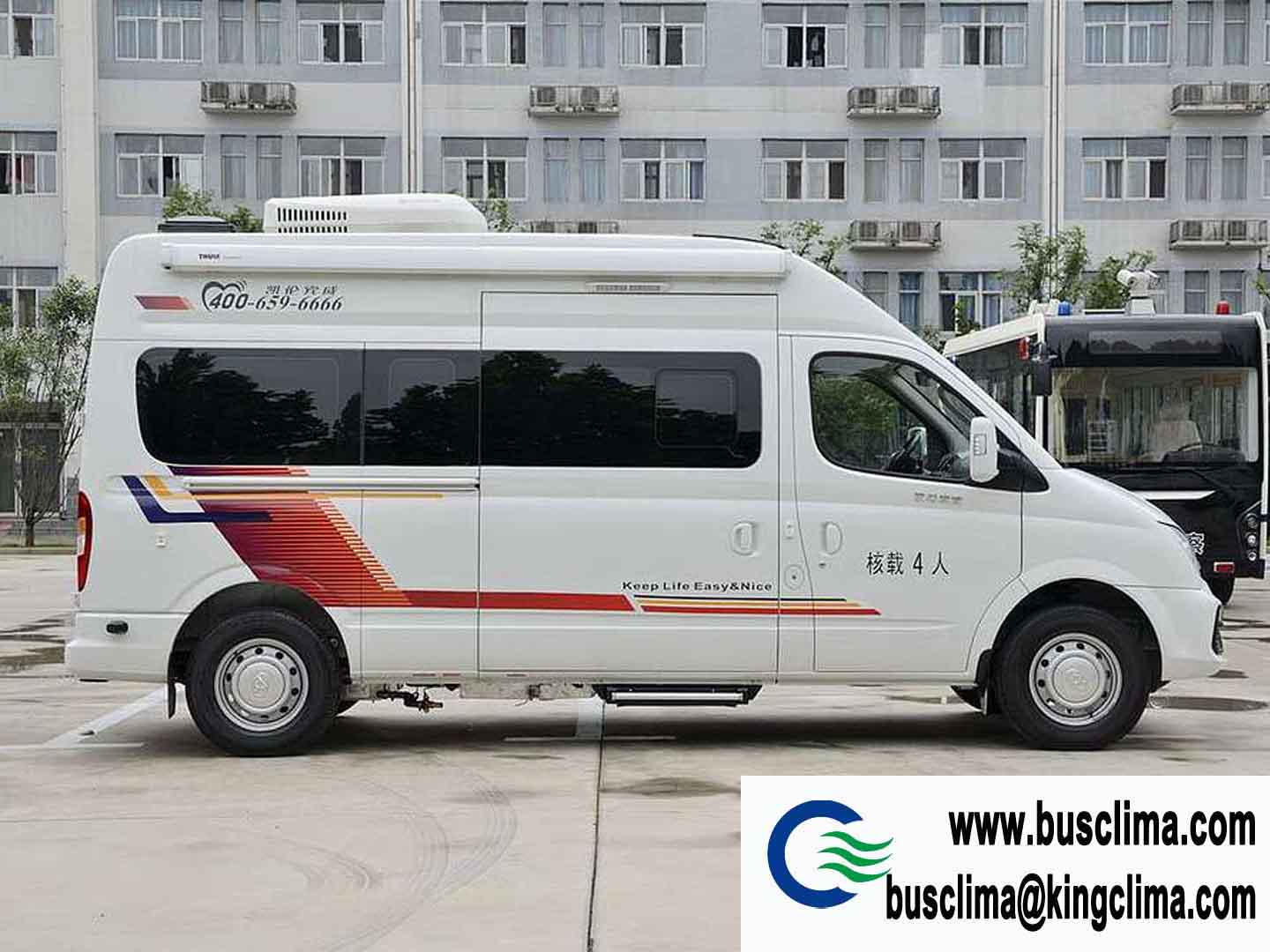
Van Aircon is the core physical carrier of an independent temperature control system, and its design and selection directly determine the system’s performance boundaries, reliability, and integration.
This article will analyze the key development trends of roof-mounted air conditioning components from four dimensions: structural reliability, regulatory compliance, functional integration, and value stratification, combined with the latest industry practices.
Sub-question 1: How do continuous vibration and extreme weather drive innovation in Van Aircon material and structural design?
Question:
Exposed to the roof for extended periods, components must withstand road vibration, airflow impact, and sun and rain exposure. What specific challenges do their outer shell structure, internal supports, and connecting components face in terms of fatigue resistance and weather resistance design?
Evidence:
1. Upgraded structural testing standards: In the “New Regulations for Vibration Testing of Commercial Vehicle Roof Equipment” (draft for comments) released by the China Society of Automotive Engineers in 2025, a composite test method based on random vibration and multi-axial mechanical impact based on actual road spectra was clearly defined for the first time. The lead drafter of the specification pointed out: “Traditional testing based on single sinusoidal vibration can no longer reflect the true failure mode. The new standard requires that after reinforcement testing, critical connection points of the component should show no structural cracks or permanent deformation.”
2. Material Application Case: A 2025 survey by the magazine *Special Purpose Vehicles & Parts* showed that in the long-haul logistics sector, components using glass fiber reinforced polymer (GFRP) shells and internal magnesium alloy supports are gradually replacing some all-metal solutions due to their excellent corrosion resistance and higher specific strength, especially in highly corrosive environments such as cold chains.
Conclusion: The reliability of a component is based on its dynamic structural integrity. Future designs must employ more precise simulation and testing methods and utilize lightweight, high-strength materials to achieve maintenance-free or low-maintenance operation throughout its lifespan.
Sub-question 2: How do urban vehicle management regulations and electrification platforms define the “installation boundaries” of Van Aircon?
Question:
Faced with urban height restrictions, vehicle appearance regulations, and the increased sensitivity of electric chassis to weight and energy consumption, what new systemic constraints are imposed on the physical dimensions, weight, drag coefficient, and installation methods of components?
Evidence:
1. Regulatory and Operational Restrictions: In 2025, a first-tier city, when updating its “Technical Specifications for Urban Delivery Vehicles,” explicitly required that “after adding roof-mounted equipment to new vehicles, the total height must not exceed the legal limit, and the drag coefficient of the vehicle at the time of manufacture must not be changed by more than ±5%.” This directly promoted the development of ultra-thin, streamlined components.
2. Electrification Adaptation Needs: According to experts sharing at the 2025 China EV100 Forum, for roof-mounted Van Air Conditioner (equipped for electric vans), every 10 kg reduction in component weight can increase the driving range by approximately 0.5% with the same amount of electricity, and the impact of low drag design on high-speed energy consumption is even more significant.
Conclusion: Component design has shifted from “functional realization” to “compliance and energy efficiency optimization.” Its development trend is towards high integration, low drag profile, and extreme lightweighting to minimize negative impacts on vehicle regulatory compliance and energy economy.
Sub-question 3: How do diverse modification scenarios drive the evolution of Van Aircon from a “closed shell” to an “integrated platform”?
Question:
When the roof space needs to simultaneously accommodate air conditioning, solar panels, lighting equipment, or satellite antennas, how can the components evolve from a single air conditioning shell into a multifunctional, scalable roof integrated platform?
Evidence:
1. Integrated modification trend: At the 2025 Shanghai International RV Show, several modification companies showcased modular roof platform systems, in which the air conditioning component was designed as one of the core modules of the platform, with standardized interfaces reserved around it for seamless installation of solar panel housings and various equipment bases.
2. Industry Expert Opinion: A senior modification technology director stated in an interview, “The future roof-mounted air conditioning component should itself be a ‘smart base.’ It should not only encapsulate the heating and cooling system but also pre-install power and signal wiring harnesses, providing expansion interfaces to adapt to the rapidly evolving needs of onboard equipment installation.”
Conclusion: To address complex customization scenarios, components are evolving from single-function “shells” to standardized, modular “integrated roof expansion platforms.” Their core value lies in providing reliable physical integration interfaces and energy information channels.
Sub-question 4: How do the decisions of different purchasing entities affect the Van Aircon supply chain and quality stratification?
Question:
When purchasing components, do OEMs, large modification shops, and end-user car owners focus on compatibility with the original vehicle, ease of modification, or final retail price, respectively? How does this lead to significant quality and price stratification in the market?
Evidence:
1. OEM (Original Equipment Manufacturer) Requirements: OEMs have the highest requirements for components, emphasizing complete NVH (Noise, Vibration, and Harshness) test data, plug-and-play compatibility with the original vehicle’s network/power system, and a warranty commitment of 8-10 years. Their procurement price is several times that of the aftermarket.
2. Price Competition in the Aftermarket: The aftermarket is polarized. The high-end market prioritizes brand and reliability, while the low-end market focuses on price. Data from an e-commerce platform in 2025 showed that the aftermarket failure rate of low-priced components (below 1000 RMB) was 3-5 times that of branded components, with the main problems concentrated on insufficient housing sealing and bracket strength.
Conclusion: The component market is highly stratified due to the different value demands of the purchasing entities. The supply chain is correspondingly differentiated into: a highly integrated, long-cycle development model serving OEMs; a high-quality, modular supply model serving professional modification shops; and a standardized, cost-driven model serving the price-sensitive market.
In summary, the development of Van Aircon components clearly reflects the evolutionary logic of the automotive parts industry: from achieving a single function, to meeting systemic constraints (regulations, energy efficiency), then to becoming a multi-functional integrated platform, and ultimately forming segmented markets corresponding to different value chains. Its future lies not only in the shell of an air conditioner, but also in becoming the physical foundation for intelligent, modular integrated roof space solutions.






 Spanish
  English