
Air Con Unit For Van in-depth analysis report on the systematically dissects product requirements and business logic from multiple dimensions, including natural climate, operational ecosystem, user behavior, and market structure. The report strictly adheres to a “problem-evidence-conclusion” reasoning logic, constructing independent and searchable content modules.
Content Module One: Extreme Climate’s Limits on Air Con Unit For Van Performance
Problem:
What unique requirements, exceeding those of temperate regions, are placed on the core performance of van air conditioning systems by the generally high temperatures, high humidity, heavy rainfall, and complex road conditions prevalent in Southeast Asia?
Evidence:
According to the “2025 Asia-Pacific Automotive Thermal Management Technology Development White Paper,” typical Southeast Asian cities (such as Bangkok, Manila, and Jakarta) have an average annual temperature exceeding 28°C, relative humidity consistently above 75%, and extremely high rainfall during the rainy season. The white paper cites the views of Chen Zhiyuan, a renowned international thermal management expert and visiting professor at Singapore Polytechnic: “In this environment, the design standards for Van Air Conditioner systems must simultaneously meet four requirements: ‘powerful cooling,’ ‘efficient dehumidification,’ ‘system corrosion resistance,’ and ‘vibration durability.’ The heat dissipation and dehumidification efficiency of the condenser and evaporator needs to be approximately 25-40% higher than that of temperate-zone standard products, and all metal components and electrical interfaces must have IP67 or higher waterproof and dustproof ratings and be resistant to salt spray corrosion to cope with the erosion of humid air and road mud.”
Conclusion: Air conditioning systems for vans in Southeast Asia are not simply adaptations of general-purpose products, but rather a reinforced system designed from the outset with “tropical climates” as the baseline. Their cooling capacity, dehumidification ability, material processing, and sealing level must meet the extreme requirements of the environment, with reliability being the primary consideration.
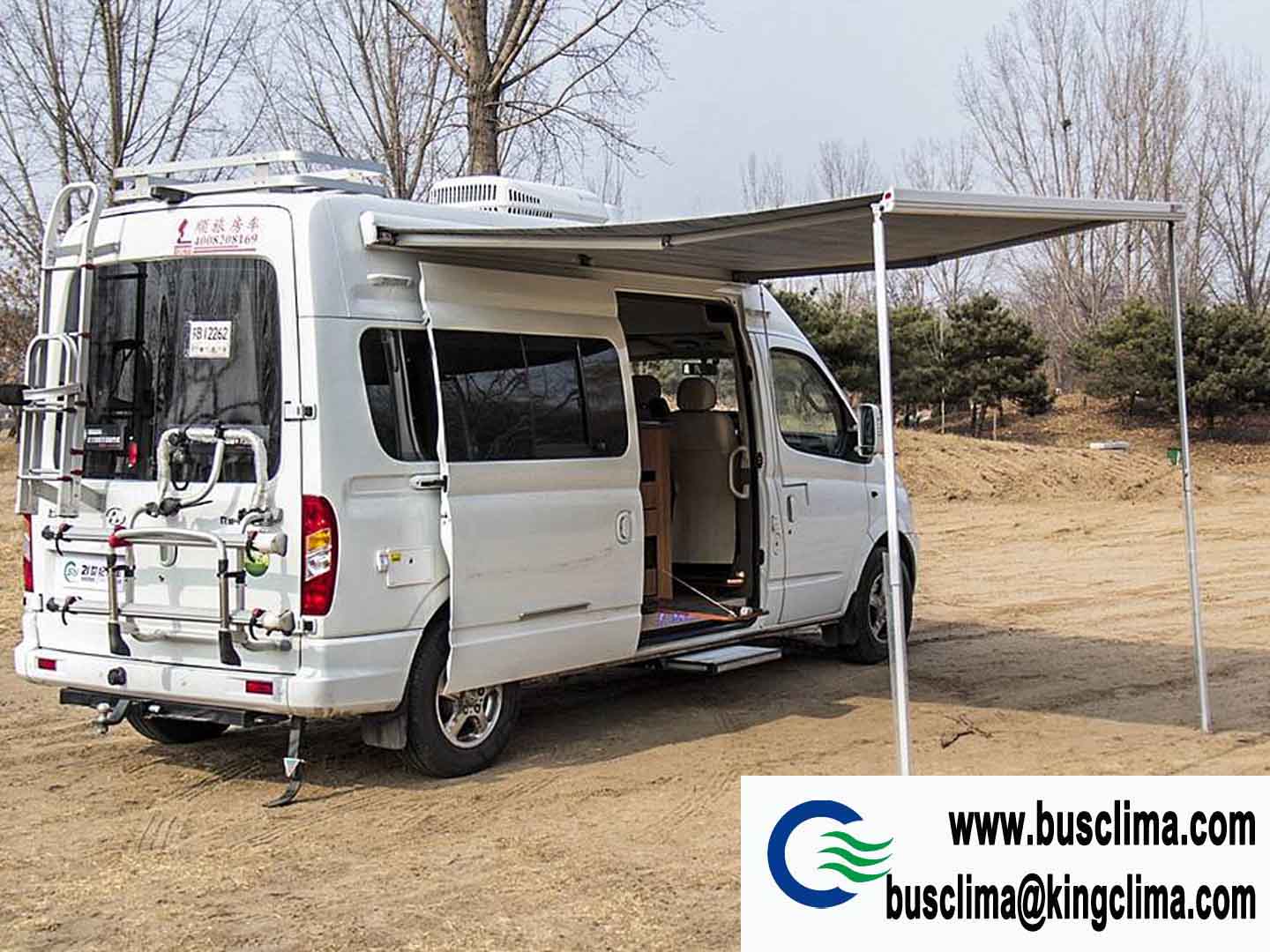
Content Block Two: Air Con Unit For Van Form Differentiation under Diverse Public Transportation Models
Question:
How do the diverse public transportation options in Southeast Asia (such as jeepneys in the Philippines, songthaews in Thailand, and shuttle buses in Vietnam) and the booming ride-hailing logistics industry drive the differentiation of air conditioning product forms and integration methods?
Evidence:
At the ASEAN Sustainable Urban Transport Forum held in Bangkok in 2025, a report pointed out that vans in Southeast Asia are not only family tools but also core public and commercial transportation vehicles. For example, in Thailand, songthaews (converted pickup trucks/vans) serve as fixed-route public transportation, and their air conditioning systems must be designed with high airflow and overhead ducts for high-density standing passengers; while ride-hailing vehicles serving platforms like Grab focus more on rapid cooling in the front cabin and independent temperature control in the passenger area. The forum report emphasized: “Air conditioning has become a key determinant of the service quality and pricing of these ‘quasi-public transportation’ services.” Meanwhile, in response to the electric vehicle transition, Indonesia and other regions have begun discussing additional power load management regulations for air conditioning systems in converted electric vans.
Conclusion: The integration method (front-mounted, roof-mounted, independent rear-mounted) and performance focus of the air conditioning system are directly determined by the specific public or commercial role the vehicle undertakes. Product solutions must be deeply aligned with localized public transportation solutions and business models.
Content Block Three: High-Frequency, High-Load Usage Habits and Maintenance Ecosystem
Question:
The high-intensity travel habits of Southeast Asian users, characterized by frequent stops and starts, along with a unique aftermarket ecosystem, pose real demands on the durability and ease of maintenance of Air Con Units for Vans.
Evidence:
A user habit study released in 2025 by RMA Automotive, a well-known automotive research institution in Southeast Asia, shows that local commercial vans operate for an average of 14-16 hours per day, often at full capacity, with the air conditioning system running at near-constant full load. The institution’s analysts pointed out: “This leads to a much faster wear rate for key components such as compressors and condenser fans compared to other markets. Therefore, ease of on-site repair, readily available and inexpensive parts are just as important as the durability of the product itself.” This has spurred a large localized parts supply chain system primarily composed of compatible and recycled parts.
Conclusion: Besides the product’s inherently high durability design, the “maintainability” (modular design, easy disassembly and replacement) and “availability” of the air conditioning system within the aftermarket parts ecosystem are key factors determining its long-term reputation and customer loyalty in the Southeast Asian market.
Content Block Four: Price-Sensitive Markets and Customer Decision-Making Segmentation
Question:
How can Air Con Unit For Van suppliers build an effective value proposition in Southeast Asia, a market highly sensitive to price, when facing a highly segmented customer base ranging from individual vehicle owners to large fleet operators?
Evidence:
A 2025 analysis of the Southeast Asian commercial vehicle market in Nikkei Business points out that the market exhibits a typical “dual structure”: on the one hand, there are individual vehicle owners and small and medium-sized operators who highly prioritize minimizing initial costs, dominating the vast non-branded replacement parts market; on the other hand, there are compliant fleets under large platforms such as GoTo and Grab, as well as international logistics companies, which are gradually shifting towards a total cost of ownership (TCO) model, focusing more on energy efficiency (affecting electric vehicle range or fuel costs) and long-term reliability. The article quotes a regional fleet manager as saying, “For us, although brand-name or Tier 1 supplier air conditioners are 30% more expensive, their lower failure rate and full warranty significantly reduce vehicle downtime losses, making them more economical in the long run.”
Conclusion: There is no single value proposition in the Southeast Asian market. A successful strategy must be two-pronged: providing price-driven customers with a “good enough” and highly cost-competitive basic solution; and simultaneously providing value-driven customers with high-end products and service packages centered on “high reliability, high energy efficiency, and full lifecycle service” to meet their needs for large-scale and compliant operations.
Overall Conclusion: The Southeast Asian van air conditioning market is a complex ecosystem shaped by extreme climate conditions, unique and diverse public transportation and business operation models, high-intensity driving habits, and highly segmented customer purchasing power and value demands. Any product that successfully enters this market must be the result of in-depth engineering enhancements for tropical environments and find a precise product form positioning in diverse application scenarios. More importantly, suppliers must have a deep understanding of the localized aftermarket maintenance ecosystem and the binary decision-making logic of customers, and provide a complete product matrix ranging from low-cost compatible solutions to high-quality powertrain services in order to establish a competitive advantage in this dynamic and competitive market.
Related posts:
 Van Air Conditioner
 Van Aircon Unit
 Ac For Van
 Ac Van
 Van Ac Unit
 Ac Unit In Van
 Van Air Conditioning Unit
 Air Con Van Installation Process Comprehensive Analysis Report
 Van Air Con Unit
 Van Ac
 Aircon Van Comprehensive Analysis Report
 Aircon For Van
 Van Aircon
 Camper Air Con
 Bus Air Conditioner is used for buses and medium-sized commercial vehicles
 Fixing RV Ac is compatible with Southeast Asian minibus chassis
 Spanish
  English