
AC for Bus Manufacturers encompasses market concentration, physical production capacity, company size, and supply chain scale.
The size of China’s bus air conditioning market is directly related to bus production. China produces approximately 100,000-120,000 large, medium, and light-duty buses annually (including public transport and highway passenger vehicles), meaning there is a corresponding demand for air conditioning in these new vehicles each year. Combined with a large aftermarket, the overall market size is considerable.
This market is not divided among hundreds or thousands of companies, but is highly concentrated in the hands of a few leading companies. Chinese manufacturers have rapidly risen by leveraging their domestic bus manufacturing advantages, with SONGZ and BUSCLIMA being typical examples. Visit www.busclima.com or contact busclima@kingclima.com
SONGZ
SONGZ has consistently maintained a market share of 35%-40% or even higher in China’s bus air conditioning sector, making it an undisputed industry giant.
Its scale is reflected in its nationwide production bases (Shanghai, Anhui, Chongqing, Xiamen, Wuhan, etc.), with an annual production capacity sufficient to power hundreds of thousands of buses.
Its clients include almost all major bus manufacturers, such as Yutong, King Long, Zhongtong, and Ankai.
Ac For Bus Manufacturer
Modern Industrial Park Model The physical scale of China’s leading Ac For Bus factories has long surpassed the traditional concept of a single factory building, evolving into modern industrial parks integrating R&D, production, and testing.
Land Area
A large bus air conditioning production base often covers hundreds of acres. For example, Songzhi’s production bases in Anhui and Chongqing are vast industrial parks with investments of hundreds of millions of yuan.
Production Lines
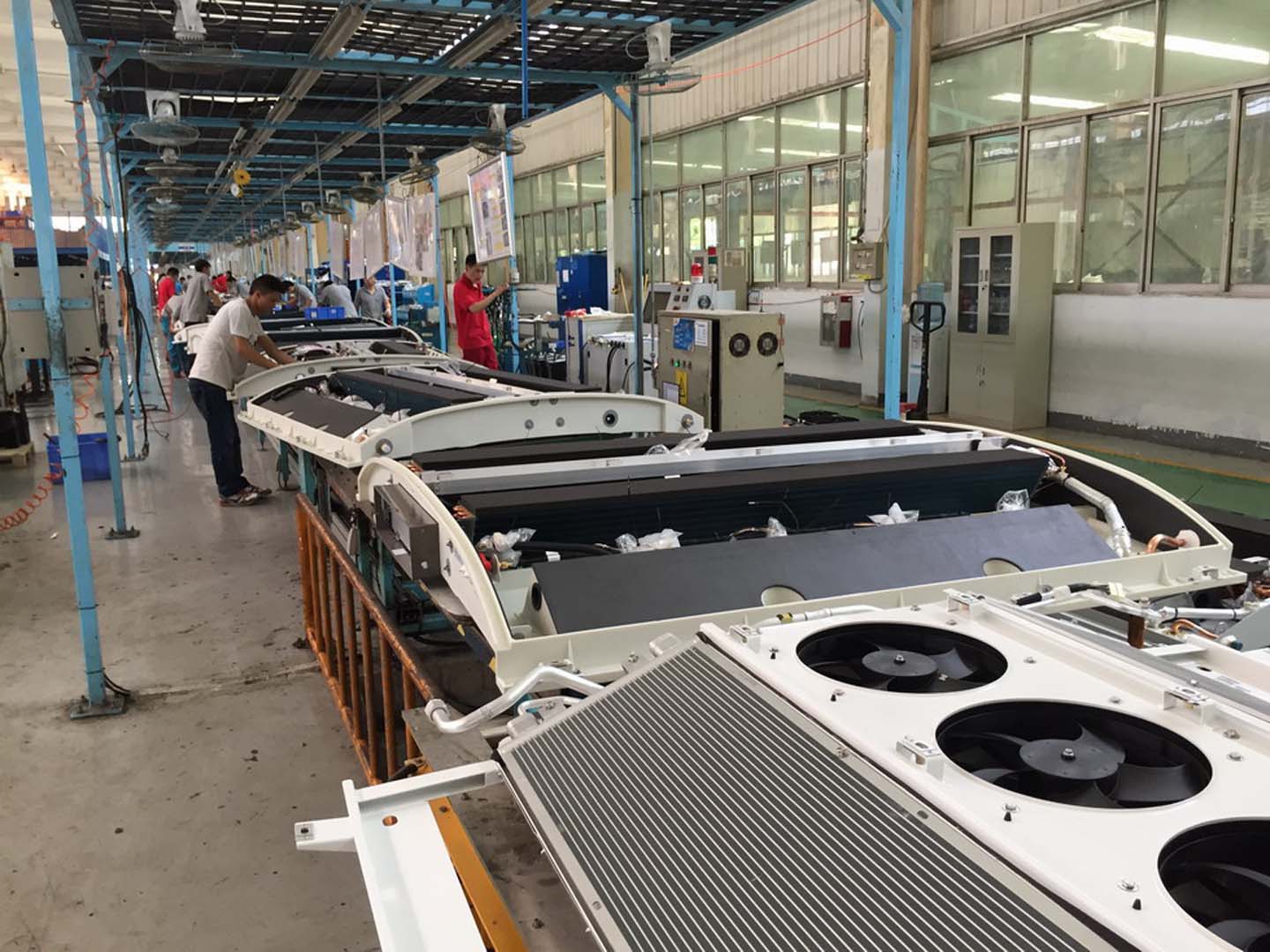
The workshops feature highly automated assembly lines.
Brazing Furnace Production Line
Used for fully automated production of condenser and evaporator cores.
Assembly Line
Multiple production lines operate in parallel, each responsible for the final assembly of different products such as overhead air conditioners and driver-only air conditioners.
Painting Line
Automated primer and topcoat spraying and baking of the air conditioner casing.
Laboratory Scale
This is key to demonstrating its technological strength. Large factories have nationally or provincially accredited testing centers.
Large-scale environmental simulation chamber
Capable of accommodating the entire bus body or complete air conditioning system, conducting extreme environmental simulation tests ranging from -40℃ to +60℃.
Performance laboratory
Equipped with high-precision airflow and heat measurement equipment.
Durability vibration table
Simulates the vibration environment of long-term vehicle operation.
Noise laboratory (semi-anechoic chamber)
Tests air conditioning operating noise.
The scale of Ac For Bus Manufacturer is also reflected in the complete and efficient supply chain system behind it.
Localized sourcing: From compressors, motors, aluminum and copper tubing, electronic control units to plastic parts, almost all components can be sourced from Chinese manufacturing clusters such as the Yangtze River Delta and Pearl River Delta.
Cost and efficiency advantages: This tightly integrated supply chain cluster results in lower procurement costs and faster response times, supporting OEMs in JIT (Just-in-Time) production and delivery, further strengthening the scale advantage and market competitiveness of leading air conditioning manufacturers.

 Spanish
  English