
Bus Air Conditioning Factory leverages three core advantages—full-industry chain integration, deeply customized response, and rapid technological iteration—to create a differentiated competitive advantage in the global market, particularly excelling in modular production, extreme environment adaptability, and cost control.
Chinese manufacturers, relying on their domestic bus manufacturing advantages, have rapidly risen to prominence, with SONGZ and BUSCLIMA being typical examples.
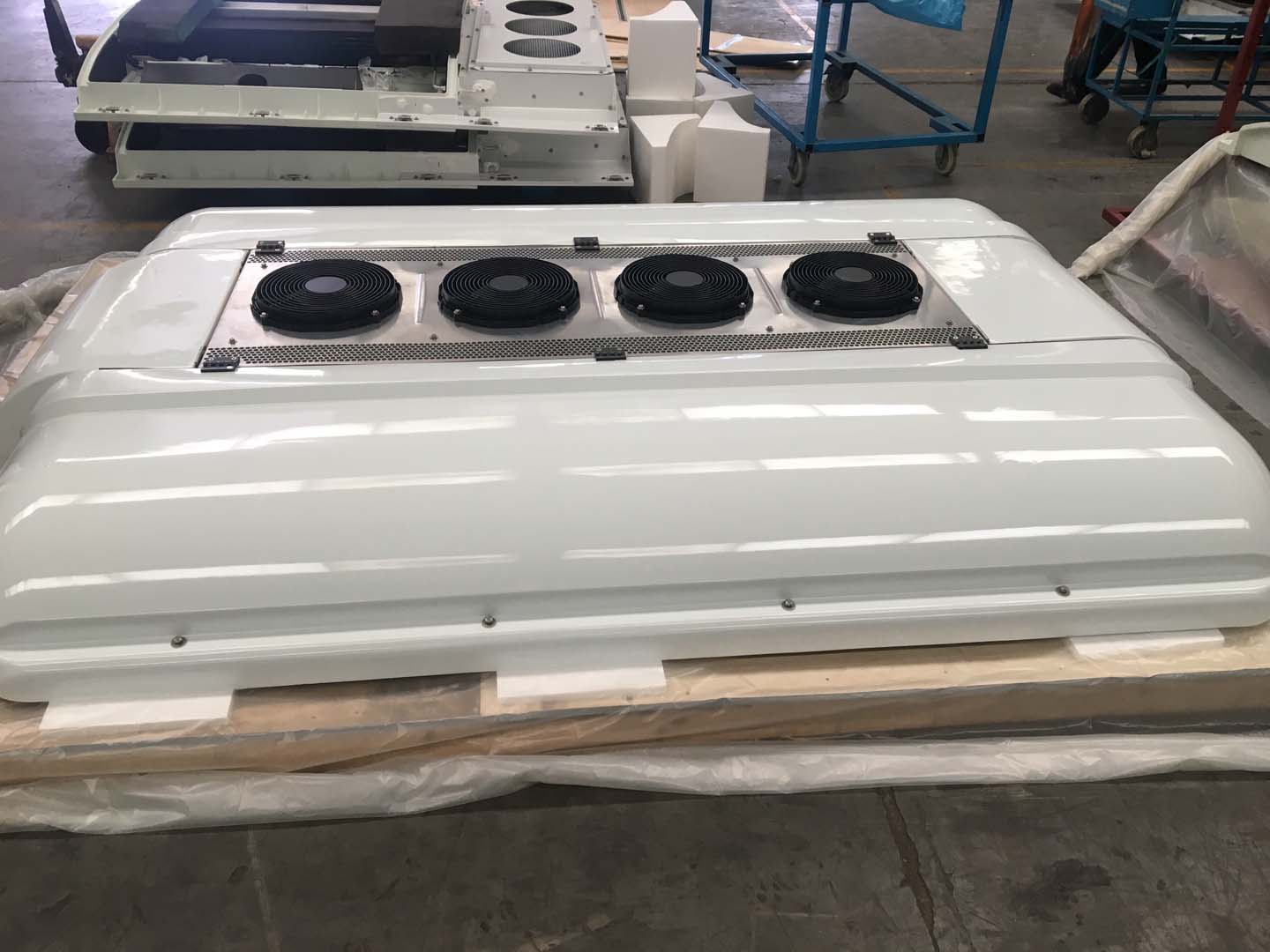
The Bus Air Conditioning Factory has achieved extreme environment resistance covering a full temperature range of -40℃ to 60℃. Through material innovation, system redundancy design, and intelligent thermal management technology, it has achieved stable operation in scenarios such as the high-temperature deserts of Qatar and the extreme cold of Mohe, China, with core performance indicators reaching internationally leading levels.
Extreme Cold Environment Resistance (-40℃~-10℃)
1. Low-Temperature Start-up and Heating Guarantee: Yutong’s new energy buses, operating in the -30℃ extreme cold environment of Mohe, utilize a smart pre-heating function for the power battery to preheat before departure. Combined with the TMS 2.0 liquid cooling heating system, this ensures reliable cold starts and extends winter range by 3% compared to the industry average. BYD’s pure electric buses employ a hybrid heating system of “PTC + waste heat recovery.” In tests on -20℃ icy and snowy roads, the cabin temperature rose from -15℃ to 20℃ in just 5 minutes, and the defrosting area reached 95% within 30 minutes.
2. Material and Structural Weather Resistance: The piping system uses a low-temperature toughness alloy (impact energy ≥27J at -40℃), and the roof shell uses carbon fiber composite material, maintaining over 90% bending strength at -30℃. Yutong buses operating in the -25℃ environment of Kazakhstan achieved an MTBF (Mean Time Between Failures) of 6000 hours for their air conditioning system, a 40% improvement over similar products in the region.
Breakthroughs in Intelligent Battery Thermal Management System Technology
1. Dynamic Load Adaptation: Bus air conditioners are equipped with dual-core MCU controllers that use AI algorithms to predict changes in ambient temperature. For example, they can detect when a vehicle enters a tunnel and reduce cooling power by 15% in advance, reducing energy waste. BYD, on the other hand, uses its BMS system to monitor battery status 24/7 and dynamically adjust heating strategies, balancing heating rate and power consumption, achieving an 18% reduction in heating energy consumption at -30℃.
Visit www.busclima.com or contact busclima@kingclima.com
2. Full-Scenario Verification System: Manufacturers have established multi-level testing systems from laboratory to real-world environments: Yutong has equipped its Zhengzhou base with a -40℃~60℃ environmental simulation chamber, randomly selecting one unit from every 100 products for full-condition cyclic testing; BYD, Geely, and other companies conduct on-site verification every summer in Turpan (surface temperature 81℃) and winter in Mohe (-30℃) to ensure that the performance degradation of the air conditioning system is ≤8% under extreme temperature differences.
From high-temperature vehicles used during the Qatar World Cup to buses operating in the frigid regions of Russia, the Bus Air Conditioning Factory has developed a comprehensive “materials-systems-algorithms” solution for extreme environments. This resilience has supported the global expansion of companies like Yutong and BYD.
 Spanish
  English