
Bus Hvac System manufacturing process involves multiple precision steps, mainly focusing on the assembly and testing of core components such as the evaporator assembly, compressor, and condenser. The following is a summary of key process steps:
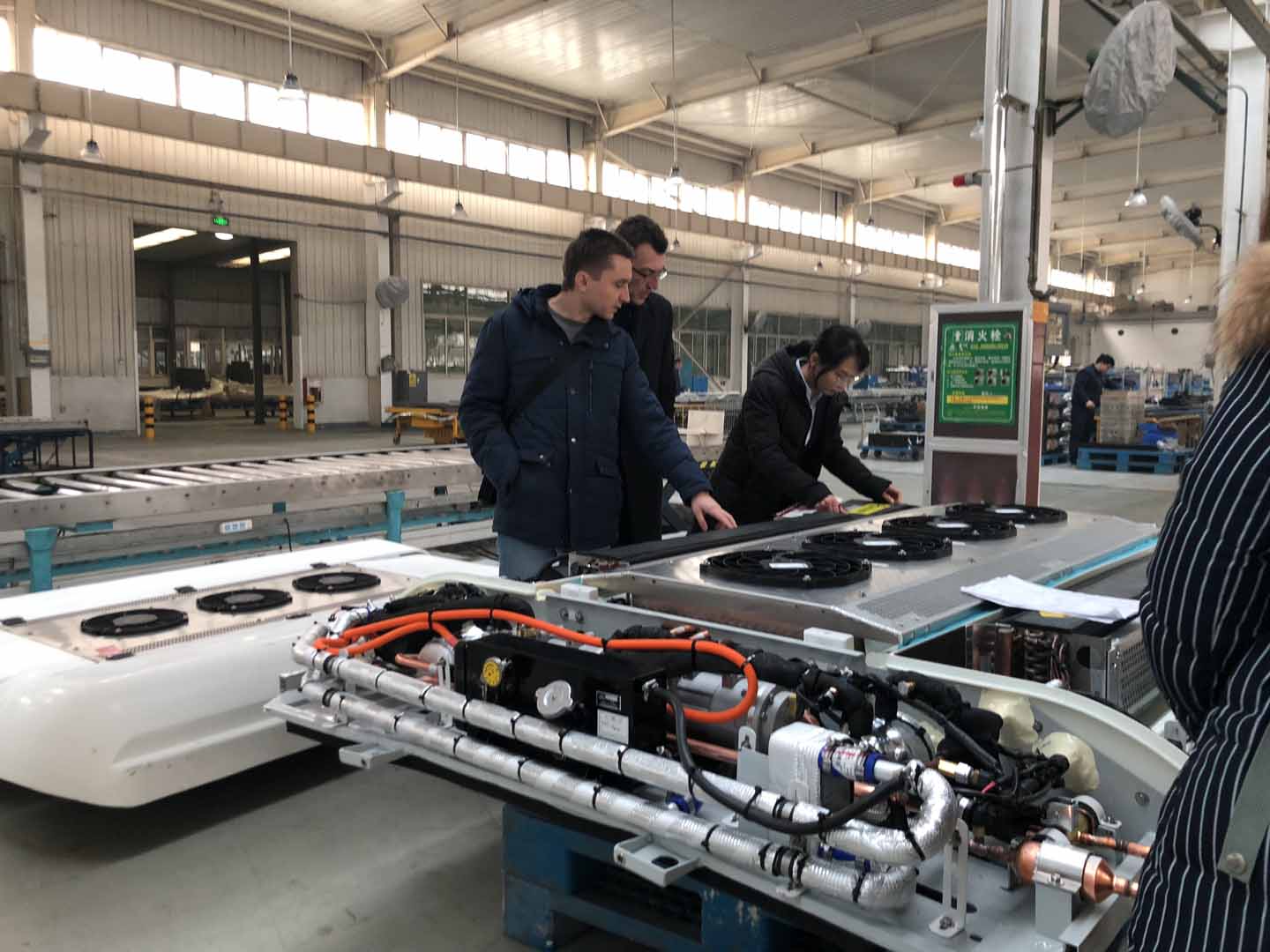
Bus Hvac System Manufacturing Process – Evaporator Assembly
1. Material Inspection: Including the integrity inspection of components such as the evaporator core, expansion valve, sight glass connecting pipe, balance pipe, and dryer bottle, ensuring no damage or defects.
2. Expansion Valve Assembly: Install the expansion valve on the evaporator core, apply refrigerant oil and tighten, while fixing the position of the temperature sensor (approximately 45° below the horizontal axis of the return pipe).
3. Sight Glass and Balance Pipe Installation: Tighten with a double wrench, ensuring the connecting pipe is not twisted and the sight glass is facing downwards.
4. Dryer Bottle Assembly: Install according to the flow direction arrow, ensuring the interface is sealed without leakage.
5. Airtightness Test: After filling with 2.5MPa nitrogen, immerse in a water tank and check for bubbles to confirm the seal.
6. Condensation Prevention: Wrap condensate-producing areas (such as the expansion valve and return pipe) with insulating putty or sponge to prevent condensation.
Bus Hvac System Manufacturing Process – Compressor and System Integration
1. Electric Compressor: New energy vehicles use scroll electric compressors driven by permanent magnet synchronous motors, equipped with frequency conversion control, adaptable to a wide speed range (600-8500rpm).
2. Refrigeration Cycle: The compressor compresses low-temperature, low-pressure gaseous refrigerant into high-temperature, high-pressure gas. After heat dissipation in the condenser and throttling by the expansion valve, it absorbs heat and cools down in the evaporator.
3. Heating System: Some models use PTC electric heating or heat pump technology, heating the air through engine coolant or electricity.
Bus Hvac System Manufacturing Process – Condenser and Radiator Manufacturing
1. Condenser: Employs microchannel technology, combining flat aluminum tubes and heat sinks, with forced convection cooling via a fan.
2. Radiator: Dual-layer flow channel design, utilizing counter-current heat exchange with engine coolant, achieving a thermal efficiency of over 90%.
Bus Hvac System Manufacturing Process – Quality Control and Intelligentization
1. Production Environment: Must be kept dry and clean to prevent impurities from entering the system.
2. Energy Efficiency and Lightweight Design: New energy vehicle air conditioners require high efficiency, low noise, and a lightweight design to improve range.
3. Intelligent Control: Integrates temperature/pressure sensors, frequency converters, and other functions, supporting fault diagnosis and software upgrades.
 Spanish
  English