
Rooftop AC Unit for Campers
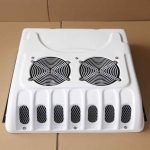
Rooftop AC units for campers constitute a distributed temperature control system. Thanks to their superior engineering adaptability, precise environmental control capabilities, and redundant reliability, they have become an indispensable core technology solution for high-end motorhomes.
With the booming global market for mobile living and high-end customized travel, Type A motorhomes built on large bus chassis are becoming the ultimate form of mobile living space.
Faced with the demanding environment of these “mobile villas,” which are over 12 meters long, have complex functional divisions, and require high energy self-sufficiency, traditional single air conditioning units are completely inadequate.
According to industry analysis, leading automotive air conditioning companies have accelerated the expansion of their application scenarios from trucks to the RV industry in 2024. This marks the explosion of demand for sophisticated temperature control in large motorhomes, and multi-unit collaboration is the key to meeting this demand.
1. System Configuration Rationale and Core Parameters – Rooftop Ac Unit Camper
Reason: The combined challenges of vast space, complex divisions, and extreme operating conditions.
The temperature control problem in bus-based motorhomes is three-dimensional: the interior is usually clearly divided into multiple functional compartments such as the cockpit, living room, separate bedrooms, and kitchen/bathroom, with a very large spatial depth. Different areas have vastly different heat load characteristics – the living area heats up rapidly under sunlight due to large panoramic windows, while the sleeping area has a rigid demand for continuous constant temperature and extreme quietness. A single cooling source, even with high power, cannot overcome the energy attenuation and noise accumulation of long-distance air delivery, inevitably leading to serious uneven cooling and heating and energy waste. At the same time, the vehicle may face all-weather challenges from 50℃ deserts to -10℃ plateaus, requiring almost military-grade requirements for the system’s cooling/heating capacity, extreme operating temperature range, and continuous reliability.
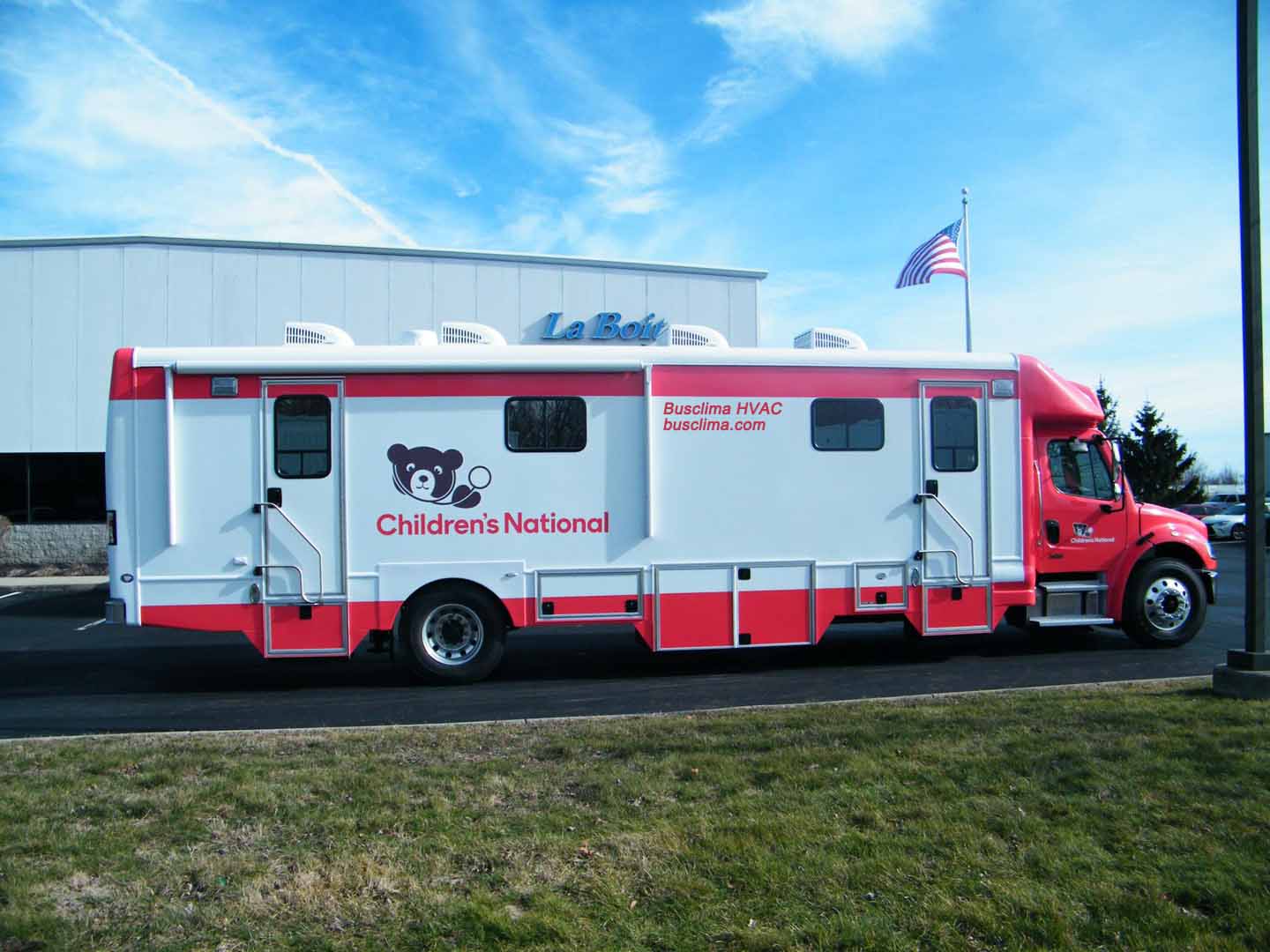
Process: Modular parameter system and precise configuration logic.
The core of a multi-unit air conditioning system lies in “distributed deployment and centralized intelligent control.” Its success depends on a precise parameterized configuration and collaborative control strategy, specifically reflected in the following points:
Cooling Capacity and Unit Combination: A single rooftop air conditioning module suitable for large motorhomes typically has a cooling capacity between 2.5kW and 2.7kW (approximately 8,500-9,200 BTU/h). For large motorhomes with a total area exceeding 40 square meters, industry practice shows that a combination of “two large and one small” or “balanced front and rear large units” is required, based on heat load calculations. For example, equipping the front living room and the middle and rear master bedroom with a high-performance module each allows for flexible coverage of cooling needs and provides a margin for extreme weather conditions.
Energy Efficiency Core and Noise Reduction Technology: Energy efficiency is the lifeline of off-grid living. The system must use a full DC inverter compressor to achieve stepless cooling capacity adjustment from 10% to 100%. As demonstrated by industry-leading solutions, using a dual-rotor inverter compressor is more efficient and operates more smoothly than traditional single-rotor compressors, reducing noise by 3-5 decibels. Simultaneously, intelligent algorithms are needed to independently adjust the compressor and fan speeds based on the actual load in each zone, avoiding energy waste from oversized systems.
Power Adaptation and Intelligent Control: Simultaneous operation of multiple air conditioners places immense pressure on the vehicle’s power system. For example, a 12V DC inverter air conditioner with an input power of 900W has a rated current of up to 75A. Therefore, the system must be equipped with a large-capacity lithium battery (usually ≥40kWh) and an intelligent energy management system (BMS). The control system should draw on cutting-edge solutions from the commercial passenger vehicle sector, such as a five-in-one integrated control system for electric air conditioning with integrated AI intelligent algorithms, enabling independent temperature control in multiple zones, remote monitoring, and fault prediction.
Result: Building a customizable, highly redundant, and precise environmental control network.
Through the above parametric design, multiple air conditioning units are integrated from multiple independent devices into an intelligent, centrally managed environmental system with precise zone control. This not only eliminates temperature dead zones but also achieves system-level redundancy through a distributed layout—if a single module fails, the remaining modules can still maintain the temperature in the basic living areas, greatly improving the safety and continuity of long-distance travel.
2. Diverse Usage Scenarios and Intelligent Response Strategies – Rooftop AC Unit Camper
Reason: The dynamic uncertainty of mobile living and the ultimate pursuit of “all-time comfort.”
The usage scenarios for motorhome buses are complex and varied, ranging from urban commuting to off-grid wilderness adventures, and from family vacations to business receptions. This demands that the temperature control system possess powerful scene adaptability, rapid temperature adjustment capabilities, and deep, intelligent coordination with the vehicle’s overall energy system.
Process: Scene-based deep coordination strategy for energy and temperature control.
Long-distance off-grid camping scenario: This is the ultimate test of the system’s energy efficiency management. Without external grid power, the intelligent energy manager (BMS) becomes crucial. It dynamically adjusts the operating priority and power limits of multiple air conditioning units based on battery power and solar input. For example, during power shortages, it can automatically switch to “sleep mode,” maintaining low-power constant temperature only in the sleeping area, thus maximizing off-grid survival time.
Extreme climate travel scenario: In scorching heat, multiple units can operate in parallel at full power, providing instantaneous, high-capacity cooling. The system requires models with a wide operating temperature range (e.g., up to 52°C ambient temperature). For modules with integrated heat pump functions, efficient heating is possible in severe cold, reducing reliance on independent fuel-fired heaters and achieving cleaner energy utilization.
High-end business reception scenario: In this case, rapid response, even and imperceptible temperature control, and extreme quietness are key. Multiple units can balance the temperature throughout the vehicle faster than a single unit. Concealed ductwork provides “draft-free” cooling, enhancing the business atmosphere. The system’s zone control capabilities allow guests in different areas to have personalized temperature settings, showcasing a premium experience.
Result: A fundamental leap from “passively adapting to the environment” to “actively creating a microclimate.”
When multiple air conditioning systems are deeply integrated with intelligent connectivity and energy management, the motorhome bus transforms from a “container” at the mercy of the external climate into an intelligent mobile home that can independently create and stably maintain an ideal environment anywhere, anytime.
3. Systemic Product Advantages – Rooftop AC Unit Camper
Reason: Limitations of single-dimensional performance and user pursuit of a comprehensive experience.
Users ultimately purchase not just the air conditioner itself, but the overall travel experience composed of temperature uniformity, spatial tranquility, air quality, and system reliability. Multiple air conditioning system solutions, achieved through top-level system design, address many inherent drawbacks of traditional single high-power solutions.
Result: Shaping core technological labels that define vehicle class and brand value.
This system transforms air conditioning from a high-energy-consuming “cost configuration” into a core “value creation unit.” It directly impacts users’ travel happiness and brand loyalty, becoming a key technological benchmark differentiating luxury mobile homes from ordinary modified vehicles.
4. Target Customer Group and Value Proposition – Rooftop AC Unit Camper
Reason: Deep value recognition and lifestyle choices behind the high investment.
Equipping a motorhome with a complete multi-zone air conditioning and energy system means a significant initial investment. This determines that the target customers are an elite group with an extreme pursuit of quality of life, technological reliability, and unique experiences, and who possess the corresponding purchasing power.
Process: Clear customer profiles and value propositions are precisely matched.
Global nomadic families and seasoned adventurers: These are the core users. Their journeys last for months, and the vehicle is their only home. They have a rigid demand for absolute system reliability, all-weather adaptability, and extreme off-grid capabilities. This investment is considered the highest priority configuration to ensure the safety and comfort of the entire family.
High-end business reception and mobile public relations platform operators: Used for receiving executives of multinational corporations, mobile press conferences, etc. In this scenario, a silent, unobtrusive, and zone-controllable stable environment is fundamental to demonstrating professionalism and prestige. The system’s performance directly relates to the quality and success rate of business activities.
Users in special industries and research institutions: Such as field documentary film crews and mobile medical platforms.
These vehicles need to stay in extreme environments for extended periods. The system’s ultra-high reliability, redundant design, and powerful environmental adaptability are core productivity tools that ensure the completion of tasks.
Rooftop AC Unit Camper promotes the industry’s business model evolution from “selling products” to “providing high-end mobile living solutions.”
For manufacturers and modification companies, providing multi-zone air conditioning system solutions means an evolution in their business logic. They are no longer just selling a vehicle, but providing users with a customized, high-value overall mobile living solution. Successful communication lies in deeply understanding the user’s travel philosophy and demonstrating its long-term value with systematic engineering data (such as temperature control simulations and energy consumption reports), thereby establishing strategic partnerships based on deep trust with high-net-worth clients.
Related posts:
 Air Conditioning Units for Motorhomes: A Distributed Temperature Control System
 4 sets of Rooftop AC Units for Campers for a 15m bus
 Camper Rooftop Air Conditioning Units
 RV Rooftop Air Conditioning Units, 2 stes, Golden Partner for Minibus RV
 Aircon Units For Motorhomes
 Modular Temperature Control Solution for Motorhomes
 Air Conditioning Units For Motorhomes
 Camper Air Conditioner 12V
 Roof Top Camper Air Conditioner
 12V Camper Air Conditioner used in medicalmobile
 Rooftop Ac Camper
 12 Volt RV Air Conditioning Units represent an energy and technological revolution
 Technical White Paper on Multi-Unit Roof AC for Campers and Buses
 Camper Aircon Unit – Modular Design Leads to a New Comfortable Travel
 15000 BTU Camper AC Multiple units
 15000 Btu Air Conditioner Rv
 12 Volt Camper Ac
 Air Conditioning Units for RV and Minibus Air Conditioner
 Spanish
  English