
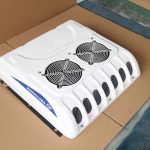
4 sets of Rooftop AC Units for Campers for a 15m bus
With the rise of global nomadic lifestyles and the increasing demand for high-quality mobile living among high-net-worth individuals, Type A motorhomes converted from large passenger buses have become the flagship category in the high-end RV market.
These “mobile villas” typically have a length exceeding 12 meters and a three-dimensional living space of 40-50 square meters, with climate control needs far exceeding those of traditional RVs.
Faced with complex and ever-changing climate environments, multi-compartment functional layouts, and the energy challenges of off-grid living, a single or dual air conditioning system is no longer sufficient.
A distributed intelligent climate control system composed of four rooftop air conditioning units is becoming the ultimate engineering solution to address the all-dimensional comfort challenges of extra-large motorhomes, thanks to its superior coverage, energy efficiency, and reliability.
According to Dataintelo’s 2025 market report, the global bus air conditioning market is expanding at a compound annual growth rate of 5.7% to reach a size of US$2.3 billion by 2032, with the demand for efficient, multi-zone climate control systems being one of the core driving forces.
1. System Parameters and Engineering Configuration: Why is “4” the golden number?
Reason: Triple considerations of physical space, heat load distribution, and redundancy safety
The internal structure of a bus motorhome is complex, usually clearly divided into multiple independent or semi-independent areas such as the driving area, living room, master bedroom, second bedroom/entertainment area, and kitchen/bathroom.
This layout results in a highly dispersed and uneven heat load.
For example, the living room with large skylights and windows experiences a surge in heat load under afternoon sunlight, while the bedrooms located in the middle and rear of the vehicle may be relatively enclosed.
A single high-power Rooftop AC Unit for Campers or a traditional dual air conditioning system, even with ducted air distribution, struggles to achieve uniform and rapid temperature control over such a long distance (more than 12 meters), easily leading to the awkward situation of “overcooling at the front and stuffiness at the back.”
Process: Modular configuration logic based on thermal calculations
The configuration of four air conditioning units is the result of precise calculations and engineering practice.
The core logic is to treat the entire vehicle as four relatively independent climate control zones for modular coverage. Zoned Cooling Capacity Configuration: Referring to professional RV air conditioning guidelines, the total cooling capacity required for large RVs (Class A) is typically between 25,000 and 30,000 BTU/h.
The four air conditioning units can be configured flexibly, such as “two large and two small” or “four medium” units. For example, one 15,000 BTU rooftop AC unit can be installed in the front living room and the master bedroom, and one 9,000-13,500 BTU rooftop AC unit in the kitchen/corridor area and the rear secondary bedroom. This provides a total cooling capacity of 48,000-57,000 BTU/h, leaving ample margin for extremely hot weather.
Air Delivery Method Selection: For a four-unit system, ducted air delivery is crucial for optimal performance.
Each rooftop air conditioner delivers cool air evenly and quietly to multiple vents in its designated area through an independent, concealed duct network.
Compared to the direct airflow of non-ducted air conditioners, the ducted system completely eliminates dead zones, achieving a “seamless” yet uniform cooling effect, especially suitable for sleeping areas at night.

Power and Control System: The simultaneous or alternating operation of four air conditioners poses a significant challenge to the RV’s energy system.
The system must be designed based on a high-voltage platform (such as 48V DC or 220V AC) and equipped with an intelligent energy manager.
The control system must achieve true multi-zone independent temperature control, allowing passengers to set the temperature and fan speed for each zone separately via a central touch panel or mobile app. The system automatically coordinates the units to operate in the most energy-efficient mode.
Result: Building a High-Redundancy, High-Precision Temperature Control Network
The four independent air conditioning units constitute not only a cooling system but also a temperature control network with redundant safety features.
Even if one unit malfunctions, the remaining three can still maintain basic comfort in most living areas, greatly improving reliability and safety during travel in remote areas.
At the same time, zoned control meets the individual temperature preferences of different family members at the same time, elevating overall comfort to residential levels.
2. Usage Scenarios and Climate Adaptability: Comprehensive Coverage from Cities to Deserts
Reason: The unpredictability of nomadic life and the pursuit of extreme experiences
The user journey of a bus-based RV may span all four seasons and diverse terrains, from humid and hot coastlines to dry and scorching deserts, from temperate grasslands to cold mountainous regions.
The air conditioning system must possess the resilience to cope with extreme climates and complex usage scenarios.
Process: System Strategy Optimization for Different Scenarios
Extreme High Temperature and Arid Regions (e.g., deserts, Gobi Desert): In these regions, the ambient temperature often exceeds 40℃.
Standard air conditioning compressors are prone to frequent shutdowns due to overheating. Therefore, at least two of the four air conditioning units should be selected from products with “T3 Tropical Climate” certification.
The compressors and condensers of these air conditioners are specially reinforced to continuously and stably output the rated cooling capacity at ambient temperatures of 52℃ or even higher, ensuring a safe haven inside the vehicle.
High Temperature and High Humidity Regions (e.g., coastal areas, rainforests): In addition to temperature, high humidity severely affects comfort. The system needs a powerful independent dehumidification mode. Through intelligent control, specific areas of the air conditioning system can be activated for low-airflow, low-temperature-difference dehumidification operation, effectively reducing humidity without excessive cooling, preventing furniture mildew and discomfort.
Long-term Off-grid Camping: This is the ultimate test of the energy management capabilities of the four air conditioning systems. Combined with a large-capacity lithium battery (usually no less than 40kWh), high-power vehicle charging, and a solar panel array exceeding 3000W, a microgrid is formed. The intelligent energy manager dynamically adjusts the operating priority and power limit of the four air conditioners based on battery power and solar input power, prioritizing the core living areas to achieve the longest possible energy endurance.
Result: Achieving “All-Terrain, All-Climate” Travel Freedom
Through targeted configuration, the four air conditioning systems free the bus-based RV from dependence on fixed campsites and temperate climates. No matter how harsh the external environment, the interior of the vehicle can always maintain a dry, cool, and comfortably zoned living environment, truly realizing the freedom of travel in a “mobile mansion.”
3. Product Core Advantage: Integrated Value Beyond Single Functionality
Reason: A paradigm shift from equipment stacking to system integration
The value of four top-mounted air conditioning units far exceeds the simple sum of four independent air conditioners. Its advantage stems from systematic engineering design from the ground up, addressing many inherent pain points in large-space temperature control.
| Advantage dimensions | Specific manifestations | Comparison with traditional solutions |
|---|---|---|
| Comfort | Uniform and comprehensive airflow: Ducted air delivery ensures the temperature difference between the front and back, and upper and lower parts of the cabin is less than ±1.5℃. Extremely quiet operation: The main noise sources (compressor and high-speed fan) are isolated on the roof, so only a faint airflow sound can be heard inside the cabin. Noise levels in the sleeping area are controlled to below 40 decibels. Personalized zone control: Four zones have independent temperature settings, without interfering with each other. |
Traditional single/dual air conditioning systems suffer from significant temperature unevenness and noise problems, and cannot provide personalized temperature control. |
| Energy efficiency and reliability | On-demand supply: The intelligent system precisely controls the variable-frequency operation of each compressor based on the actual load in each area, avoiding energy waste caused by oversized equipment, resulting in an overall energy efficiency improvement of over 30%. Natural redundancy: The multi-unit architecture means there is no single point of failure risk, and the overall system reliability is exponentially increased. |
Fixed-frequency air conditioners consume a lot of electricity due to frequent starting and stopping, and a single unit failure can cause the entire vehicle’s air conditioning system to malfunction. |
| Space and aesthetics | Maximizing chassis space: All equipment is integrated into the roof, freeing up valuable space in the chassis for large fuel tanks, water tanks, battery packs, or storage compartments. Clean interior design: The ducted system features only small air vents, eliminating bulky indoor units and maintaining the integrity and premium feel of the interior design. |
Some under-floor air conditioning systems occupy storage space, and split-system indoor units can detract from the interior aesthetics. |
| Intelligent | Predictive energy management: Can be linked with navigation and weather forecasts to pre-cool the vehicle before entering high-temperature areas. Remote control: Supports remote starting/adjusting of the air conditioning via a mobile app, ensuring comfort upon entering the vehicle. |
Traditional systems have limited functionality and lack intelligent connectivity and remote control capabilities. |
Process: Systematic construction of multi-dimensional advantages
Result: Defining the value benchmark for luxury motorhomes
This system transforms air conditioning from a “cost configuration” into a core “value creation unit.” It directly relates to users’ travel happiness, the vehicle’s off-grid capabilities, and overall luxury quality, making it a key technological differentiator that sets high-end motorhomes apart from ordinary vehicles and justifies a product premium.
4. Target Customer Group and Decision Drivers: Who is it for, and why is it worthwhile?
Reason: Deep value recognition behind the high cost
A top-of-the-line system of four top-mounted air conditioners and supporting energy systems can cost as much as 15%-20% of the total vehicle price. This determines that its target customers are a top-tier group pursuing the ultimate quality of life and with ample budgets.
Process: Precise matching of customer profiles and value propositions
Global long-distance travel families and explorers: These are the core users. They plan to travel around the world for months or even years, and the vehicle is their only and permanent home. They have almost obsessive demands for the system’s absolute reliability, all-weather adaptability, and off-grid endurance. Investing in this system is the highest level of insurance purchased for the health, safety, and travel enjoyment of the entire family.
Top-tier business reception and mobile club operators: Used for receiving distinguished clients, as a mobile CEO office, or a high-end event salon. In such scenarios, quiet, uniform, and imperceptible environmental control is fundamental to demonstrating professionalism and prestige. Four-zone independent temperature control allows each guest to feel carefully cared for, while the system’s stable operation guarantees the smooth progress of business activities.
Special industries and research units: For example, geological exploration, film and television production, and field engineering command vehicles. These vehicles need to stay in extreme environments for extended periods, becoming a base for work and life. The system’s ultra-high reliability, redundant design, and powerful extreme climate working capabilities are key productivity tools to ensure task completion and personnel safety. Results: From Product Sales to Lifestyle Solutions
For manufacturers and conversion companies, offering four rooftop air conditioning systems means going beyond traditional vehicle sales and instead providing a comprehensive, high-end mobile living solution. The sales process requires in-depth discussions with customers about their travel dreams, frequent destinations, and family habits, using systematic engineering data (such as temperature control curves under different climates and simulations of off-grid days) to demonstrate the long-term value of the investment. This fosters deep collaborative relationships with high-net-worth clients based on trust and shared vision.
Outlook: Deep Integration with Intelligence and Electrification
In the future, the four-zone air conditioning system in motorhomes will be further integrated into the wave of vehicle intelligence and electrification. Through deep integration with the battery management system (BMS), the air conditioning system will become an intelligent participant in the vehicle’s energy flow, maximizing the range of electric motorhomes while ensuring comfort. Simultaneously, using V2X (vehicle-to-everything) technology, the vehicle can prioritize using grid power for pre-cooling/pre-heating the air conditioning while charging, further saving onboard energy. As Haier Air Conditioning emphasized when leading the development of the IEC international standard for parking air conditioning, a healthy, intelligent, and integrated cabin environment is the direction of global mobile living. The four-zone rooftop air conditioning system is the first realization of this future vision in today’s motorhomes.
Related posts:
 Air Conditioning Units For Motorhomes
 Modular Temperature Control Solution for Motorhomes
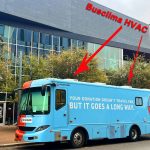 12V Camper Air Conditioner used in medicalmobile
 Technical White Paper on Multi-Unit Roof AC for Campers and Buses
 12 Volt RV Air Conditioning Units represent an energy and technological revolution
 Camper Aircon Unit – Modular Design Leads to a New Comfortable Travel
 15000 BTU Camper AC Multiple units
 15000 Btu Air Conditioner Rv
 12 Volt Camper Ac
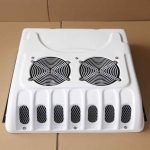 Air Conditioning Units for RV and Minibus Air Conditioner
 15000 Btu Camper Air Conditioner
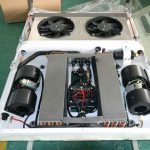 Air Conditioning Units for Campers Installation Process
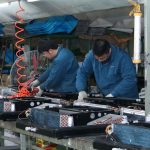 Air Conditioning for Motorhomes Manufacturing Process
 Similarities between RV Camper Air Conditioner and Minibus AC
 Ac For RV Camper Market Analysis Report
 Camper Air Conditioner
 Camper Ac
 Bus Air Conditioner is used for buses and medium-sized commercial vehicles