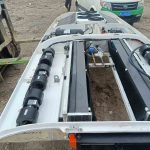
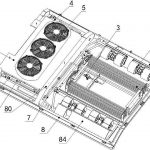
Van aircon unit is indispensable mobile forces in urban and rural logistics, passenger transport, and special industry transportation.
The comfort and safety of their passenger and cargo storage spaces are directly affected by the performance of the refrigeration unit (commonly known as “vehicle air conditioning”). Traditionally, air conditioning has been considered a single-function component, but modern applications show that its selection, configuration, and performance evaluation must be placed within a comprehensive framework.
This article will delve into four key sub-questions: local climate adaptability, complementarity with public transportation options, evolution of travel habits, and customer segmentation. Combining the latest policies and industry data, it will systematically analyze the development needs and solutions for van aircon units.
Sub-question 1: How do local climate characteristics determine the technical and performance thresholds of van aircon units?
Question:
China has a vast territory and significant climate differences, ranging from the frigid Northeast to the hot and humid South China. This places different levels of demands on the cooling output, energy consumption control, system reliability, and dehumidification function of van aircon units. How can the impact of climate parameters on the core indicators of the refrigeration unit be quantified?
Evidence:
1. Authoritative Data: According to the “2023 China Climate Bulletin” released by the National Climate Center of the China Meteorological Administration, the national average temperature in 2023 was the highest on record. In many parts of South and East China, the number of days with high temperatures (≥35℃) was 10-20 days more than usual, and regional high-temperature events were characterized by “early start, late end, and long duration.” This indicates that the demand for efficient cooling is expanding both geographically and temporally.
2. Technical Standards: At the “National Commercial Vehicle Thermal Management Technology Seminar” held in March 2025, Li Gong, Chairman of the Refrigeration Branch of the China Society of Automotive Engineers and a senior engineer, pointed out: “In the next three years, the rated cooling capacity standard for commercial vehicle air conditioners in high-temperature and high-humidity environments is expected to increase by 15%-20%, and the anti-corrosion and anti-mildew coating of the evaporator and the anti-dust clogging design of the condenser will become mandatory technical evaluation items.”
3. Industry Practice: An article in the Equipment section of the *China Transportation News* on January 15, 2025, titled “The ‘Cold’ War Escalates: North-South Differences in Special Purpose Vehicle Air Conditioning,” interviewed several leading modification companies. The report points out that in regions with large diurnal temperature variations and frequent dust storms, such as Xinjiang and Northwest China, customers generally require independent dual-evaporator systems (independent temperature control for the cab and cargo compartment) and reversible dust-collecting condenser fans. In contrast, in the Yangtze River Delta and Pearl River Delta regions, customers are more concerned with rapid cooling capabilities and cooling stability at low idle speeds.
Conclusion: Climate is a fundamental input variable in refrigeration unit design. Future technological development must transcend the single concept of “cooling” and evolve towards climate-adaptive and environmentally robust systems. Manufacturers need to provide a differentiated product matrix based on climate zones and clearly indicate the standard climate conditions corresponding to their core performance indicators.
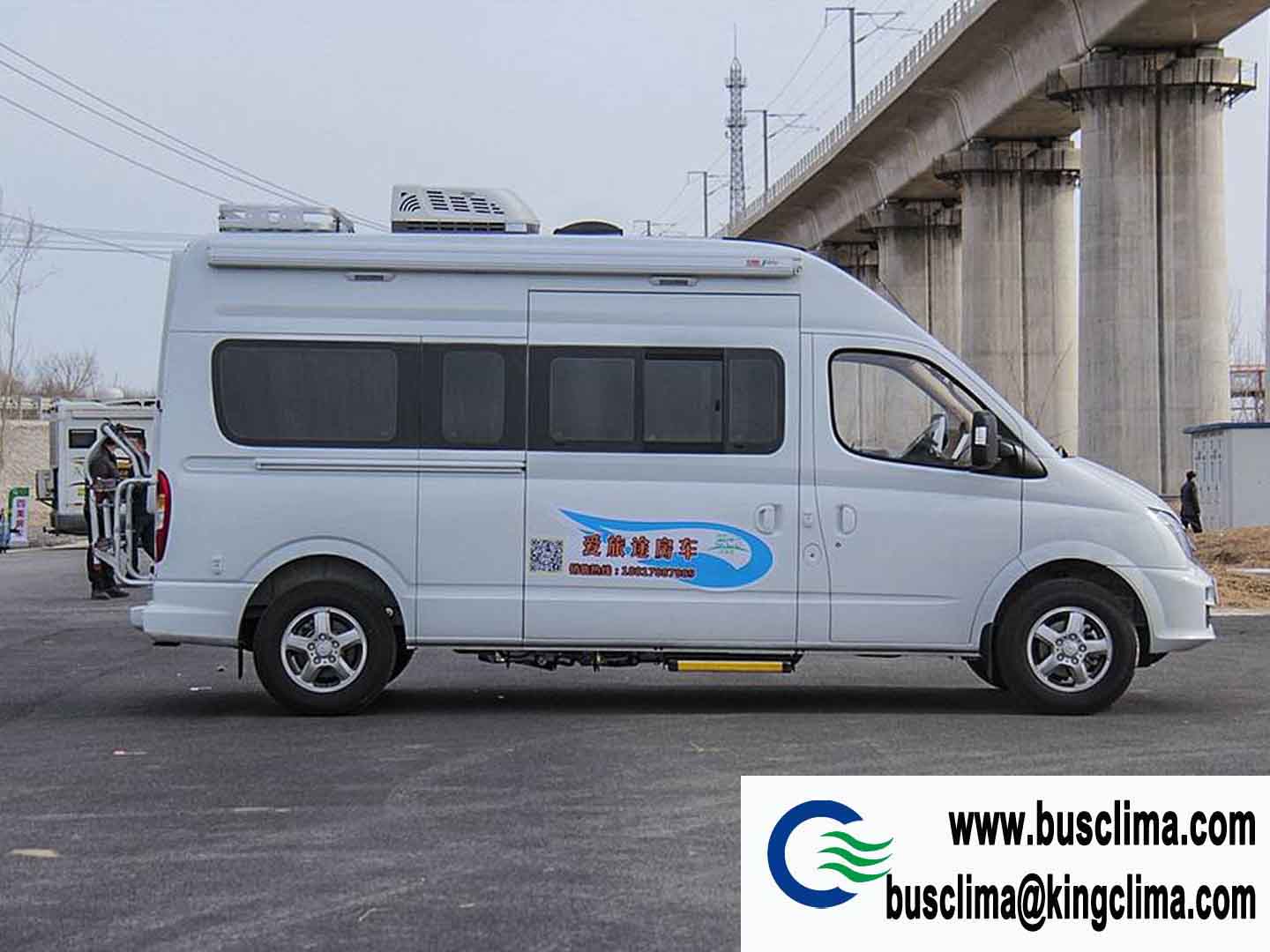
Sub-question 2: How can urban public transportation solutions reshape the functional positioning of Van Aircon Units?
Question:
With the improvement of urban public transportation networks such as subways, main bus lines, and customized buses, the role of vans in passenger transport is transforming from “mainstream transportation” to “last-mile connection” and “customized services.” What new requirements does this shift place on the passenger experience, especially for the refrigeration unit?
Evidence:
1. Policy Guidance: According to the “Several Opinions on Promoting the Healthy and Sustainable Development of Urban Public Transportation” issued by the Ministry of Transport at the end of 2024, the development of “micro-circulation routes with bus-like operation” and “customized passenger transport services with on-demand response” is explicitly encouraged. This means that the interior environment quality of minibuses serving such routes needs to be on par with high-end public transportation.
2. Authoritative Viewpoint: Dr. Wang, a researcher in urban transportation planning, emphasized when interpreting the above policy: “The comfort of ‘last-mile’ connecting vehicles directly affects the public’s evaluation of the entire chain of public transportation services. In summer, a quickly formed cool environment inside the vehicle is the ‘basic comfort line,’ while temperature uniformity, low noise, and air freshness are key to improving satisfaction.”
3. Demand Case: In tourist cities and airport hubs, 9-seater luxury business minibuses used for pick-up and drop-off services (such as modified Mercedes-Benz Vito and Volkswagen Multivan) have adopted dual-zone Van Air Conditioner, independent rear touch panels, and air purification systems with PM2.5 filtration and negative ion generation as standard configurations. This positioning reflects that in high-end connecting scenarios, the cooling unit has been deeply integrated with air quality management.
Conclusion: The upgraded role of van refrigeration units in the public transportation system requires a shift from “essential” to “quality-oriented.” Quiet operation, intelligent features, and comprehensive air quality management have become core competitive advantages, aiming to provide passengers with a brief but comfortable, healthy, and imperceptible high-quality mobile space experience.
Sub-question 3: What new demands have the evolution of public travel and consumption habits generated for Van Aircon Units?
Question:
The rise of e-commerce express delivery, fresh food delivery, mobile retail, and multi-functional service vehicles (such as mobile coffee trucks and medical examination vehicles) has made vans not only transportation tools but also temporary work or commercial spaces. How does this affect the functional expansion of refrigeration systems?
Evidence:
1. Industry report: According to the “2024 China Intra-city Instant Logistics Industry White Paper,” fresh food and refrigerated food delivery orders account for over 30% of total orders, with an average annual growth rate of 25%. Many vans used for such deliveries need to have their cargo compartments converted into independently temperature-controlled refrigerated/frozen spaces, placing extremely high demands on the reliability, accuracy, and energy consumption of the original vehicle air conditioning system or additional refrigeration units.
2. Emerging Scenarios: In its February 2025 feature article, “Shops on Wheels,” *Automotive Business Review* described how vans converted into mobile coffee trucks, fast food trucks, and book lending vans require continuous and stable cooling in their work areas (bar/operation room) to ensure equipment operation and food freshness, while simultaneously maintaining a comfortable temperature in the customer waiting area. This has spurred the demand for complex system designs that integrate multiple zones with coordinated temperature control.
3. User Habits: With the widespread adoption of live streaming and short video creation, many service vehicles (such as photography and equipment support vehicles) have become temporary studios. Precision electronic equipment is extremely sensitive to high temperatures, requiring refrigeration systems to maintain a constant, low-temperature “equipment-suitable environment” within the vehicle—a stark contrast to traditional personnel comfort requirements.
Conclusion: The diversification of travel and consumption habits has greatly expanded the application scenarios for van refrigeration units. The demand extends from “serving people” to “serving goods, serving equipment, and serving business processes.” Future solutions must possess high modularity, customizability, and functional scalability to flexibly address various needs, from cold chain logistics to mobile commerce.
Sub-question 4: How do the core needs of different customer groups influence the purchase decision of refrigeration units?
Question:
The user group of vans is complex, including individual business owners, logistics companies, leasing companies, and government institutions. How do different customers weigh the cost, efficiency, and maintenance of refrigeration units differently when making purchasing decisions?
Evidence:
1. Cost-sensitive customers (e.g., individual business owners, small merchants): These customers prioritize initial purchase cost and fuel consumption. Refrigeration system dealers report that they typically choose the lowest-priced aftermarket installation option, paying less attention to brand and energy efficiency ratio, but products with high failure rates can lead to serious subsequent complaints.
2. Lifecycle Cost Sensitive Customers (e.g., large logistics companies, passenger transport companies): An article in the April 2025 issue of *Transport Manager World*, titled “The ‘Hidden Costs’ of Fleet Operations: Energy Efficiency Analysis of Vehicle Accessories,” quoted a fleet manager from a large courier company: “When purchasing vehicles, we specifically evaluate the COP (Coefficient of Performance) and IPLV (Integrated Part Load Value) of the air conditioning system. The fuel savings of a highly efficient and energy-saving air conditioning system over a three-year operating cycle are sufficient to cover its higher initial purchase cost.” They prefer original equipment manufacturer (OEM) high-efficiency air conditioning systems or integrated retrofit solutions from well-known brands.
3. Compliance and Reliability Prioritized Customers (e.g., vaccine delivery vehicles, police patrol cars, bank armored trucks): These customers are constrained by industry regulations or stringent internal standards. For example, vaccine delivery vehicles used by disease control departments must meet GSP (Good Supply Practice) cold chain transportation verification standards. Their refrigeration units require special functions such as continuous temperature monitoring and recording, power outage recovery, and rapid cooling, and suppliers must provide complete verification documentation and support. Price is not the primary determining factor.
Conclusion: Customer segmentation directly determines the value orientation of refrigeration units. The market supply side cannot respond with a “one-size-fits-all” approach to products; instead, it should offer a clear value proposition spectrum: from economical solutions that meet basic functions, to high-efficiency solutions that emphasize long-term savings, and then to highly reliable professional solutions that meet special needs, accompanied by corresponding financial, service, and validation support.
In summary, the van refrigeration unit has evolved from a simple comfort feature into a critical system affecting operational efficiency, cargo safety, commercial value, and even public transportation service satisfaction. A comprehensive evaluation must systematically consider the hard constraints of geographical climate, its new role in public transportation networks, new scenarios arising from consumption patterns, and the diverse value choices driven by customer economics. Only by delving into these sub-issues and integrating policy guidance, technological frontiers, and real market feedback can manufacturers, modifiers, and end-users be provided with truly future-oriented decision-making basis and solutions. In this process, the refrigeration unit will continuously redefine itself, becoming an indispensable “environmentally intelligent core” in smart mobile spaces.